
Religion
Prayers on pause
Unable to pray in sync, the senior priest left the geh sarna ceremony midway and resumed when a replacement was sent
The abrupt suspension of the geh sarna prayers by a senior priest midway through a funeral ceremony at Bom-bay’s Doongerwadi has sent shock waves through the community.
On April 15, 2010, 80-year-old Ervad Jal Balsara, displeased with the recitation and pace of his co-priest, 41-year-old Ervad Dara Karanjia, swore at his junior and walked out of the bungli within 15 minutes of commencing the prayers. A replacement priest, Ervad Dara Panthaky was summoned to perform the geh sarna ceremony with Balsara and it was almost noon when the body was consigned to the Tower of Silence.
A litany of complaints, starting with the letter by Minoo Vaghchhipawalla, brother of the deceased Godrej Baug resident Phiroz Vaghchhipawalla, were directed at Balsara.
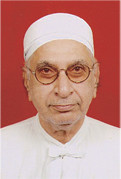
Ervad Jal Balsara: responsible to God
"This brother of mine…must have spent lakhs of rupees going to Udvada to offer his prayers. That day I felt extremely sorry for my dead brother because even in his dreams he may not have imagined that a priest who is supposed to guide him in his last journey to the other world would do so with… complete disregard to human decency toward the departed soul,” lamented Minoo publicly announcing his decision to not have "such men lead me to the other world” or his body consigned to the Doongerwadi.
Performing countless geh sarna prayers during the 52 years he has served at the Doongerwadi, Balsara’s proficiency in these prayers is unparalleled. "There were times when I have prayed for six funerals in one day,” he told Parsiana. Viewing the "maran ni antim kriya (final funeral prayer)” as one that deserved to be prayed with utmost sincerity he refused to condone the "third class mobed jé vaachi nai saké, sarkhu bhani nai saké (who could neither read nor pray appropriately). Bahr ni kamani malé téthi mokli aapé [he was sent here to earn additional income (depending on the bungli, for the funeral prayers a priest earns Rs 350-500)]. Mané khudrat né javaabdaari khari ké nai (Am I not answerable to God)?” enquired Balsara.
Unlike many panthakies who appoint agents like Balsara to take care of the obsequies at Doongerwadi, Mahrukh Madon who handles the affairs of the Soonaiji Agiary at Gowalia Tank with which Karanjia is presently attached as also the Jokhi Agiary at Godrej Baug, maintains, "I don’t have any agents. Respecting his age and seniority I give the first preference to Jal Balsara” when assigning Doongerwadi duties and then take "any mobed who is free.” She insists that Balsara had been forewarned that Karanjia is slow and had he expressed his inability to accommodate the junior, she would have deputed another priest from the beginning. Peeved with the insinuations that Karanjia cannot pray she explained that the tempo of prayers is much slower in the smaller villages of Gujarat where they take a pause after every two lines. In fact in the villages, any behdin or finally even a dog may take the place of a second priest. "Is a dog better or a slow priest?” she enquires.
During the eight years he served as panthaky of the Pardi Agiary, he has performed the geh sarna several times, maintains Karanjia, although this would have been his first geh sarna in Bombay following his migration to the city two years ago. Whilst the funeral prayers in Bombay are completed within 40 minutes, in Gujarat they stretch to nearly an hour, he gives his reasons for slow recitation. Ofttimes the only priest in the area, behdins are called in to help and in fact Vaghchhipawallas’ brother Dhun who resides in the village Vaghchhipa has paired with him for the geh sarna prayers, mentions Karanjia. It was following the closure of the textile mills in Surat where he worked as dyeing supervisor that Karanjia took to practicing mobedi as a full-time career. Having completed his navar in 1982 and maratab in 1984 in Baroda, he reads from the Khordeh Avesta when praying, he candidly admits. The furore at Doongerwadi was more because of the monopoly enjoyed and the non-acceptance of those who are new. "Aaparné khabar nai hati, nai tau khasi jaté (Had I known I would have opted out from the beginning).” The regular priests who come for the geh sarna at Doongerwadi are "all senior citizens,” points out Madon.
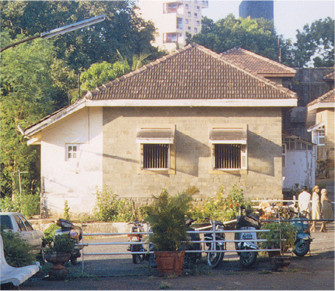
One of the bunglis at Doongerwadi
Was Balsara justified in leaving the geh sarna ceremony? Does his reasoning for leaving the geh sarna have any religious basis? Was abusing a fellow priest in the middle of the geh sarna a justifiable act? These queries by Minoo Vaghchhipawalla earned a slew of responses from community activists and letter-writers:
"As a senior and experienced priest he should have handled the alleged ‘incapacity’ of his colleague priest with sensitivity and understanding. Walking away midway during the geh sarna ceremony is not only professional misconduct but insulting to the deceased and the deceased’s loved ones,” acknowledged Bombay Parsi Punchayet (BPP) trustee Noshir Dad-rawala.
"To avoid this re-happening, we at ARZ (Association for Revival of Zoroastrianism) have recorded the geh sarna prayers on CD which will be provided to any Zoroastrian on ‘no charge’ basis excluding packing, handling and postage charges. A CD of other daily Zoroastrian prayers is also available. You may make multiple copies of these CDs and circulate amongst fellow Zoroastrians without any obligation to ARZ. For details please contact abillimoria @gmail.com, arzmumbai@yahoo.com, kerssiewadia@gmail.com or vispyw@ hotmail.com,” notes an e-mail from ARZ trustee Aspi Billimoria.
Terming Balsara’s behavior "atrocious,” Perviz Dara Bhote commented, "Walking away in the midst of the ceremony because the priest who partnered him did not synchronize with him lacks all sense of decency and smacks of a large ego…The best thing would be to do away with the ridiculous system of allowing only the progeny of the athornans to be ordained as priests…The community is being held to ransom by these men for the simple reason that the rule of the marketplace holds sway — greater the demand, greater the bhav (pun intended). There are several behdins with a true spiritual bent of mind who can be indoctrinated as priests and we can then be released from this mafia-like behavior…”
Mickie Sorabjee considered Balsara’s behavior as "unpardonable, no matter the reasons or explanations belatedly proffered to bring things into perspective… Such an errant professional among our priestly class deserves to be debarred and banned. Not those obliging priests who compassionately offer to execute the four-day prayers of mounting numbers of devout Parsis who out of compulsion opt for cremation as opposed to the traditional practice of dakhmenashini…”
Concurred former BPP trustee Jamsheed Kanga, "I feel that such behavior needs to be checked. Balsara has virtual monopoly at Doongerwadi. His behavior can classify him as a renegade. Trustees should act against him instead of penalizing (Ervads Khushroo) Madon and (Framroze) Mirza.”
"It will be solely because of the high-handedness of the likes (of Balsara) that Parsis/Zarathoshtis will soon say, ‘To hell with all this gibberish, we’ve had enough!’ What will the mobeds do then? Whom will they boss over? They must realize that the halcyon days of the mobeds will be over long before the ‘pure’ Parsis/Zarathoshtis are extinct. That is, if they are not over already,” remarked Phiroze Javeri.
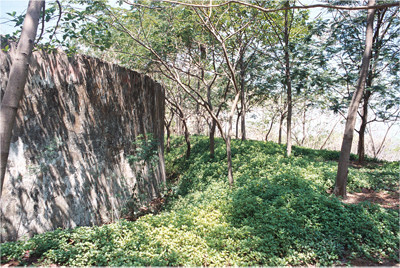
One of the dakhmas at Doongerwadi
The only e-mail in defence of Balsara was by Ervad Marzban Hathiram, panthaky of the Ustad Saheb Behramshah N. Shroff Daremeher at Jogeshwari. He wrote at length commending Balsara’s dedication: "He is available night or day, on every day, including Parsi festival holidays when most priests refuse to work. His dedication and steadfastness towards his job is commendable and sets an example to mobeds half his age who get tired easily.”
Giving him credit for "standing at one place for 45 minutes, praying in a loud and sonorous voice the very difficult Ahunavaiti Gatha,” Hathiram continues, "Every stanza of the Gatha (of four lines) must be recited in one breath, without stopping to catch breath… We all have our weaknesses and Ervad Jal is no exception. His years of dealing with death have made him somewhat rough and curt… In the incident which happened recently, a lot of blame has been put on Ervad Jal Balsara which is totally unfair. If there is anybody to blame it is the priest who did not know how to pray the Ahunavaiti Gatha and more so the panthaky who deputed this priest to Doongerwadi. With-in mobedi circles, the ‘abilities’ of Ervad Karanjia are so well known that he has had to move from one agiary to another…” Balsara’s only fault was not declining to pray with Karanjia from the beginning, believed Hathiram.
"The BPP should sack this priest immediately,” declared Berjis Desai in his column "Parsi tari arsi” in The Bombay Samachar of April 25, 2010 adding, "Will any church, any temple, any faith tolerate this conduct?”
"He is not an employee of the BPP. He is not on our payroll,” BPP chairman Dinshaw Mehta conveyed to Parsiana. Thus although it was not necessary for the BPP to intervene in the matter they sent Balsara a letter expressing their disappointment and hoping such an incident would not recur. "If the panthakies don’t want Balsara, they should send their own two priests” to perform the geh sarna ceremony. The onus is on the relatives and panthaky to organize for the jora (dual) priests but they prefer to pass on the buck thinking "maathaa dookan ma kah paré (why get involved in avoidable nitty-gritties)?” explained Mehta who along with BPP trustee Khojeste Mistree rushed to the scene on the day of the fiasco to resolve the crisis.
This incident brings to light a "great deficiency in our mobedi tola (sect) today — the lack of internal audit and a central authority…” remarked Hathiram. "The state of our priesthood also reflects the state of our community. We are like a herd of cattle without a master — dhani vagar naa dhor.”
◆ ◆ ◆
From the archive