
Religion
Two in one
The Bai Jerbai Cowasjee Dinshaw Adenwalla Lonavla Daremeher houses two sacred fires thereby saving on costs and personnel
When the occasional Parsis committed suicide by jumping off the Duke’s Nose point in Khandala, the authorities contacted Ervad Shavaksha Fatakia, the Lonavla agiary’s panthaky in the days of yore. If no one else came forward to claim the body, Fatakia who served the Bai Jerbai Cowasjee Dinshaw Adenwalla Lonavla Daremeher from 1918 to 1975 at a salary of Rs 50, performed the final rites and placed the body in the local Tower of Silence at his own cost, recalls the agiary founder’s great-grandson and presently chairman Cowasjee N. Dinshaw.
The salary was low but the priest earned sufficiently from visitors, bungalow owners and local residents. Fatakia even placed tiles at his own cost in an adjoining dadgah room which was formally white-washed, Dinshaw notes.
Today the priest’s salary is over Rs 9,000, with additional income coming from the ceremonies performed both in the agiary and at private residences, he adds.
"The customer must be satisfied,” said Dinshaw stressing the basis for the priest to earn a healthy monetary return. The panthaky’s personal touch is important to the financial activity of a fire temple, believes Dinshaw. A managerial system where the priest does not earn from the laity but only draws a salary from the trust may not work as effectively.
But despite the revenue realized, the "main problem” in managing an agiary today is obtaining mobeds, states Dinshaw. In some places, the agiary is left in the charge of the chasniwalla (the mobed’s assistant and person responsible for the cleanliness of the fire temples) with the priest only attending five times a day to perform the boi ceremony. In one agiary the panthaky’s two sons gave up lucrative panthakiships to join multinational concerns. They did not wish to continue with the round-the-clock rigors of priesthood.
Dinshaw who is also chairman of the Bai Soonabai Hirji Jivanji Readymoney Agiary at Gowalia Tank, and a trustee of the Cowasji Maneckji Ashburner Daremeher, the Sett Pallonji Khushedji Cama Daremeher, both at Grant Road and the Bai Dhanbai and Cawasji Dadabhai Daremeher in Bangalore, notes that in three of the agiaries the cost of the kathi wood is borne by the trustees while in one, Cama, the panthaky procures the kathi at his expense.
The consumption of kathi depends on how the priest utilizes it, notes Dinshaw Desai who works in the trust's office. If the fire is kept burning bright more wood is required. The annual kathi bill comes to over a lakh of rupees perfire.
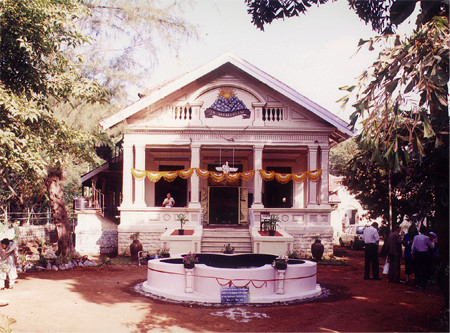
Cowasjee Dinshaw Adenwalla Daremeher at Lonavla
Aside from kathi the other major expenses in running a fire temple are the salary of the panthaky and chasniwalla, municipal taxes and repairs (Rs 50,000 a year is the minimum for this, states Dinshaw).
The Lonavla agiary constructed in 1899 in the Western ghat hill station has the rare distinction of hosting two adarian fires, one the original fire consecrated in 1899 and the second flown in to Bombay by Air India from Aden on November 17, 1976 and brought in a motorcade to Lonavla. The Lonavla agiary was built by Cowasjee Dinshaw in memory of his wife, Jerbai, while the fire in Aden at the Cowasjee Dinshaw, CIE (Companion of the Indian Empire) Aden Agiary Trust was consecrated in the year 1883 by Dinshaw in memory of his son, father, mother and wife.
With almost no Parsis left in the port city of Aden, the trustees decided to shift the fire to India. The fires are kept in two separate rooms (keblas). "All agiaries have spare rooms,” notes Dinshaw.
Making ends meet for the trust is an uphill task. Aside from the ancestral corpus, donations are few and far between, states the chairman. But benevolent and philanthropic individuals do come forward.
The Master Group’s Capt Percy Master funded the recent repairs and renovations of the Lonavla agiary and Pallon Mistry of Shapoorji Pallonji paid for the repairs of the Bangalore dadgah, says Din-shaw.
While housing two fires under the same roof saves on costs and especially personnel, Dinshaw is doubtful many other trusts would follow this example. "The trustees will not agree. They would not want to lose the (original) name,” he notes.
The fire temples in Khambat and Zanzibar were both extinguished due to the absence of people to look after them, he says. In Khambat the priest fell ill and his son had to take him to a larger city for treatment. He locked the fire temple door and left, says Dinshaw. In Zanzibar the fire temple property has reportedly been sold and some monies realized. These may be used for funding a darbe mehr in North America or Tajikistan, notes Dinshaw.
Finding Parsi electricians, plumbers, masons or painters for odd jobs is difficult especially for out-of-town fire temples. One worshipper objected when a non-Parsi electrician was changing a light fixture on the front porch of the Lonavla fire temple, recalls Dinshaw. The trustees explained that this in no way violated the sanctity of the premises as it was outside the prayer hall."One has to be practical,” says Dinshaw.
With all the problems of managing fire temples, what does the future hold for the institution? Dinshaw does not have an answer but notes that divine forces have looked after the community for over 3,000 years and would continue to do so.
A tentative set of service rules governing the employment of a panthaky has been furnished by Cowasjee N. Dinshaw.
Service rules for the panthaky
— An agreement to be made for a minimum of three or five years, whatever is applicable.
— A complete inventory of the agiary’s utensils, furniture, vessels, prayer books and any other moveable properties, etc to be taken by the panthaky at the time of taking charge of the agiary and subsequently every year preferably by March end.
— The panthaky shall not bring in his own furniture, fixtures, etc without the explicit written permission of the managing trustee.
— Juddin navjotes of any kind should never be performed following the resolutions passed by the high priests from time to time. No after-death rituals of the first four days shall be performed for persons who are cremated or the children of a Parsi woman married to non-Parsis.
— The panthaky should take the permission of the managing trustee in writing if any navjotes, marriages or any other major ceremonies are going to be performed in the agiary. No food can be served at such a ceremony, but only soft drinks can be served on the veranda. However, exceptions to the above can be made with the permission of the managing trustee.
— The panthaky must keep a register of all the major religious ceremonies e.g. jashans, navjotes, marriages, death ceremonies, etc performed by him in the agiary or anywhere else mentioning therein their full names, addresses, telephone numbers, date and time one day in advance.
— The panthaky should not accept any photographs of any prophet or of any person without obtaining the explicit written permission of the managing trustee. If the permission is granted, it will be the absolute privilege of the managing trustee as to where the said photographs should be exhibited.
— The panthaky will ensure that the agiary is used strictly for religious purposes only. No devotee will be permitted to make use of the agiary as a meeting place or a library except for religious occasions.
— The panthaky will not take any other outside job as a mobed. He must be in the agiary at all times. However, he may consent to perform ceremonies such as sachkars at the residence of his clients, if so requested. At the death of his clients or any of his family members, the panthaky may assist at the Towers of Silence.
— The panthaky will ensure that the agiary is properly lit at sunset. The agiary is to close daily at 9 p.m. and from 1 p.m. to 3 p.m. (Permission to hold a navjote and/or other ceremonies in the agiary is to be obtained from the managing trustee.)
— If there are any thefts or transgressions etc, and/or complaints have to be lodged with the police/municipality/electricity board, etc, it will be the responsibility of the panthaky to do so and to follow-up the matters properly.
— The panthaky should be able to prepare daran, papdi, malido. If he requires help, he may avail of it.
— The panthaky will employ good mobeds and servants, those who can perform religious ceremonies with dignity, and their salaries and perks are to be paid by the panthaky. He will ensure that the agiary is kept neat and clean at all times. The panthaky will employ a cook, chasniwalla and other employees needed for cleaning the agiary.
— It will be the responsibility of the panthaky to see there is no default or lapse in the proper running, functioning and administration of the affairs of the agiary. If there is any lapse or default, the panthaky will be accountable first, and expected to set things right, in the shortest possible time.
— The panthaky will avail of one month’s leave on completion of one year’s service. If for any reason he proposes to go on leave, he will make an application in writing to the trustees at least 15 days prior to the proposed leave and also make arrangements for replacement for the period.
— It will be the panthaky’s pious duty to ensure that all ceremonies are performed in pristine purity.
— Satum, afargan, faroksi and baj ceremonies will have to be performed as and when required.
— He will ensure that all the furniture, doors, windows and floors of the agiary are cleaned and washed regularly.
— He must always put on a white turban and dugli or badian (shirt like apparel) while on the agiary premises.
— Any repair work required in the agiary must be reported to the managing trustee or the staff, in writing, and no repairs should be carried out by the panthaky without the prior written permission of the trustees.
— He will abide by the tenets, customs and traditions of our religion and community and will not perform any ceremony nor do anything which is contrary to our tenets, customs and traditions.
— He will abide by the rules and regulations in force from time to time and carry out the directions of the trustees.
— His services will be subject to termination by giving three calendar months’ notice, in writing, by either side.
— Residential accommodation to the panthaky will be provided.
— Kathi will be provided by the trustees. The minimum rent bill of the agiary telephone will be paid by the trustees. Any amount over and above the minimum will be paid by the panthaky.
— He will be paid Saliyuni of Rs ………..
— At muktad time, permission of the chairman must be taken for fixing the charges for tables and behras.
— The electricity bill will be paid 10 percent by the panthaky and 90 percent by the trust.
— Mediclaim: The trustees will reimburse the mobed his annual mediclaim premium, not exceeding Rs __ or at actual, whichever is less, and upon presenting a copy of the policy. If so desired, the immediate family members or dependents of the mobed may also avail of a joint mediclaim policy within the prescribed amount of Rs __.
— School fees and admission fees: The trustees will provide for the reimbursement of school fees for two children. The trustees will reimburse a maximum of Rs __ per month per child against supporting school fee vouchers.
— In the event of a death in the community where the services of the agiary’s mobed is sought, the mobeds will be reimbursed an extra amount at the rate of Rs __ per day per mobed for a maximum of two mobeds for four days’ ceremonies, by the trustees, totaling Rs __ per mobed per ruvan (corpse).
— Leave travel allowance: Permanent mobeds will be reimbursed a flat sum of Rs __ per year towards leave travel allowance.
— Muktad reimbursement: Each mobbed will receive an additional amount for the annual muktad prayers. The amount will be specified at the time of the muktad.
◆ ◆ ◆
From the archive