
Welfare
The social spirit
Parsis continue the tradition of fund-raising for deserving causes
It was a combination of cause and celebration. The cause was the raising of funds for the Maharashtra State Women’s Council and the Time and Talents Club. The celebration was "Fiesta Adora,” an afternoon of fun with a Spanish slant — Spanish music, a demonstration of Spanish cooking, a mini bazaar, free gifts, raffle prizes and a chance for one lucky person at the Taj Ballroom on August 2, 2003 to win an 18-carat diamond-studded rakhi, on the eve of Raksha Bandhan, courtesy Adora Collections!
The organizational thread weaving the afternoon together was DBS Office Business Centers and its dynamic director Perveez Aggarwal. "Adora” means glory in Spanish, announced Aggarwal, exhorting the assembled ladies and the sprinkling of gents to walk around the Ballroom to view and buy the trendsetting jewelry, sparkling in its showcases, as well as the embroidered articles and novelties on sale at the various stalls.
Stirring up an appetite for Spanish cuisine with a live demonstration was young Taj chef, Kaizad Kamdin. "Onions, garlic, herbs and olive oil are basic ingredients in Spanish cooking,” narrated Kamdin, towering over his collection of pots, pans, spatulas and spoons, the tall chef’s cap adding to his considerable height! "It’s always a little bit of this, a little bit of that; the Spanish play with the food and improvise,” he described, deft fingers sprinkling pepper, peppers and potatoes into the whisked egg mixture, popping it into the oven and upturning the well-risen Spanish omelette onto a plate.
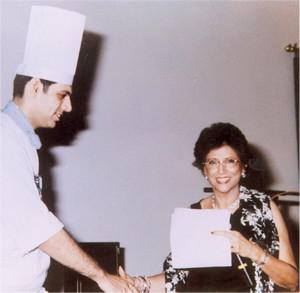
The creativity of cuisine: Aggarwal (right) felicitates Kamdin
"I have always been fascinated by the hotel industry,” Kamdin told Parsiana. "After I started my training at the Indian Institute of Hotel Management at Aurangabad, I realized I had a strong inclination towards the kitchen. For me cooking is a passion and Parsis, as you know, are fond of food!” Specializing in Continental cuisine and attached currently to the banquet rooms, the young man originally from Poona has been with the Taj in Bombay for four years.
As tall glasses of sangria (a cocktail of red wine, orange liqueur, orange juice, chopped apple, etc), did the rounds of the Ballroom, Aggarwal announced: "With the typical generosity of the Billimoria family, Cobra Wines forwarded to us a case of red wine to use in the making of sangria.”
Chief guest Zarine Khan, successful entrepreneur and interior designer, lauded Aggarwal’s "zest, enthusiasm and effort” despite the unexpected problems that cropped up due to a change of date from July 30 to August 2 because of a Bombay bandh. One of India’s first fashion models, Khan exhorted women to assert their individual identity. "The creativity of the wife should not be strangled, it should flow and grow,” she stated, asserting that women are equal if not better than their male counterparts in all fields today. But never let go of your feminine traits or become bullies or nags at home, she advised. Khan’s interior design business has blossomed to include export of furniture, as well as interior design for prestigious projects like the palace of the king of Nepal, five star hotels, corporate offices, etc, despite the fact that she has no formal degree in interior design.
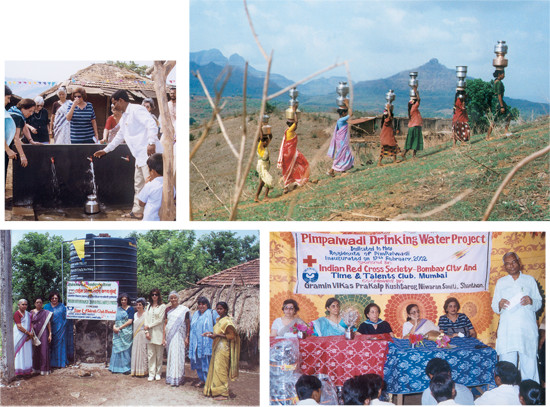
From left, 1st row: clear water on tap; the pre-project trudge uphill; 2nd row: Time and Talents Club ladies with villagers at Morba and Pimpalwadi
In addition to running DBS Office Business Centers — the "you run your business while we run your office” people — which has seven centers in six major cities, Aggarwal also runs an enterprise called "My Beautiful Embroideries” which promotes Indian hand embroidery. The 1992 riots in Bombay displaced many skilled artisans who went from door-to-door seeking work. "I enjoy helping the craftspeople and am excited about finding a market for their talents. The fountain of enthusiasm it brings forth is truly appreciable and keeps alive the spirit of creativity in my life,” she asserts. Young men take the order and then courier it off to their villages — hundreds of miles away — where the entire family works around the frame upon which the fabric to be embroidered is fastened. The work force has increased from two families to three. Along the way "some trials, plenty more tribulations” are encountered but the final product does us proud, she notes.
The rich creations of saris, scarves, stoles, skirts, kameez-pants, etc are exported on order to the US, UK, Canada, Europe, Hongkong, Bangkok, etc, ranging in price from US $ 100 to $ 800, which include air courier charges, according to their brochure. Aggarwal favors the "Parsi gara” style of embroidery — flowers, birds and borders in resplendent colors on rich silk. "I use motifs similar to the traditional garas and modernize them with georgette or chiffon, instead of the traditional gajji silk,” Aggarwal told Namrata Sharma Zakaria in a newspaper interview. "This brings the cost down drastically. While a traditional gara would cost anything between two lakh to five lakh rupees, the ones I make cost between Rs 28,000 and Rs 48,000. Some people frown, saying ‘Oh, but this is new.’ I think it makes the saris more accessible and keeps them alive.” Aggarwal’s Parsi lineage has given her six traditional garas which she preserves as antiques as they are too precious and delicate to wear and she believes it is sacrilege to cut up a gara. "My travels take me to a lot of exciting places and along with me goes a bundle of My Beautiful Embroideries,” she states, as Indian embroideries are "hot fashion news in the West.”
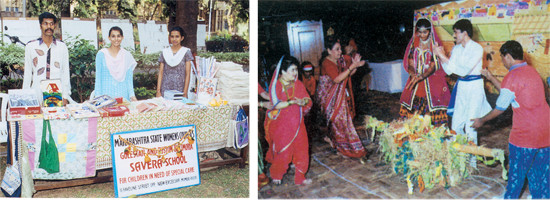
From left: Savera School products on sale; children in need of special care in song and dance
With Millennium Recipes, the cook book published by The Time and Talents Club (T&TC) in 2002, achieving brisk business from their stall at the Fiesta and elsewhere, T & TC president Delara Jejeebhoy says the Club is down to its last few copies and a reprint would be required. Sale proceeds from the book serve to further the Club’s numerous charities. As part of an ongoing project, five villages in Panvel district have been helped with a clean supply of piped water, and the Club is soon to embark on the sixth village (jointly with the Red Cross), explains Jejeebhoy, adding that the project came about as for several reasons villagers had been relocated by the government to a place which was uphill and far from a water source. "The women had to walk several kilometers up and down many times a day to fetch water. Now that the pipes have been laid and pumps supplied, the villagers have benefited to such an extent that Balwadis have opened, women are occupying themselves with sewing, etc. The government has declared one of them, village Shivansai, a model village,” states Jejeebhoy. With T&TC now in its 70th year, major fund raisers are planned for later this year and in early 2004 to further their objectives of help to the deserving in the fields of health, education and social relief.
"At the close of World War I, there was a feeling among the women of Bombay, both Indian and European, that the energy aroused during War Work should not become dormant and (they) decided to form a Women’s Council. Thus the year 1919 heralded the birth of the Bombay Presidency Women’s Council [later christened the Maharashtra State Women’s Council (MSWC)] with the wives of the then British officials/dignitaries as president and chairman and Lady Mehri Dorab Tata as vice chairman,” states the MSWC resumé.
Tata was also the first Indian president of the Council which has dedicated itself over the last eight decades to the social and economic upliftment of women and children. While MSWC’s Gulestan and Rustom Billimoria Savera School at Fort focuses on children in need of special care, The Homi J. H. Taleyarkhan Training Centre seeks to provide skills like embroidery, catering, beauty and grooming, etc to young girls sent to their Asha Sadan (‘House of Hope’ for women and children, established way back in 1921) which also rehabilitates commercial sex workers by providing them an alternative profession.
"We have a number of Parsi ladies on our Funds Committee — Thrity Taleyar-khan, Khorshed Aga and others have been with us for a very long time,” explains current MSWC vice chairman Farida Patel. "Perveez is the vice chairman of our Funds Committee and helps us with ideas as well as facilities.”
MSWC also runs the Bapnu Ghar at Worli which provides temporary shelter and a hostel for working women in social distress, the Nari Khandelwal Sadan which runs a free library and reading room; projects for street children, health clinics, family planning and adoption programs. The Labour Committee, Matunga Labour Camp runs child and adult literacy classes in Hindi, Marathi and English at Dharavi (Asia’s largest slum). Their permanent building with a courtyard, amidst the squalid labyrinth of open sewers and shanties, serves as an oasis of learning. It also has vocational training and recreation facilities. The Funds Committee has its task cut out, with an annual 15 percent increase in expenditure, due to inflation as well as increases in pay scales, according to MSWC sources.
"How deep is your love for your brother,” queries Aggarwal. Put it to the test and join hands for a good cause, she adds, endorsing the social spirit for which the Parsis have long been known.
◆ ◆ ◆
From the archive