
Books
Parsi Portraits
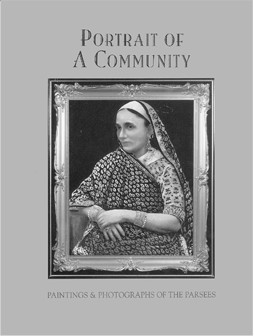
Portrait of A Community: An Exhibition of Paintings and Photographs of the Parsees. Published in 2002 by Chemould Publications and Arts, Jehangir Art Gallery, Bombay 400023. Pp: 137. Price: Rs 750 (US $ 30 inclusive of postage).
The exhibition of an illustrious past, that gladdened the eye and lifted the spirit, has itself been preserved for posterity. A volume of 137 art paper pages recaptures some of the finest exhibits that wowed art lovers in Bombay with reproduction and designing to match.
Graphic designer Dhun Cordo’s effective layouts and juxtaposition of text, color and black and white cameos has been enhanced by the dedication and immense skill of photographers Prakash Rao, Noshir Gobhai, Kaikhushru Dustoor, Cherag Mewawala, Ayesha Soni, Homi Jal, Fram Petit, Sanjeev Prabhu and Noshir Havewala — all of whom the chairperson of the exhibition committee Khorshed Gandhy has acknowledged in her Foreword to the book. The processing and printing excellence of Comart Lithographers and Silverpoint Press respectively add the proverbial icing to the magnificent cake. "The photographers were... faced with tremendous limitations as many (paintings) hung in dark corners and at immense heights where the reflection of their covering glass proved a great challenge,” she notes.
Priya Maholay’s text places the fine illustrations in the context of art history. In the chapter titled "The Paradigm of Parsi Portraits,” she explains how the advent of the English language and education in western liberal ideas led inevitably to the acceptance and understanding of the art traditions of the ruling race. The establishment of schools of art in the western mode went almost hand in hand with the establishment of the universities.
"Lord Macaulay, on the laying of the foundation of the British-Indian educational system, aimed at bringing up a class ‘who may be interpreters between us and the millions whom we govern; a class of persons, Indian in blood and color, but English in taste, in opinions, in morals and in intellect.’” Thus, she notes, "art education was an instrument to inculcate western sociocultural values in the Indians, alienating them from their traditional systems.”
Explaining the rise of the Company School of Painting at the beginning of the 18th century, Maholay records that "itinerant (English) artists were backed by the East India Company, seeking to document natural history, architecture and ethnic groups of India among portraits.” By the 1850s this school had moved into the twilight zone. As India passed from the Company to the Crown, "the British aimed at a complete metamorphosis of the Indian artistic scene and sensitivity,” and schools of art based on "European Naturalism, a style of painting that included scientific perspective and possessed photographic realism” became a part of the Anglo-Indian landscape. The artists that these schools spawned, as much as their teachers, had a ready clientele among the westernizing Indian elite and middle classes, notably the Parsis, with their upwardly mobile social and economic stature.
"Indeed,” writes Maholay, "as Bombay has been the turning point for the destiny of the East India Company, so it was for the Parsi community. Eighteenth and nineteenth century Parsis made themselves indispensable to the ruling British power and wealth base of India, by acting as intermediaries. Over time, many enterprising Parsis accomplished themselves in the cotton trade, shipping, banking and the opium trade in Bombay. In making Bombay the commercial port as the English had envisaged, the industrious Parsis became the chief instruments. In turn, the material prosperity acquired under the British led the Parsis into revering the English culture as progressive, scientific and superior.”
Referring to the "perspective, depth and tonal values” which the newfound technique of oil painting provided, Maholay speaks of the "new possibilities” becoming available to Indian artists: "Life-size portraits under the British emerged as an entirely new concept, for, in recent centuries, the Indian eye had been trained to look at the miniature format of painting. The sheer realism of the flesh tones, the fullness of the bodies, the shimmering ornaments reflecting light, evoked a magical quality. These realistic and clinically superior paintings in oil were a mark of ‘progressiveness.’ Besides, Indian traditional genres of painting, chiefly miniatures, had witnessed a consistent decline for sometime now.”
To match the changing concepts and techniques was the physical presence of oil paints in portable, collapsible tubes — a result of the growing exports of Britain after the Industrial Revolution.
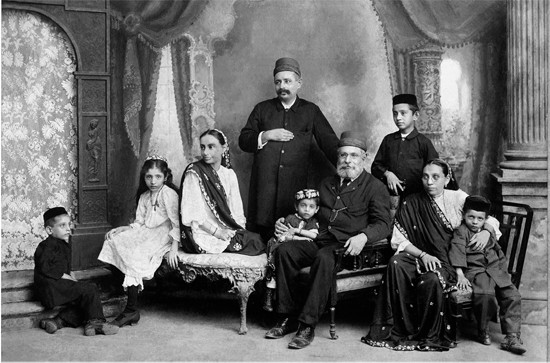
An unidentified Parsi family
Courtesy: Sam N. J. Maneckshaw
The J. J. School of Art, founded by Sir Jamsetjee Jejeebhoy in 1857 played an important role in popularizing oil portraits. As the precepts and principles of the Royal Academy of Britain were transplanted in the Indian milieu, "elite artists were seen as enterprising individuals replacing traditional artisans, art societies taking over the functions of aristocratic patrons and art schools as agents of the Raj seeking to inculcate ‘good taste’ in its subjects.” Portrait painters earned up to Rs 100-200 whereas the work of decorative painters fetched Rs 25 (sic!). "For the artists, it began as an individual response to a medium, but its sustenance and further perseverance were influenced by trends in patronage and the process of recognition from exhibitions and art journalism.” Artist Pestonjee Bo-manji was said to be "highly conscious of the exhibition circuit.”
Side by side with signed portraits by outstanding artists of the time grew a thriving culture of copies and imitations from originals as witnessed by many an unsigned portrait. Portraits became "visual repositories” of traditional dress, furniture, trade or professional accessories and its prints or copies served as visiting cards, souvenirs or other memorabilia, Maholay tells us. Parsis then held high political positions in many an erstwhile Indian state and unveiling a commissioned portrait became a major social event. Also the Parsis’ philanthropic bent led to the deifying of trade barons whose liberality endowed institutions of learning or benevolence.
Maholay also explores the network between art school students and itinerant western artists, of underpaid students seeking to prove their talent as beginners, earning just enough to buy paint and canvas for the next piece of work.
The chapter "Pioneers and Paintings” traces the metamorphosis of the community from agrarian to commercial with snippets of information on the legends of the era like the Jejeebhoys, the Tatas, the Wadias, the Petits and the Readymoneys, Sorab Pithawala’s dramatic rendition of Dadabhai Naoroji, the poise and confidence of Sorabji Pochkhanwala, the intrepidity of Sir Pherozeshah Mehta engraved forever on the community psyche by an unknown artist, and many more.
The advent of the camera furthered the detail of the art portrait. Maholay recalls the Parsi connection with photography: "Several Parsis, besides patronizing the art, also owned photo studios in Bombay. The famous EOS Studios at Kalbadevi in Bombay was first established as Bombay Photographic Studio in 1857 by Pervezji Dadabhoy Vazifdar in partnership with a British gentleman. Pervezji specialized in architectural photographs besides portraits. He received commissioned work from leading Parsis and the Gujarati business community. Patrons often liked to have themselves photographed at the studio. They were offered a choice of different backdrops and decor. Standard props were maintained at the studios for this purpose. On other occasions when they wished to record an event or ceremony in its physical context, Pervezji was invited to the venue. This was true of navjotes, weddings, graduation ceremonies and more. All studios in Bombay functioned on these lines. Some of these still survive, like the famous Hamilton Studios at Ballard Estate. The EOS wound up its business in 1990.”
Hand-colored photographs were a genre by themselves where the photographer also possessed artistic skills and an eye for detail, adding colors onto the black and white photograph. An outstanding exponent of this genre was the American artist Phillips who ended up by placing the effectively painted photograph under a convex domed glass "which lent it depth and perspective,” writes Maholay.
Among the many outstanding portraits and groups is a double page rendition of the first All-Parsi cricket team to go to Lords in 1886, courtesy the Marylebone Cricket Club.
Jhablas and kors, embroidered topis, phetas, pugrees, diamonds and pearls, traditional regalia and imperial fashions, tennis racket and mathabana stand cheek by jowl. "The fascinating variety of portrait photographs of Parsis, bears testimony to their unstinted patronage of the art and their love for it. Props consisting of Victorian furniture, mostly a chair, divan, and table with a vase and clock were popularly favored settings. The patriarch occupying center position, or seated on the chair, with his wife behind or by his side and children at the feet was common. Levels were created for better composition in case of large groups.”
In contrast to European realism is the technique of painting on glass, a foreign import which flourished at the end of the 18th and beginning of the 19th centuries when the subjects were largely mythological and, in the Parsi context, originating in the Shahnamah. Maholay explains the art form: "A reverse methodology from that of painting on paper was followed here and was executed on the back of the glass. Since the painting had to be viewed through the glass, the details were painted first, like the jewelry, and finer patterns; this was followed by the major color portions and last came the background. The glass was then backed by a piece of dark paper followed by a thick wood. This was then framed, to assure safe storage and handling.”
Six such paintings of members of the Petit family at the J. N. Petit Library complete this beautiful publication which documents the life-style and larger-than-life personalities that the community produced in its heyday. The publication makes for a worthy gift for friends, family and posterity.
◆ ◆ ◆
From the archive