
ART
Pursuing Parsi portraits
The Delhi Art Gallery comes to Bombay with Parsi portraits dominating the exhibition
In a bye lane of Kala Ghoda in a newly refurbished heritage building Delhi Art Gallery (DAG) is holding its third exhibition in Bombay from March 29 to June 30. Titled "Indian Portraits: the Face of a People,” it traces the growth of portrait art in India.
"Portraiture was not an Indian medium at all,” curator Kishore Singh starts his discourse, having flown down from Delhi with Ashish Anand, owner of DAG. Singh enlightened us on how Indian artists copied their overseas counterparts, using light and depth in the western tradition. However, Parsi artists chose to do portraits with models in traditional garb — draped in saris, garas and topis – as we were drawn to western civilization. Manchershaw F. Pithawalla and Pestonji Bomanji, two such Parsi portraitists who were trained in art schools and used the chiaroscuro technique of strong and bold contrasts of light and dark which achieved a sense of volume in modeling three-dimensional figures. Bomanji made a name for himself in oil portraiture having studied at J. J. School of Art and was referred to as the Indian Rembrandt, after the Dutch portraitist.
"Portraiture was not an Indian medium at all,” curator Kishore Singh starts his discourse, having flown down from Delhi with Ashish Anand, owner of DAG. Singh enlightened us on how Indian artists copied their overseas counterparts, using light and depth in the western tradition. However, Parsi artists chose to do portraits with models in traditional garb — draped in saris, garas and topis – as we were drawn to western civilization. Manchershaw F. Pithawalla and Pestonji Bomanji, two such Parsi portraitists who were trained in art schools and used the chiaroscuro technique of strong and bold contrasts of light and dark which achieved a sense of volume in modeling three-dimensional figures. Bomanji made a name for himself in oil portraiture having studied at J. J. School of Art and was referred to as the Indian Rembrandt, after the Dutch portraitist.
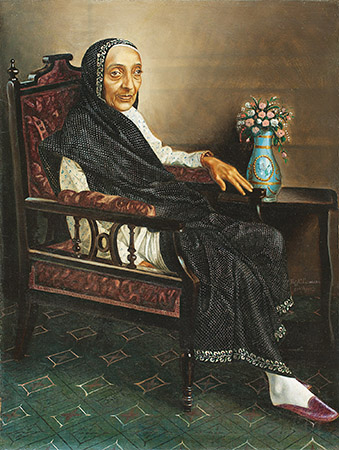
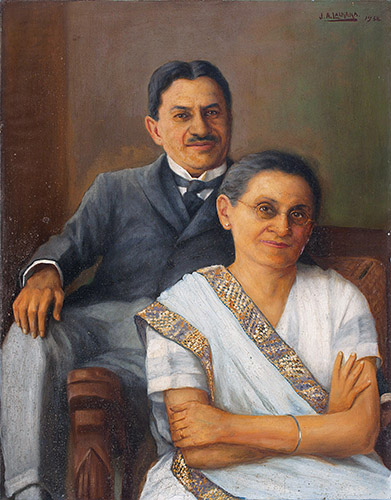
Unknown by Koulji Tachakra (left); Parsi couple by Jehangir Lalkaka
Apart from the two named above, some of the other Parsi artists on display are Jehangir A. Lalkaka with three frames — depicting his mother Bai Pirojbai, a Parsi couple and a gentleman in a pugree. Referring to Sawlaram Haldankar’s portrait of "A Parsi Woman in a Pink Sari,” Singh pointed out that it was probably a commissioned portrait as seen from the stiffness of the posture and the stance, whilst Lalkaka’s mother exudes a softness that the son portrays with a personal touch; you learn as you trail after the curator. There is also Ardeshir Tavaria on display and a painting of Lady Meherbai Dorab Tata (née Bhabha) painted by the Irish Sir John Lavery. Meherbai was the paternal aunt (fui) of the nuclear scientist Homi Bhabha. The lesser known Koulji Ardeshir Tachakra is showcased with an untitled portrait of an old Parsi woman in a lahe ni sari as worn by widows in mourning and the traditional mathabana (white headgear). Another artist represented is Hormusji Deboo who was sought after by the community to paint portraits.
Art historian Singh further stated that stature and position of the subject became important and got depicted more and more as time went by. Typifying this is the anonymous portrait of a lady in an aquamarine sari with a long-sleeved lace blouse revealing the drapery and textile details with the new-found intricacies that capture as much detail in paint as the public was getting used to in photography.
The serious influx of photography in India in the late 1840s led to artists being assigned to photo studios. They either had to please the patron with paintings in likeness to the subject or make copies as true to the given photograph as possible, leading to restrictions on creativity. In commissioned portraits, no liberties were taken as portraits were rejected by the patron, if displeased. Sometimes a secondary artist was assigned to complete the background after the completion of portraits — the two artists’ perceptions not always blending or complementing the subject represented.
The serious influx of photography in India in the late 1840s led to artists being assigned to photo studios. They either had to please the patron with paintings in likeness to the subject or make copies as true to the given photograph as possible, leading to restrictions on creativity. In commissioned portraits, no liberties were taken as portraits were rejected by the patron, if displeased. Sometimes a secondary artist was assigned to complete the background after the completion of portraits — the two artists’ perceptions not always blending or complementing the subject represented.
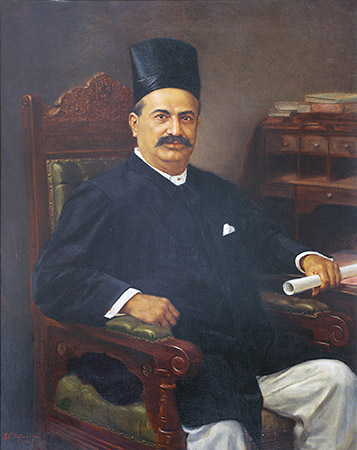
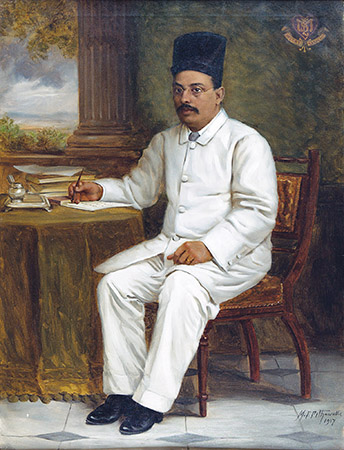
A gentleman with a pugree (left) and Untitled by Manchershaw Pithawalla
Before the arrival of European artists in the 17th century, the art of portrait-making in India "gravitated towards the gods and goddesses or mythological, legendary heroes and heroines and royalty; it was not so much about creating a likeness to the subject but more about imparting heroism to the subject,” curator Singh stated in the newspaper Live Mint.
Further, the Indian ethos did not celebrate the glamor of the personal self as the main themes remained celestial creatures or symbols. The only portraits were of kings and concubines – queens were rarely, if ever, put on display. "As painting caught on in India, the relationship between the artist and the painted became special. Sometimes a portrait was reproduced from a photograph rather than having a subject pose for the artist,” the curator elaborated.
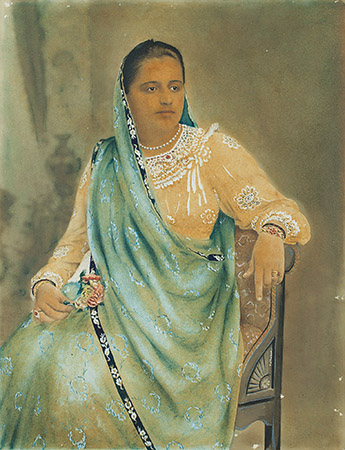
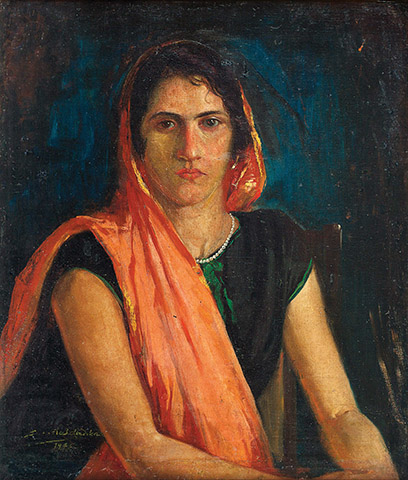
Artist and subject unknown; Lady in pink sari by Sawlaram Haldankar
Parsis did not wear their deity on their sleeves, nor were they prone to celebrating heroism in their day-to-day living. Consequently, Parsi portraiture was devoid of iconography and the Parsi frames chosen fit into DAG’s tenet of "we looked at real living people that artists were painting in whatever period they were working in.”
DAG has on display 160 works by about 120 artists in Bombay from a total of 400 portraits of about 150 artists in their possession in Delhi. Their collection, started 20 years ago, boasts a total of 34,000 oeuvres. Five months have passed since the Gallery was inaugurated in Bombay. At the exhibition, there was a dominance of frames with portraits of Parsis and well-known Parsi artists. The Progressive Artists’ Group (PAG) is another well represented body with M. F. Husain, F. N. Souza and Akbar Padamsee. There are five or six paintings of Rabindranath Tagore and his nephew Abanindranath (Tagore); as also of Abdul Aziz Raiba, K. Krishna Hebbar, Abalall Rahiman, Rabin Mondal, Jamini Roy, Laxman Pai and some British painters of the time. Similarly terracotta busts represented by Jacob Epstein and S. Dhanapal occupied a small space on the third of the four floors of the Gallery. There are also some lithographs, prints and even gelatin silver prints where silver salts are suspended in gelatin to form images.
Singh is particularly attentive to viewers showing an interest and offers the history, explanation and even the exclusivity of the peered at frames. Maneck Davar of Spenta Multimedia (SM) co-hosted the event as the gallery wanted to reach out to the Parsi community in Bombay since several portraits of Parsi men and women are on display.
The Gallery has a self-published coffee table book eponymously titled, Indian Portraits – the Face of a People, costing Rs 5,000. Sold at their galleries in Delhi and Bombay and on the website, it has not been released in general bookstores. Their website www.delhiartgallery.com gives details of all the portraits in the exhibition. Pleased with the response to the preview and the interest shown, DAG wants to further their association with SM and the commercial capital of the country. This may be earlier than thought, with another exhibition scheduled for viewing in Bombay around Diwali this year.
◆ ◆ ◆
From the archive