
Cover Story
Community Cameos
Rediscovered, selected, refurbished, a host of community portraits went on display at the National Gallery of Modern Art
In a glittering response to a gilded invitation the spectators were a part of the spectacle as India’s former Chief Justice Sam Bharucha presided over the inauguration of the "Portrait of a Community” — an exhibition of paintings, photographs and artefacts of the Parsis — on October 8, 2002. Barring the two or three rows of early birds sharing space with a beautiful floral arrangement by Kamal Kerawalla of Baimai Florists, there was standing room only at the ground level of the Sir Cowasji Jehangir Hall aka the National Gallery of Modern Art (NGMA). Larger-than-life-size representations of Sir Pherozeshah Mehta, Dadabhai Naoroji, Sir Jamsetji Jejee-bhoy, various generations of the Petit family, merchants, shipbuilders, priests et al saw the audience settling on the steps leading to the upper levels and thronging the bannisters. The exhibition, in the words of outstanding bureaucrat and NGMA advisory committee chairman B. G. Deshmukh, served as "an added visual dimension to our understanding of the Parsi community.”
Conceptualized by Khorshed and Kekoo Gandhy of the Chemould Art Gallery, a committee of 15 members joined ranks so that a seed of thought planted three years earlier at the 150th anniversary celebrations of the J. J. Benevolent Institution could bear fruit. "We are surrounded by these portraits without realizing their value. They need to be seen and recognized as our heritage,” said Gandhy in her welcome address narrating how the idea had emerged.
Though the Parsi community had been in India for over a millennium, it was "the advent of the British and the industrialization and world trade that they brought that activized us,” noted Bharucha. Speaking of Parsi entre-preneurship, he referred to the "enormous blackboard sign of ‘Navroji and Sons, est 1858’” he had seen in the township of Dharamsala, the Himalayan retreat where the Dalai Lama has his headquarters. Wondering whether the property had changed hands, Bharucha said he "went in on the pretext of buying a copy of The Times of India,” and found this "Parsi gentleman, the proprietor of the shop, who told me his ancestors had followed the British Army there after the Mutiny and (at one time had) sold Scotch at eight annas a bottle!” Another memory Bharucha recalled was that of a full-length portrait of four Parsi ladies clad in garas and holding a ses. The painting by Ravi Verma graces the principal guest suite of the Raj Bhavan at Trivandrum, Bharucha informed the gathering.
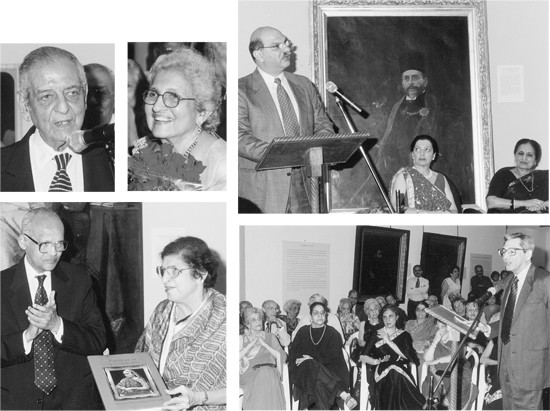
L to R (top): Kekoo and Khorshed Gandhy; Jejeebhoy, Modi and Doshi. (Below) Deshmukh and P. Bharucha; a section of the audience listening to S. Bharucha
"Grateful for the labor of love” that lay behind the selection, transportation and refurbishing of the portraits, Bharucha noted, "This exhibition is due in many ways to the apprehension that the Parsi community is dying out. I do not share that apprehension.” He added the rider, "If a few boatloads (of people) can survive for over 1,000 years, I’m sure we are in no danger of imminent decease!”
"This cameo portrayal of a community that has made Bombay proud,” led Deshmukh to recall the pivotal part Parsis have played in the development of Bombay and "in shaping its character.” As generous patrons of art, "it was the Parsis who revived and patronized the performing arts... Through the Parsi theater they encouraged all forms of art, including painting. In fact, the origins of Hindi cinema can be traced to the innovative approach of the Parsi theater. Their contribution to the culture of this city is invaluable.”
"Ninety percent of the community is ensconced in the baugs. The remaining 10 percent is on canvas and pedestals. This exhibition is all about this 10 percent,” remarked Rustom Jejeebhoy, descendant of the patriarch who gave Bombay, among other benefits, her first public hospital and school of art — now linked by a flyover named after the great Sir Jamsetji Jejeebhoy. Congratulating Gandhy on conceiving the exhibition and bringing it to fruition, he credited her with creating awareness of the artistic heritage in our community to which it had hitherto paid as much heed as a "donkey carrying a sack of gold.” Thanking the NGMA for the free use of the C. J. Hall Jejeebhoy stated, "Reluctant collectors were more amenable to cooperate (with the organizers) when they realized that the exhibition was to be held at the NGMA.”
A catalog of the exhibition which in the words of compere Homai Modi "has turned out in reality to be a coffee-table book,” was ceremonially released by Bharucha’s wife Perin and copies presented to Deshmukh and NGMA director Saryu Doshi (for the review see "Parsi Portraits,” p 40). With the conclusion of the formal program the guests wowed their way to the upper exit, sampling a spread of refreshments, courtesy the Taj Mahal Hotel, en route.
Materializing the concept
"I had never visited so many agiaries as I did in these three years!” confessed Gandhy during an interview with Parsiana a few days later. She recalled the sudden realization "that we have these pictures but we never find out who they are or try to appreciate the quality of the painting.” Not wanting to make it "a list of important ancestors,” Gandhy said she started making notes of the portraits as she went from institution to institution, concentrating on the quality of painting, finding the photographers to photograph them — a tough task given the high and dingy locations and the glass fronted frames that reflected the flash of the camera.
After the initial selection, the organizers had to write to each owner for permission to exhibit, collect funds for restoration (anything above Rs 5,000 each), insurance (over four crore rupees), cartage, publication of the brochure, etc. Some owners gave their own insurance, some even shared the transportation costs, acknowledged Gandhy.
Financial and material support came from expected and unexpected sources: the Bombay Parsi Punchayet, Sir Dorab Tata Foundation, Sir Ratan Tata Trust, the Godrej Foundation, the Hongkong and Shanghai Banking Corporation, the Volkart Foundation of Switzerland; skilled professionals — Parsi and non-Parsi photographers, Burjor and Fred Poonawala of Comart Lithographers, outstanding designers Dhun Cordo and Pinakin Patel who volunteeered their services for the catalog and the exhibition displays. Mounting groups of pictures on fabric screens, Patel said "he wanted to do it as a return to the Parsis for what they had done for the city,” Gandhy told Parsiana.
An unexpectedly happy find was Priya Maholay who had just returned from London after finishing her masters in Indian Art History at the School of Oriental and African Studies (SOAS). She said she had just tendered her curriculum vitae to Marg when member of the exhibition committee Saker Mistri met Marg’s Radhika Sabavala looking for an essayist for the catalog and a curator for the exhibition. Maholay not only wrote the text of the catalog but was a knowledgeable and willing guide to groups of schoolchildren as well as adults, highlighting the special effects in each painting, providing the biographical and social background of the worthies on canvas, often culled from Boman Patel’s Parsi Prakash. The icing on the cake was Doshi’s suggestion that the exhibition be held at the NGMA. "The place has truly lent itself. Every level has something special... its own setting,” Gandhy’s appreciation was unmistakable. Last but not the least was the family’s moral support. Husband "Kekoo helped a lot in getting some of the pictures that I was not getting;” daughter Rashna conceived the idea of a parallel contemporary exhibition which was on view simultaneously at the Chemould Art Gallery; daughter Shirin set up appointments with different people, went to various Parsi homes, including two or three in Poona. "Without Rustom Jejeebhoy’s encouragement the project would have remained a dream,” she had publicly acknowledged at the inaugural.
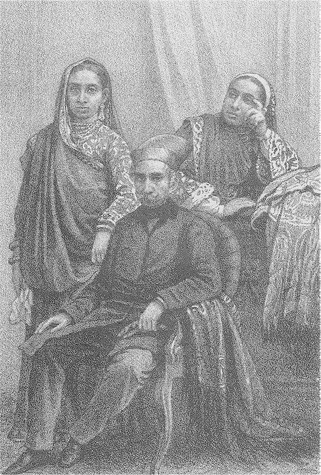
Lithograph of Manockjee Cursetjee Shroff with daughters Serenebai and Aimai K. R. Cama
Courtesy: Khorshed Gandhy
There were unexpected reversals. After their eight or nine paintings had been included in the published catalog, the H. B. Wadia Atas Bahram trustees refused to release them for exhibition. "The legality of a trust giving it is a little doubtful,” Cusrow Wadia told Parsiana. "The union of Central Bank workers refused to part with (founder of the bank) Sorabji Pochkhanawala’s portrait for so many days because they do namaskar to it every morning,” a bemused Gandhy told us. Three paintings plus one prize winning painting of yesteryears from the Prince of Wales Museum were also withdrawn, she noted. Sir Pherozeshah Mehta’s portrait, entrusted to the J. J. School of Art for restoration, "came on the day we were hanging it up... Paintings from the Dadysett Atash Behram helped to fill the empty space when the Wadias refused,” Gandhy recalled the heart-stoppers of the final four days spent on putting up the paintings, as grouped by Mistri and Maholay to optimum effect.
Gandhy’s reward was not only the attendance of young and old (e.g. 98-year-old retired architect Savak Mehta, who has spent his life feeding lepers and street children, according to his neighbors Sheroo and Boman Mody, gamely reviewed all four levels of the exhibition) and the accolades that followed but the realization voiced by community members: "Things we had tucked away in boxes we now display with pride!”
"It’s my turn to talk”
The exhibition committee of "Portrait of a Community” comprising Pilloo Cooper, Homi Dhalla, Dara Gandhy, Mehlli Gobhai, Pheroza Godrej, Cyrus Guzder, Jejeebhoy, Yezdi Karanjia, Bachi Kar-karia, Sam N. J. Maneckshaw, Mistri, Modi, Kayan Pandole, B. Poonawala and Kersi Treasurywala under the chairperson Khorshed Gandhy, had organized a series of cultural events through the three week exhibition. The programs chalked up included "Silent Sentinels: Parsi statues seen but unnoticed,” an illustrated talk by Marzban Giara; In the Footsteps of my Forefathers, a video film produced by Tenaz Dubash; Such A Long Journey, a film based on Rohinton Mistry’s novel; "The Iran experience,” an illustrated talk by Khojeste Mistree; "It’s my turn to talk: Contemporary issues and today’s generation,” a seminar and discussion, moderated by journalist Karkaria; "In a Parsi home: Furniture and Artefacts,” a talk by Niloufer Rustomji. Two other programs — the three-day seminar "Treasures from the Zoroastrian World” organized by The Museum Society of Bombay and a three-hour guided walking tour of the "Parsi heritage trail” organized by that Society in conjunction with Zoroastrian Studies — were also held during the tenure of the exhibition.
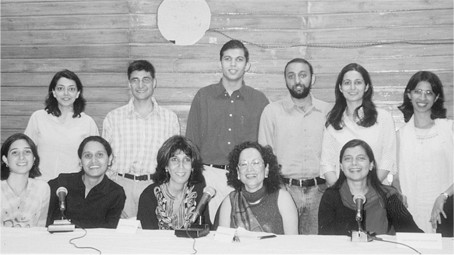
Today’s generation spoke on contemporary issues. Moderator Karkaria seated, 4th from left
On October 26, 2002 10 Zoroastrian youths explored issues facing the contemporary community. Between Burzin Mehta, Khushnuma Khambatta, Khushnuma Dadachanji, Anahita Pandole, Vinifer Gandhi, Tanaz Noble, Rustom Jamasp, Hoshang Gotla, Merzeen Aga and Zia Parakh they spanned the gamut of opinion from rigid orthodoxy to radical liberalism.
Introducing the program Mistri noted that while the paintings on display "reflect the environment of the 18th and 19th centuries,” the exhibition committee felt that the youth needed a platform to voice their concerns. Over two meetings the youths came up with a list of issues. "Interestingly, they are not new issues,” commented Mistri noting how our forefathers had shaped the community’s identity through the religion; that Jerbai Wadia had expressed her concern for community housing through the baugs she created; that no community has as rich a legacy of entrepreneurship as the Parsis do; that public service as an ideal was translated by our ancestors into libraries, hospitals, educational institutions, wells and water fountains.
Karkaria spelt out the "rules of engagement:” three minutes speaking time per participant, one hour for discussion and 30 minutes for questions from the floor. Urging a spirit of objectivity and frankness, she reminded the speakers to restrict themselves to issues and eschew attacks on individuals.
Identity was the first issue on the mat. Noble, a college student who grew up in the Andaman and Nicobar Islands where the total Parsi community comprised three Parsi families, found the culture of the baugs hard to digest. Gandhi pointed out that community-minded youths are free to join organizations like the Holiday Programme for Youth Club and the Young Collegians’ Zoroastrian Association. Aga spoke of the "cultural schizophrenia,” of staunch Iranian Zoroastrianism versus its diluted Indian counterpart, of alienation and amnesia. Jamasp, a deepsea diver with exploration companies, referred to the descriptions of the universe in the Khorshed Nyaish corroborated by NASA (National Aeronautics and Space Administration) scientists. "Zoroastrianisn has a deeper meaning than moral science. (I may have) freedom of choice to alter Zoroastrianism but am I negating the future generations’ right to know Zoroastrianism in its pristine spirit?” he asked.
Speaking about entrepreneurship Burzin Mehta, a budding copywriter, spoke of the divergence in attitudes. Big businesses had worked hard and shared their prosperity. They did not subscribe to a nine to five job with a starting salary of Rs 10,000 and a trip abroad. "We are turning from benefactors of charity to beneficiaries of charity,” he noted.
Gotla supported Mehta’s thesis. It was Jerbai Wadia’s dream of raising the standard of living of the poor Parsis that led her to build housing, ensure education. Gotla felt it was conceivable for Parsi youths to take a loan, "work twice as hard to pay off the loan... time for us to pull up our socks and complete a great lady’s dream.”
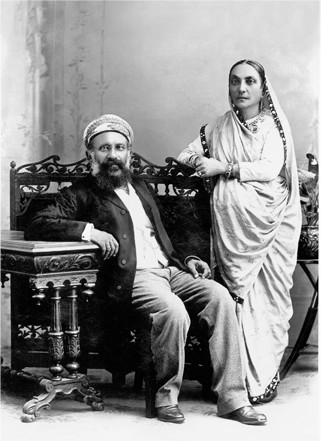
Khan Bahadur and Ms M. C. Murzban
Photograph by Raja Deen Dayal, 1899
Courtesy: Hemlata Jain
Pandole, a working gynecologist with two children who has been fighting a very intense and difficult legal campaign against the destruction of trees by hoarding-owners, is an example of someone who is public spirited, said Karkaria. "You don’t have to build public libraries. You don’t need to build in stone like a century ago... Let us come out of our comfort zone and do something for the larger community, for the city,” urged Pandole.
Parakh, who wants to teach, was sad that most Bombayites don’t take responsibility for the problems the city faces — the pollution, the dirt, the corruption. "If we just do our bit at the personal level, our city will be a nicer place to live in,” she said.
Dadachanji and Khambatta lined up on opposite sides of the intermarriage debate. We need an "amending body to suit religion to contemporary times. My brother doesn’t want to be a navar. I’m ready. Why can’t I?” demanded Dadachanji. Khambatta termed the navjote of intermarried progeny a "24-hour phenomenon.”
"How can I be proud of being a Zoroastrian if I am ashamed of my sudreh-kusti at a party?” jibed Jamasp. "How much do we know of the religion we want to change?” added Gandhi.
Noting that the community is divided into two vocal bodies on most issues, Burzin Mehta suggested that formalizing both attitudes "would stop the ungainly debates and constant bickering.”
The audience joined issue. Aghast, a lady asked, "Divide the agiaries and atash behrams?” Karkaria referred to the "historical truth of desecration” of fire-temples which was no longer the case. "In this age of information are we destroying the spirit of enquiry by preventing questioning of age-old practices?” she asked.
Eleanor Mirza, a non-Parsi who has been following the identity crisis since the past 10-20 years, said, "(You) belittle Zarathushtra, (let) wonderful things go to waste by not letting others follow.”
Dr J. V. Undevia, whose research on the G6PD issue had brought him close to the community, stated that "the rate of consanguinous marriages in the community is coming down. Parsi boys and girls now have different sets of measures... A larger number of Parsi girls marry out than boys.” (Parsiana statistics show that more boys marry out than girls.) Responded Dadachanji, "Girls are more educated, qualified. Just look at the boys — you’ll know...”
◆ ◆ ◆
From the archive