
From obscurity to opulence
Across Oceans and Flowing Silks: From Canton to Bombay — 18th to 20th Centuries edited by Pheroza J. Godrej and Firoza Punthakey-Mistree with Sudha Seshadri. (And) No Parsi is an Island edited by Ranjit Hoskote and Nancy Adajania with Pheroza J. Godrej. Published in 2013 by Spenta Multimedia, Peninsula Spenta, 2nd floor, Mathuradas Mill Compound, Senapati Bapat Marg, Lower Parel, Bombay 400013; website: www.spentamultimedia.com. Pp: 388. Price: Rs 2,500.
The Parsi secret of consistent success was in keeping determinedly out-caste’d such that travel, trade, and transfiguration presented no setbacks which pseudo-religious constraints imposed upon Indian majorities. Pent-up energies stored over centuries of self-imposed localism were to be released, firstly under the great Mughals, and then unleashed with purposeful determination across several seas and various fronts, chief among which was trade.
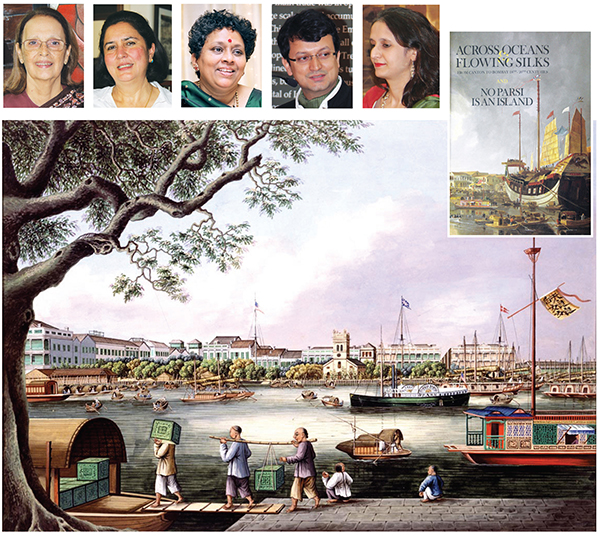
That settled, one proceeds to delve into this vast 9”x11” compendium. Its first part, Across Oceans... is organized across a short Introduction by the assiduous Pheroza Godrej and Firoza Punthakey-Mistree duo, then an episodic preface by Homi K. Bhabha (Harvard) the general rightness of whose summation via Parsi self-containment markers is partially respected in this review.
Passing over his "conversion” views with their futile conflicts between Zoroastrian prescription and Parsi proscription, one is led on to Bhabha’s "soft power” usage to account for Parsi emergence in the cosmopolitan settings of the India-China trade: it was "in terms of piecemeal reform rather than social revolution.” One would rather have suspected Parsi entrepreneurial opportunism through acquiescence and condescension towards British colonial demands. It transcended "soft power” wherever it was exercised — Bhabha has employed this metaphorical compound some half dozen times to ease his sentimental approach to Parsi ascendancy from obscurity to opulence: he dishes up quite a khichri sahs!
Quite where his "conversion” thesis fits in — "a non-proselytizing faith,” says he (!) — is unclear: converts do not seek to become Parsis, but Zoroastrian through realization of their deeply held inner convictions. Like it or not, Zoroastrianism as a pragmatic system born of a uniquely humanist philosophy is universally aligned.
.jpg)
The above items are succeeded by essays outlining Parsi pre-eminence in trade (and taste!) from reliable authorities on economic and cultural histories, before being catapulted into the main exhibition catalog. The pertinently selected illustrations, mainly in full color, are sparklingly reproduced in eye-captivatingly large format, sometimes over double page spreads: their informatively attached captions nicely complement the texts.
References and bibliographies are rich sources for further explorations, and those in this catalog are no exception — barring two classic monographs which would have added zest and balanced out the occasionally bland argumentation. These absentees are Charles Boxer’s Seaborne Empire studies of the Portuguese and the Dutch: they are never too passé for extended researches elsewhere.
Ghulam Nadri’s opener deals succinctly with the 18th century Surat Parsis. With the decline of the brief Portuguese presence there, the Dutch occupied the prime trading port facilities for some 150 years before yielding commercial space to emergent British interests. Their grandiose mausolea in the Surat cemetery are massive and depressingly ugly. The respective East India Companies and 1824 Anglo-Dutch Treaty divided up the vast wealth-producing East Asian trading emporia. Proficient in Gujarati and hinterland tongues, the Parsis, with initiative and enterprise to match, became brokers, contractors and provisioners. Their story is neatly summarized by Nadri.
But by what strange quirk has Tirthankar Roy in his otherwise innocuous essay "Embracing the World” arrived at "a pejorative Marxist term” in designating Parsi sheths as compradors? It was but a sound 17th century Portuguese trade appellation for "buyer, purchaser.” This back-projected, revisionist distortion is to be refuted.
An abundance of color pictures throughout the bulk of the catalog was assembled from varied sources, and all are very good indeed. The photographic essay on "Yazd: The Land of Mountains and Pirs” has several items of interest, from Zardushti womens’ cotton and silken wear — shalwar and qamiz, maqnuns and laachaks [read: trousers, blousons, (waist-deep) head scarves, bonnets], to the wearers themselves; early monochromes of the Zardushti great and good, posed solo or with their families; the exteriors of Pirs in the Yazd region.
The inevitable ".... Parsi Arrival” displays Portuguese illustrated maps of Diu, Chaul and Thane. Some captions to the 17th and 18th century engravings — again the inexplicable fascination with the dead and disposed! — fall short somewhat. Early 14th century Christian travelers hold key importance: the Dominican Friar Jordanus (he was Catalan, not "of France”) and the Franciscan Odoric (again, not "of France”) of Pordenone, Friuli (Italy), were missionaries seeking to attract the lower orders and doubtless even the Gujarat Parsis.
Early foreign trade was eastwards — to South Asia and on to China. Their departure port was Surat on the Tapti — "The Gateway to China Trade” — until it silted up to an uncommercial degree for deep-draught sea-going trade vessels. From being weavers, artisans and agriculturers, the Surat Parsis rose to becoming brokers, ship-builders and outright ship owners trading on their own account.
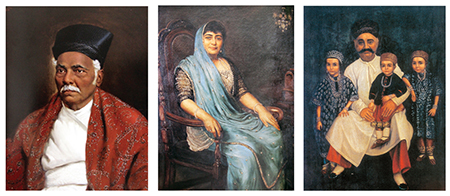
Brokers firstly to the Portuguese, and later to the British East India Company, Rustom Maneck and his son Naoroji are resplendently pictured. They had successfully pursued the debt owing them by the British. When Surat became further crippled through natural disasters and Maratha raids, the move southward to the malarial islands that then constituted Bombay (ceded 1662 by the Portuguese) with its deep harbor potential, caused the Parsi migration under British protection to help found the great metropolis which it became through sheer enterprize.
Jesse Palsetia tells their story with balance and zest in his deeply researched article, "Early Commerce and the City of Bombay,” on the making of that amazing financial hub city by the Parsis. Their mercantile prowess was initially exercised as agents of the British East India Company; later, they were to found their own business houses for trade with the Far East where they had established factorial agencies. The variety of occupations too became noteworthy: in the development of dockyards; ships victuallers, stevedores, shipwrights; building contractors and in Parsi religious foundations.
The China trade was conducted mainly from the ports of Bombay and Calcutta. Businesses flourishing from exports of cotton and the insidious opium helped fund several Parsi projects; the recent trend among researchers to exonerate the shethias from large-scale dealings in this addictive, debilitating habit among the Chinese masses is to be stoutly countered by hard facts and not sentiment. The best that can be said of Parsi participation in this vile trade is that the former lack of ethical scruples for rank mercantilism was overcome, and out of this grim evil came forth a morality of benevolence.
The illustrations, with useful captions, that accompany Palsetia’s article well depict the 18th and 19th century Parsi plutocrats. Among them are the patel, "headman of village/s” of Bombay, Cowasjee Rustumjee (Patel), noted for contracting work on sailing vessels, and construction of fire temples and dakhmas. Bombay’s largest landowners included Pestonjee Bomanjee Wadia, responsible with others for the cotton and opium trade — he owned several opium clippers. Kharshedji Fardunji Parekh was another large scale China trader, while Jamsetjee Bomanji Wadia built merchant vessels and naval frigates for the Admiralty. All in all, they were to prove indispensable to the making of Bombay; thenceforth, their philanthropy and charity formed the stuff of legend.
Poetically titled as "To Count the Very Stars of Heaven,” Mariam Dossal’s eulogy concludes with some very big names who shaped Bombay for which she added, "These were individuals who actually touched the skies...” How wonderful! Differently constructed are the short trade-bound essays of Amitav Ghosh and Rusheed Wadia — each meritorious within their Parsi activity timescales.
"The Emergence of Style and Grandeur” by Punthakey-Mistree and Godrej cosily encapsulates the Parsi entrepreneur’s mixed acculturations while resident in the factory zones of the Chinese trade ports. They resulted in grandiose Bombay mansions overstuffed with European furnishings and Far East treasures, enthusiastically amassed, though not always well coordinated.
Several illustrated pages are devoted to decorated porcelain, carved furniture (often quite hideous), ornate glassware, and Chinese artists’ return offerings. Some certainly do warrant specialized study; others are uninteresting by far.
Across Oceans nevertheless remains a compelling work — dare this reviewer hope that it will spur future generations of scholars, Parsi, Irani or whosoever, to freshly investigate (from the post — "Cultural Revolution” Chinese side?) and better appreciate past achievements in the beckoning light of this fine compilation?
No Parsi is an Island
The subconsciously resonating byways of this Ranjit Hoskote, Nancy Adajania, Pheroza Godrej collaboration display much imaginative force. The prefatory essay relates to their purview of some 150 years of representative Parsi artists through the prism of Homi Bhabha’s "in-between” classification. It is a useful introduction to what follows pictorially. This reviewer is uncomfortable with their analysis: it is precious and it is overdone. For when modern artists strive and strain to explain their translated vision, then the bemused beholder entertains doubts over what is to be objectively viewed: the fable of the emperor’s new clothes springs to mind! Is it to be art or artifice from now on? One treads cautiously!
Would the divine John Donne, Meditation XVII, had he knowledge of the sub-continental Parsis, not have agreed its paraphrase from "No man is an island, entire of itself; every man is a piece of the continent, a part of the main...?” It pans out as the most telling application to this two-part tome, and Donne surely rejoices!
Their depictions of representative Parsi art, plane and in the round, with some artifacts, is an apéritif for the culturally adventurous reader. Proceeding from the 19th century Pestonji Bomanji with his eclectic canvases, comfortably accommodated within roughly 2’x3’ sizes, one comes to the Pithawalla father-and-son works, listed "Untitled,” save for the smile-inducing two-bottle imbiber in "The Dawn of Prohibition,” and to Jehangir Lalkaka with his sombrely mystifying "Zoroaster,” cowled, heavily draped and hazardously gripping a blazing fire urn. This spooky image has since found favor within several fanciful books.
Shiavax Chavda, with his wide-ranging artistic commitments — from Dalda to dancers, has 17 pages devoted to his varied interests. Those reproduced here extend from visiting ballet companies to tantric Tata Theatre murals: the former group includes a dynamic study of Stalin’s favorite ballerina Maya Plisetskaya. His kathak dancer sketches display movements frozen in timely poses; his fascination with the dance in all its variety is explained by his relationship to the Vajifdar sisters. Where, however, the undersigned is stymied — due to his fossilized critical faculties — are Chavda’s oil on canvas abstractions: how exactly does one appraise these? Also, where are the iconoclastic but serious Maqbool Husain and Pakistan’s profoundly humanitarian Jimmy Engineer? Where’s Naina Kanodia, the naïve chronicler of soberly staid Parsis?
Fully perplexing are the later art works: they are noticeably derivative (does one not get whiffs of Giacometti, Brancusi, Hepworth and Caro?), giving a worrying sense of déjà vu, "seen it all before.” The selection process has deteriorated over the last pages. Nelly Sethna’s weaves, complete with quipu-like fringes, affords relief and remains attractive. For the rest, the less this aesthetically depleted writer comments, the better!
Despite an undisputed numerical decline of the Parsis in India, this ample tome has with insightful emphasis shown their mixed bag acculturations, cultural stabilization and advancement. Their innate trade skills, far from being diluted, have burgeoned with new diasporan zeal and globalized attitudes freed from insular and colonial constraints.
Let Parsis everywhere who dwell with past glories and future uncertainties square up to Donne’s "...never send to know for whom the bell tolls; it tolls for thee,” for they had through the subcontinent’s imperial past contributed mightily to India’s Brave New World, and evidentially still do — from sea to shining sea!