
Politics and Policy
Walkover for Antia
Though three candidates stood for election, Burjor Antia’s entry onto the BPP board was a foregone conclusion
"Giving back to the community,” trustee-elect Burjor Antia, a noted solicitor and yozdathregar mobed, announced a donation of five lakh rupees to the Bombay Parsi Punchayet (BPP) in his thanksgiving speech. The money is to be split 50:50 between the F. S. Parukh Dharamshalla and a solar reflector for Doongerwadi. He had romped home with 436 votes from a total of 576, leaving fellow contender Rustom Tirandaz at 135 votes trailing by a margin of 301 votes. Rustom Irani, the third candidate, received a total of four votes with much cheering from observers watching the counting process. There was only one invalid vote.
The resounding victory for Antia had been anticipated and suggestions had been made privately to Tirandaz and Irani to withdraw their nominations in the interest of saving an estimated Rs 1.5 lakh of Punchayet funds — the current cost of a trusteeship election — for more constructive use. The suggestion had been publicly carried by Jam-e-Jamshed Weekly in an editorial on November 24, 2002.
Though legend has it that a sitting trustee never loses his reelection (Dinshaw Tamboly defeating Mehroo Bengalee was a notable exception), Tirandaz, at the end of his seven-year term, had lost to challenger Maneck Engineer on October 26, 2002 by only 112 votes. But the former corporator and trustee’s demagoguery was no match for Antia’s 40 years of community work, as trustee of Iranshah, the Anjuman and Banaji Atash Behrams of Bombay and several agiaries of Bombay and Surat, of Masina Hospital, Sir J. J. Charity Trust and the M. F. Cama Athornan Institute, to name a few. Moreover, as the BPP’s solicitor for as many years, Antia is well aware of the history of the Punchayet’s problems. For once, at the end of the day (December 14, 2002), Tirandaz had little to say.
Well-known lawyers, doctors and priests stood behind him. Athornan Mandal president Cowasjee Dinshaw had proposed and former BPP chairman, noted solicitor and Antia’s partner at Mulla & Mulla and Cragie Blunt and Caroe Eruch Desai had seconded his candidature. Former BPP chairman, noted doctor and author Aspi Golwalla publicly supported him. And the Alert Zoroastrians Association (AZA), spawned by perceived inequities at the Dinshaw Mehta/Maneck Engineer election in June 2001, worked as his electoral campaigners.
Antia’s manifesto advocates community harmony with the BPP providing leadership that is dynamic but also pragmatic, with transparency and accountability in its working. The provision of homes, higher education, employment/self-employment, care for the aged and the inculcation of Zarathushtra’s message among the youth are his concerns, listed in that order. Like Tirandaz and Irani, Antia also believes that a complete census of the community needs to be the first step towards community amelioration.
Proposed by Zarin Engineer, Tirandaz had been seconded by his wife Armaity, according to the BPP notice in the Jamé (December 1, 2002).
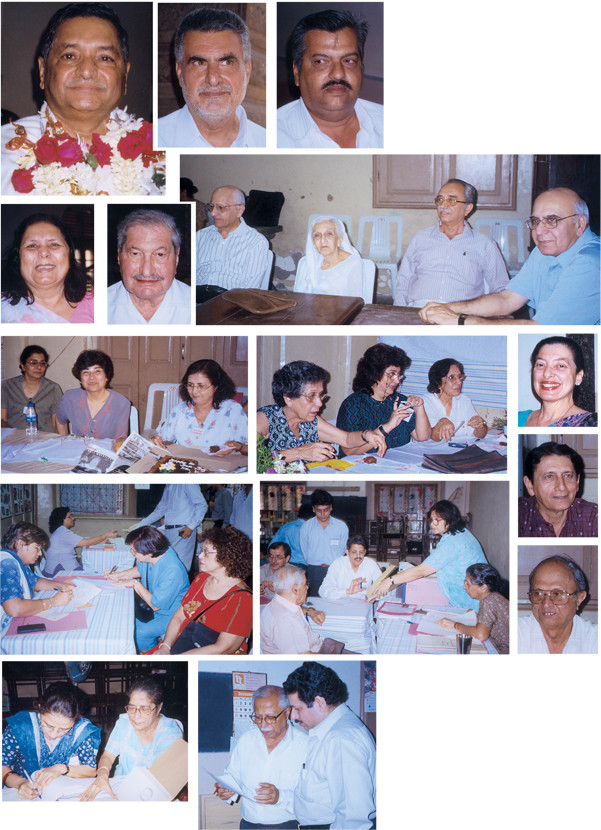
Clockwise from 2nd row: Dinshaw Tamboly, Engineer, Silloo Kavarana, Minoo Shroff, Jamshed Guzder, Roshan Antia, Burjor Antia, Tirandaz and Irani ; Verticle column (right): Homai Modi, Rusi Bhumgara and Rusi Toddywala Left alongside: Hormuzdiar and Mehli Colah Third row: (left) Tirandaz supporters; (right) Antia volunteers 4th and 5th rows: Punchayet staff checking certificates, providing duplicates and ballot papers
Irani, whose single page manifesto spoke of "the need to kick-start the reform process in our community,” advocated "proactive steps” to stem the declining population, the navjote of children whose either parent is a Zoroastrian, the establishment of a crematorium exclusively for Zoroastrians and the assurance of death ceremonies for buried or cremated Zoroastrians. He sought to "reinstill religious faith” among those Zoroastrians who worship at the shrines of other faiths. He also advocated formal links with all major Zoroastrian organizations like the WZO (World Zoroastrian Organisation) and FEZANA (Federation of Zoroastrian Associations of North America) in order to create an integrated Zoroastrian community worldwide. "If you share these thoughts and convictions, let us act together. The DDD — AG (Disposal of the Dead with Dignity — Action Group) has in the past attempted, but certain vested interests have successfully thwarted their efforts. It is high time sensible, practical and unbiased Zoroastrians get together, think together, and act together consistently for the survival and progress of Zoroastrians all over the globe.”
In his "Parsi Tari Arsi” column in The Bombay Samachar (December 15, 2002) columnist Berjis Desai asks "Who is Rustom Irani?” and notes, "Rustom Irani has emerged from nowhere. While, in the past, quite a few fruitcakes have made it their business to force an election, Rustom Irani appears to be different. He is openly advocating the liberal cause... (Though) he may not get more than 10 votes, his symbolic candidacy ought not to go unnoticed. Unfortunately, we do not know much about the man, i.e. what is his work experience, etc.” Irani’s candidature was proposed by Meherjee Makati and seconded by Minoo Khan.
At the ‘Know your candidate’ session organized by the Young Rathestars (YR) at Dadar’s Athornan Madressa on December 6, 2002 Irani stated that he had been born in a zamindar family in Chembur, lived in his grandmother’s flat at Tardeo’s Tata Colony since 1984, had been elected to the Iranian Zoroastrian Anjuman in 1984 and had been involved in the protection of Zoroastrian refugees fleeing Iran during the Iran/Iraq war. He said he had been invited to join the board of the Zoroastrian Co-operative Bank in 1991. A strident speaker ["Kaan faaty gaya (burst my eardrums),” groaned a lady in the audience], seemingly more fluent in Gujarati, Irani thundered that he would stand again if not elected this time. In answer to a question Irani stated that he was not involved in any criminal case but had a civil suit against Tata Power, who had allegedly acquired his property and had not paid him his compensation to date. He claimed his "net worth was over 16 crore rupees.” In answer to another question Irani said he was not a member of the DDD — AG and that his concept was to revert to "what we were 1,200 years ago.”
Predictably the staunchly orthodox Antia was sought to be grilled by questions regarding the navjotes of American engineer Joseph Peterson and Jewish born Magdalena Rustomji performed by his reformist brother, the Chicago head priest Kersey Antia — to no avail. Antia cooly cited his own many publications dating back to 1952 condemning conversion and interfaith marriages. But a querist who protested the "obsolete constitution of the Surat Parsi Panchayat (SPP)” where trustees are nominated, not elected by universal adult franchise (UAF), had touched a raw nerve. The right to appoint and remove trustees of the SPP vests with the Bombay based Parsee Surat Charity Fund where Antia is a trustee. Noting that electoral rights to the Bombay Municipal Corporation (BMC) and Parliament vest with the population because it pays taxes, he asked, "What taxes do you pay to the BPP? You see what type of people stand for election to the BMC and the Legislative Assembly... A charity trust should be run by persons who have expertise, by successful people. The trust will be swindled by UAF... Let the BPP’s 8,000 donors become 80,000 (to earn the right to vote). We have removed people who were going wrong at the SPP. You have to perform!” asserted an increasingly agitated Antia.
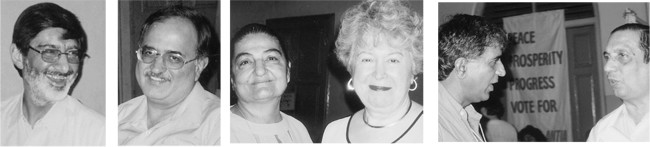
L to R : Zeree Jehangirji, Zarir Bha-thena, Manijeh Irani and Gordarfrid Aresh, Randeria and Farrokh Sidhwa
A needling query by Kersi Randeria of AZA directed to Tirandaz regarding the small plot of about 20,000 sq ft in Andheri East, flanked on three sides by Panthaky Baug which was purchased by the BPP at a whopping three crore rupees, was parried by the latter saying, "Ask Burjorji. He negotiated the lease.” An irate Antia denied having anything to do with the negotiations. He said he only drafted the legal documents. The altercation that ensued between Tirandaz and Randeria had to be quietened by the organizers.
Insurance executive Maneck Dastur who chaired the meet had declared that members of the audience were restricted to one question each with total question time being 30 minutes. When five ques-tions from a single querist were put to the candidates and the time ran out, there were protests at the unfairness and criticism of the meet being "badly conducted.” Dastur apologized and YR’s Silloo Mahava intervened to ensure that all questions would be answered.
Election procedures
According to the policy and practice of the BPP a team of officials separate the ballot from the envelope which already bears a printed number which has been entered on the BPP register. They place a corresponding sign on each to link them in the event of any litigation during the three months following the election. When the counting is concluded, ballots and envelopes are locked into the ballot box which is then stowed in the BPP’s safe deposit vault. Alleged threats by an incumbent trustee to violate the secrecy of the ballot led some campaigners to seek to know what happens to the papers after three months of safekeeping. Trustees Minoo Shroff and Dinshaw Tamboly informed Parsiana that the BPP’s chief executive officer seeks the board’s official permission to destroy the papers. BPP CEO Behram Dastur further informed Parsiana that the papers are then shredded.
Between 10 a.m. and 1 p.m. on December 14, 2002, 382 votes had been cast. The next four hours, until the doors closed to the poll at 5 p.m., saw 194 votes trickling in. Furious at this waste of community resources (a substantial amount is spent in statutory advertisements as stipulated by the election scheme) when candidates were so unevenly matched, president of the election Rustom Hormuzdiar, who has been on the job since the past 10 years, felt some changes in the rules were mandatory. He suggested that a hike in deposits from candidates from the current Rs 500 to Rs 5,000 might deter frivolous candidature. (In the general elections, deposits are returned to the candidate if they garner a certain maximum percent of the votes cast.) Also, the demand for duplicate certificates necessitates 12 persons on call through the day of the election. At the last election held on October 26, 2002, 59 duplicate certificates were issued. This election saw 32 more issued at a cost of Rs 10 each. Hormuzdiar feels that this amount needed to be hiked to Rs 100.
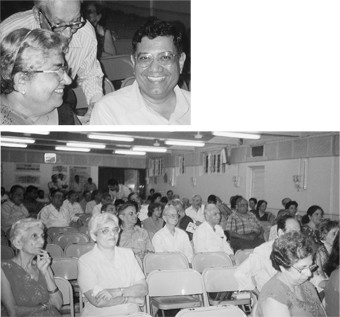
Mahava and Dastur and the audience at the Athornan Madressa
The last minute demand for duplicate certificates casts an oblique light on the level of responsibility of the Anjuman Committee (AC) members who vote for trustees. As it is, of an estimated 1,390 members now on the AC, only 776 (56 percent) voted in October and 576 (41 percent) in December.
While the BPP seems to be making no effort to expedite the passage of its revised election scheme through the Bombay High Court, the current AC whose seven-year legal term began in 1992 and ended in 1999 continues its increasingly lackluster performance. One may recall that a turnout of 1,237 members of a total of 1,604 (77 percent) had exercised their franchise at the first trusteeship election in March 1993 after the AC’s 802 elected members joined their 802 donor counterparts at the end of December 1992.
Parsiana’s interview with Antia will feature in the February issue.
◆ ◆ ◆
From the archive