
Sports
A coach and a gentleman
For over 30 years, the late Keki Tarapore molded the careers of many of India’s leading cricketers
The spectacular success of his protégé — Rahul Dravid, "Mr Dependable” — in the recently concluded India-England cricket Test series in England would have warmed the cockles of coach Keki Tarapore’s heart, had he been alive. With a career best double century (217) in the fourth Test, hard on the heels of a century each in the earlier two, India’s Man-of-the-Series Dravid, "the one-drop (number three batsman) from Karnataka became the fulcrum of the side, in fact its lifeline,” wrote Ayaz Memon in The Times of India of September 10, 2002. India’s vice captain as well, Dravid aggregated 602 runs from six innings!
Building his batting career brick by brick and sometimes referred to as "The Wall,” Dravid’s reaction on missing his first Test century at Lord’s in the 1996 series was: "It hurts, but it’s no good thinking about it.” "Something had to be done. So he consulted his coach, the late Tarapore, to iron out the defects in his technique. It was not so much his game but his temperament that seemed to be at fault,” observes veteran sportswriter K. N. Prabhu in "Placid Rock,” in Outlook magazine, September 16, 2002.
"I first met Tarapore as a 12-year-old boy when I attended the summer coaching camp at the KSCA (Karnataka State Cricket Association)... Tarapore always ran the nets very efficiently and watched over them with hawk eyes... Personally, he knew my game well and was always ready with a quiet word if he noticed anything wrong... He believed in my ability long before I did and was always pushing me to maximize my potential,” Dravid related his views to G. Krishnan, published as a press tribute shortly after Tarapore’s death in Bangalore on July 12 last year at the age of 78.
Many a famous face was seen paying their last respects — ace spin bowler Anil Kumble, speedsters Javagal Srinath and Venkatesh Prasad, veteran wicketkeeper Syed Kirmani and scores of others whose careers he helped to shape. Over a coaching career spanning more than 30 years, some of India’s most successful players — E. A. S. Prasanna, B. S. Chandrashekar, G. R. Vishwanath, Brijesh Patel, Roger Binny, etc — had the benefit of Tarapore’s guidance from their school and college days, as did scores of Ranji Trophy players. A life profile of Tarapore was forwarded to Parsiana on his first death anniversary by his son Shahvir, himself a one-day international (ODI) umpire on the umpires panel of the Board of Control for Cricket in India (BCCI).
From 1975-91, Tarapore was involved in the conduct of the BCCI’s annual national summer camps held in Bangalore and Bombay, when Hemu Adhikari was the national coach. The parade of cricketing talent at these camps included Kapil Dev, Wisden’s "Indian cricketer of the century,” Mohammed Azharuddin, Ravi Shastri, Navjot Sidhu, Shivlal Yadav and many others.
"He (Tarapore) helped me in the early ’90s when I could not get my outswing going,” asserted Srinath at the time of Tarapore’s death. "He sorted out that problem. Later, he used to call me regularly and give me advice before each series...: ‘Sri, watch out for overstepping. There is nothing more unpardonable than dismissing a batsman and then being called for no-ball.’”
"(Tarapore) was the one who asked me to take up wicketkeeping in my school days. He encouraged me and backed me every single time,” opined Kirmani. Stated Binny: "I used to play a whole lot of other games, but Tarapore believed that I should concentrate on cricket. He did not just let that go. He would call up regularly and enquire why I missed practice... and ensure that I did not miss a single match.”
"If you come to play cricket, look like a cricketer,” Tarapore advised his young wards, setting the lead by being in white himself, with neatly polished white shoes even at practice. "It was a common sight to see him perched on his scooter with his dark glasses and leather gloves on, following inter-school, inter-club, junior and senior cricket. He moved from ground to ground, religiously watching... The following day he would recall in detail (without resorting to notes) the errors made by the cricketer. In the 10 years I trained under him, I cannot ever recall his having raised his voice,” stated well-known sports writer Vedam Jaishankar in a lengthy tribute entitled "Coach par excellence” published in The Indian Express of July 15, 2001. On days when practice was not possible due to wet conditions, Tarapore would devote the time to the rules, traditions and the spirit behind what is known as the ‘gentleman’s game.’
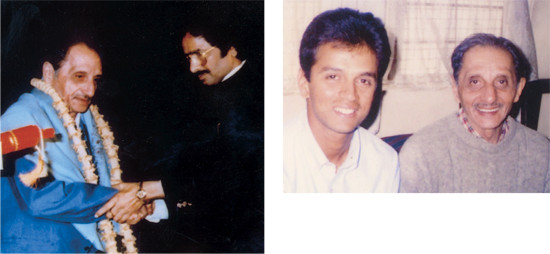
Tarapore (far left) receiving the Rajyotsava Award from the then Karnataka chief minister Bangarappa and (above) with Dravid (left)
Ailing for the last few months before his death, Tarapore’s left toe and later the leg itself had to be amputated. "Tarapore was really a tough man and the courage and strength he showed during the death of his younger son Kaizad (a promising cricketer who died of hepatitis at the age of 26) and the way he handled the tragedy was unbelievable,” recalled Dravid in his tribute.
Born in Indore on October 11, 1922, Tarapore’s early years were spent in Lahore in pre-Partition India where his father Bezon worked for the Singer company. The family later moved to Bangalore where Tarapore’s brother Dinyar played as a left arm spinner in Mysore junior cricket, while sister Jer was a Mysore state table tennis champion in the ’50s, states Shahvir. Keki’s own cricketing debut in 1945 in the Ranji Trophy for Mysore turned out to be an unfortunate start and he was allotted the role of drinks (twelfth) man for five long years! Opting for a career in coaching, the Mysore State Cricket Association (later the KSCA) sent him along with a few other Mysore players for a three-week coaching stint at Bombay’s Brabourne Stadium under the legendary Prince Duleepsinhji. "What I learnt in those three weeks I don’t think I’ve ever picked up in the whole of my life,” recalled Tarapore later.
In 1960, Tarapore was appointed official cricket coach under the Rajkumari Sports Coaching Scheme [which later evolved as a National Institute of Sports (NIS) scheme] and was posted at Jaipur. A transfer back to the Garden City (Bangalore) followed, first through the NIS and then through the BCCI. During 1970-71, Tarapore was the chief coach in cricket at the NIS headquarters in Patiala, states Shahvir. The "well-known and much loved” cricket teacher was in charge of the Karnataka Ranji Trophy state team nets for almost 30 years, during which time Karnataka won the national championship three times — in 1974, 1976 and 1983.
"His (Tarapore’s) decision to make cricket coaching his profession must have come as a surprise even to his close associates in those days,” stated one of India’s most successful bowlers Chandrashekar in an emotional recollection published in The Sunday Express of July 22, 2001. Karnataka cricket teams are known for their discipline, wrote Chandrashekar adding that Tarapore’s contribution here "has to be written in letters of gold. Yet another remarkable thing was his focus on fielding... He would not let you go till you took a catch in a particular style and in a particular position. And you just could not escape him if you had the misfortune to make an erratic ‘pick up and throw,’” penned Chandrashekar, adding that Tarapore’s "wonderful pep talks” benefitted him at various stages of his career. Dravid’s evolution as a seasoned slip and close-in catcher is a vindication of Tarapore’s continued efforts to drill into his students the basics of cricket.
Tarapore’s life partner Nargis has also devoted a lifetime to children, being a teacher of Hindi at the Sophia High School in Bangalore for 35 years, states their daughter Kashmira Bose, proudly pointing out that a Parsi teaching Hindi for so many decades and that too in south India is no mean feat! "Our father has been the inspiration behind our family,” states Shahvir who has so far officiated as umpire (on field) in three ODIs, India versus New Zealand at Hyderabad in 1999, India versus Australia at Visakhapatnam in 2001 and India against Zimbabwe at Mohali in March 2002. Shahvir has also been a TV and reserve umpire. Having played for Karnataka as a leg spinner in the Ranji Trophy between 1980-86, Shahvir now plays for Syndicate Bank where he is employed. Being on the all India umpires panel, Shahvir keenly looks forward to the time he can officiate in Test matches as well.
President of Bangalore’s United Cricket Club till a few months before his death, the Karnataka Government honored Tarapore with its Rajyotsava Award in 1991 for his dedicated services to the cause of cricket. In February 2001, a benefit match raised Rs 10 lakhs for the ailing coach, with Dravid and Brijesh Patel (now chairman of the BCCI selection committee) being the main driving forces behind it. "I cannot think of a more deserving person for the Dronacharya award (for coaches) than him,” Dravid stated. "He commanded respect and didn’t demand it... I think getting coached by Tarapore at such an early age was one of the luckiest things that happened to me.”
◆ ◆ ◆
From the archive