
In Memoriam
“The complete cricketer”
Died: Pallanji (Polly) Ratanji Umrigar, 80, well-known yesteryear cricketer who had earned the respect of the sports fraternity during the 50 years he was involved with the national cricket team as player, captain, manager, chairman of the selection committee and as executive secretary of the Board of Control for Cricket in India (BCCI), at his residence in Bombay on November 7, 2006 following Non-Hodgkins Lymphoma.
Died: Pallanji (Polly) Ratanji Umrigar, 80, well-known yesteryear cricketer who had earned the respect of the sports fraternity during the 50 years he was involved with the national cricket team as player, captain, manager, chairman of the selection committee and as executive secretary of the Board of Control for Cricket in India (BCCI), at his residence in Bombay on November 7, 2006 following Non-Hodgkins Lymphoma.
Variously described as "the greatest Parsi cricketer,” "one of the most outstanding sportsmen of our times,” "palm-tree hitter,” Umrigar enjoyed the honor of having one of the gates at the Wankhede Stadium named after him as also a restaurant cum bar at the Cricket Club of India (CCI). The BCCI has the Under-15 tournament named after Umrigar. According to a Press Trust of India (PTI) report in the Hindustan Times of November 8, the most promising cricketer of the year from this season will see the recipient get a cheque of five lakh rupees in Umrigar’s memory. BCCI president Sharad Pawar was quoted in The Indian Express, November 8, "As a national selector, manager of the India team, he had been hailed as a fair man with an incisive mind. He would figure in everyone’s all-time India team. His greatest contribution to Indian cricket came as an administrator when he steered the BCCI as its executive secretary at a most crucial juncture. It was the time when the Board was expanding its cricketing activities with the first flush of sponsorship money.”
"It was his love for the game and pride in donning the Indian colors,” that led Umrigar to devote his all to cricket even though he played in an era when cricketers were paid in hundreds, commented Minoo Shroff, chairman of the Bombay Parsi Punchayet (BPP) at the condolence meeting jointly convened by the BPP and CCI on November 29, 2006. Despite the "immense respect he commanded” and his "feats on the field” Umrigar remained "a model of self effacement,” added Shroff referring to "the three big joys in a Bombay Parsi’s life – his dog, car and cricket. Parsis have lost the best it has produced. I hope youngsters will be inspired to take to this game.”
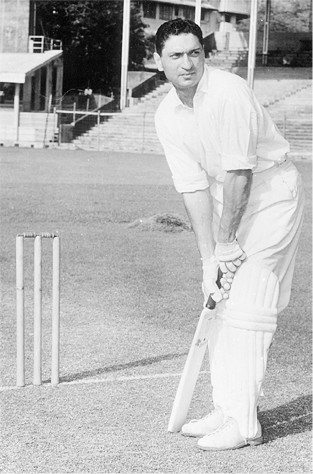
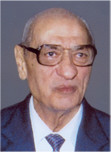
Umrigar in his heydays (above) and in recent times (top)
"When he retired in 1963 Umrigar had played in 59 Tests, the highest at that time, scoring 3,631 runs, also the highest, averaging 42.2. In the process he hit 12 centuries, then the highest, and 14 fifties, captured 35 wickets at an average of 42.08 and held 33 catches… (He) was the first Indian batsman to score a double century in Test cricket when he slammed 223 against New Zealand at Hyderabad in 1955-56… Truly a great all-rounder,” read the condolence resolution passed at the meeting referring to him "as the Bradman of Indian cricket as like Sir Don he held practically every important record in India during his heyday.”
He played "his first Test match against West Indies at Brabourne Stadium in December 1948 – the first official Test match played here,” reads the reverse of the menu card at Polly Umrigar’s Sportsman’s Bar which bears an introduction to this popular cricketer. In the eight tests he skippered from 1955-59 as India’s eighth captain, India won two matches, lost two and drew four. To him goes the credit of being the first manager on a tour abroad. He was also for some time the coach of both the men and women teams.
Some of the cricketers who had played on the same pitch as Umrigar reminisced about the giant among Indian cricketers at the condolence meet. "Dedication and application earmarked his cricket,” commended Nari Contractor who was Umrigar’s roommate when playing for the Indian team and recalled Umrigar’s daily morning prayer, "Eh Khuda, thora runs karaav (God, help me to get some runs)!”
His ability to take quick runs between wickets made former umpire Pilloo Reporter recall one occasion when after hooking the ball towards the boundary he went for his runs. He had completed his third run while his partner was panting at the start of the third: "I was wondering whether Polly could ever get run out.”
"I would like to remember him for his humanity, courtesy, humility, modesty, total lack of false pretentiousness,” mentioned Rusi Cooper who had played with him for the Pentangular series. Supplemented Mehli Irani who had played on the same team as Umrigar during their college days, for the Parsi Cyclists and the Kanga League, "He was totally disciplined and a great motivator of the game. He had great talent for leadership and a great understanding of the game.”
"He was a typical maidan cricketer but had not acquired the vocabulary of the Parsi cricket club!” exclaimed Madhav Apte who had played cricket with Umrigar in 1952.
Keeping track of Umrigar’s cricket career for nearly 60 years, cricketer Madhav Mantri referred to the strategies he deployed and made mention of his "parallel throws” which were his speciality as a fielder.
Author of many cricket manuals Kersi Meher-Homji of Australia wrote in his tribute, "When Indian cricketers were called ‘dull dogs’ in 1950s, Polly infused life into the game with his towering sixes…He was big in every way, in build and heart…Unfortunately One-Day Internationals came too late for him as he retired in the early 1960s. Else he would have been a striking success with his palm-tree hitting, nagging off-spin and sharp fielding.”
"Madhav Mantri and Polly Umrigar made cricketers of me,” acknowledged R. G. Nadkarni describing Umrigar as the "perfect all rounder…there are very few coaches like him who could demonstrate your faults.” With their surplus earnings, today Test cricketers may not know where to put their money. In those days Umrigar started a scheme because he was concerned about their future, appreciated Nadkarni. In fact the pension for retired cricketers was enhanced thanks to statistics provided by Umrigar.
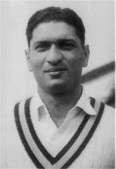
Umrigar: inspiration to cricketers
Former Test captain Ajit Wadekar who considered Umrigar his "idol” gave credit to the "complete cricketer” for giving him, then a novice, the impetus to take cricket seriously when he overheard a remark made by the veteran to his captain Vijay Manjrekar: "nallo saaru raméch (the youngster plays well).” As Wadekar further acknowledged, "What I did as captain was what I got from playing under Pollykaka.” Every match was important for Umrigar and he had been pulled up by Pollykaka for throwing his wicket after five-six runs in a benefit match and on another occasion for getting out in the last over in one Ranji Trophy match after making a good score.
As a groundsman his skill was unparalleled and as an administrator too he would be approached by his juniors for tips to improve their game. Former Indian captain Sunil Gavaskar was quoted in Hindustan Times (November 9), "His cricketing knowledge was second to none…Even if he wasn’t involved in a game but was only watching it, he would think of why a fielder has to be moved and when a spinner has to be introduced…” Noted former captain Dilip Vengsarkar, "He was my manager during my debut series against New Zealand in 1976. He was a father figure to me and had the best cricketing brain I ever experienced…” Always willing to share his knowledge and experience, when executive secretary of the BCCI, nobody was given the reply "I’m very busy.”
He had played a vital part in preparing the pitch at Wankhede and also at the Bandra-Kurla Complex. The indoor coaching school at the Wankhede Stadium too had received considerable impetus from Umrigar. When TV came to India in 1972 Umrigar had contributed substantially to enhance the popularity of a serial on how to play cricket. In later years he kept busy answering queries from upcoming cricketers, most often directed to Umrigar, on the website CricketforIndia.com
Sholapur born Umrigar’s early education and cricket practice was in that small town in Maharashtra. He completed his matriculation from Bombay’s Bharda New High School after which he graduated in science from St Xavier’s College. He was planning to do his MSc when Vinoo Mankad prevailed on him to join the League in Manchester, recalls Umrigar’s wife Dinoo. Among the teams for which he played during his younger days were Lord Northbrook, Young Zoroastrians, St Xavier’s, University of Bombay, Associated Cement Companies (where he was employed), Parsi Cyclists, Garware Club House. When he progressed to first class cricket he played for the Bombay squad in the Ranji Trophy and was a member of the West Zone team in the Duleep Trophy before he was selected as a Test cricketer.
On the eve of one of his international trips, shortly after he had been blessed with his first darshan of Meher Baba, Umrigar received a message from the saint stating, "You will do very well.” Though he was not then the captain, he did play very well. It was only later that they became Baba lovers, states Dinoo explaining how faith in Meher Baba’s teachings tided them over difficulties. Broad-minded Umrigar who happily welcomed his non-Parsi daughter-in-law into the family fold believed that children of Parsis who have married out of the community should be permitted entry to fire temples. For his funeral therefore the family decided to leave his body overnight in the Doongerwadi morgue, and allow his non-Parsi associates to pay their respects the next morning before proceeding with the traditional geh sarna ceremony in the afternoon.
The government of India conferred on him the Padma Shri in 1962. In the 1971-72 season, a benefit match for Umrigar was organized in Kolhapur by the Maharashtra Cricket Association. In 1989 he was named a Charles Burgess Fry beneficiary at Sharjah. He also enjoyed the distinction of being included as an honorary life member of the Marylebone Cricket Club. In 1998 he was presented the prestigious Col C. K. Nayudu Award.
On several occasions Umrigar was featured in the annual calendar brought out by CCI. Including him among "India’s best 12 all rounders (from 1932-2003)” the 2004 calendar describes him: "Fighter from hair to heel. Never gave anything less than 100 percent. Great batsman, best slip fielder India has produced who was also outstanding in the outfield. Utility bowler who in his younger days could bowl with a new ball, he bowled long spells as an off spinner and could surprise you with on spin as well. A dream man to have in any team and an outstanding captain himself...His contribution to the game of cricket is unparalleled.”
The cricket legend is survived by his wife Dinoo, sons Pesi and Fali, and daughter Shireen Dinyar Lala.
◆ ◆ ◆
From the archive