
Sports
“You win at your inconvenience...”
Yachtsman Farokh Tarapore is the only Indian to have won a world championship twice in different classes of boat
Big seas, small seas, riding his yacht over white horses raising their heads majestically, caught in the eye of a squall or becalmed in a windless sea, world champion Farokh Tarapore knows through 30 years of competitive sailing, that time and tide wait for no man.
"Yachting is as much a sport of the mind as of the body. You can’t control the wind, but you can trim your sails. Your mental toughness is as important as your physical fitness,” says the wiry, sun-bronzed helmsman who has won many a medal at international and national events (see "The winning formula,” Parsiana, October 1995).
Tarapore is the only Indian so far to have won two world championships in two different classes of boat — at the 1991 Worlds in Bombay in the Enterprise Class with Kelly Rao as crew, and at the 2002 Worlds at Tavira in Portugal in the 420 class, with Vikas Kapila crewing. "A world championship is a gruelling competition. You have to sail 15 races, including qualifiers. In Tavira, there were competitors from 24 countries who had come with coaches, costly equipment and tremendous support,” narrates Tarapore who is convinced that it was not just the desire but the belief that they could and would win that saw them in cruise control right up to the trophy.
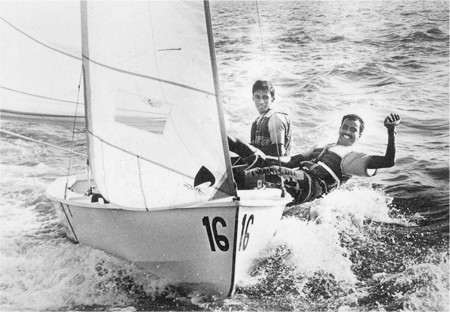
Tarapore (left) and Rao in cruise control
"At the post-win press conference, the Press asked whether we expected to win and they were astounded when we said ‘yes!’” he smiles. "We did not even have a coach. The 420 boat, which is half a meter shorter than the 470, is a new class in India and was introduced just a year before the world championships. The hull of the boat is Indian-made, everything else is imported. The two of us believed we could win this championship — it did not matter what other people believed,” he says. The conditions in Portugal were "nice and hot,” favorable to the Indians. "I like warmer places. In chilly conditions so much of your energy goes in fighting the cold,” he remarks. Fuelling their self-belief was a poster they made which had the Indian tricolor and the word GOLD in bold letters on it. Pasted on the outside of their apartment door, the poster, says Tarapore, carried a message not just for themselves but for others to imbibe as well!
With the 2004 Athens Olympics already on the horizon preparations have begun. Sailing in the Kiel Week (where they were placed in the gold fleet) in Germany in June this year, then the pre-Olympics at Athens in August and the world championships in Spain in September (which are one of the qualifying events) will serve to clear the deck for the country’s participation. "The overall expenditure until the Olympics is around Rs 75 lakhs. This year I’ll require at least Rs 30 lakhs and so far we have received not a penny. With the promised money not coming from the department of sports (Government of India) and also no sponsors willing to help, we have been pushed into a tight corner... I’m mostly doing administrative work when my job is to just sail,” Tarapore told Sunil Warrier of the Times News Network just before he left for the Kiel Week in June this year.
"World championships are held annually but the Olympics are special — they come but once in four years, countries’ pride and prestige are involved, people put in huge amounts of money. The Olympic Games are a high-pressure competition. Very few Indians even succeed in qualifying for them,” Tarapore said to Parsiana. With three Olympian experiences (Los Angeles in 1984, Busan in 1988 and Barcelona in 1992) already tucked firmly under his sail, Tarapore is not daunted by the fact that the Olympics are a very, very tough test. You can’t go into a major competition if you are afraid of losing. There is only one reason to go and that is to win, he believes.
Risks inherent in yachting do not daunt him. Well aware of the power of wind and waves or a possible May Day situation, Tarapore admits he has had "a few close calls” and though rescue boats are present, rescuers are sometimes caught in trying to extricate themselves from a storm.
Tarapore’s boat-handling skills have seen his trophy cupboard fill with medals of every hue, won at national and international regattas in Europe, South Africa, Middle East and Far East since 1974 in several classes of boat — Cadet, Enterprise, Fireball, Seabird, J24, 420 and 470, with the 470 having fetched him maximum medals. At the 1982 Asian Games, with the yachting events being held in his own backyard, Bombay, Tarapore struck gold with Zarir Karanjia as crew. Four years later came silver in South Korea at the X Asian Games with Dhruv Bhandari; in 1990 in Beijing it was a bronze at the XI Asian Games with Cyrus Cama crewing, followed by another bronze in Japan at the XII Asian Games with Kelly Rao. The Pusan Asian Games in 2002 were a disappointment, with Tarapore and Kapila finishing just a point behind the bronze medallists. "I like to have different crew for different classes. Factors like height, body weight, etc vary for the type of boat,” he observes. Currently, he has paired with Lt Amit Arvind to sail for India in the 470 class.
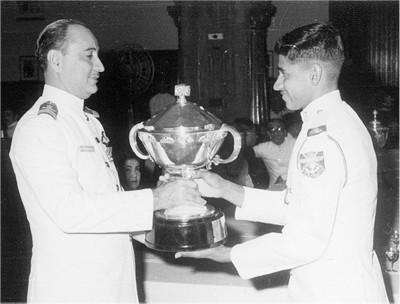
Tarapore (right): doing the Navy proud
The Yachting Association of India’s "Yachtsman of the Year” in 1986, 1991 and 1994, Tarapore was honored with the Arjuna Award (the highest sports award in India) in 1982 and the Shiv Chhatrapati Award (the highest in Maharashtra state), in 1985. His employers, the Indian Navy (IN), presented him the Vishist Seva Medal in 1983.
Seduced by the sea even as a schoolboy (St Sebastian and Don Bosco in Bombay), Tarapore joined the National Defence Academy (NDA) at Khadakvasla, graduating (through the Academy) with a BSc degree from New Delhi’s Jawaharlal Nehru University. "I learnt a lot from those fantastic years. At the NDA they push the physical limits to the utmost,” he declares. He then joined the IN. "My passion was to compete (in yachting) and I could see me living my dream through the avenue of the Navy. They played a huge role in support. I had a great time,” recollections animate the mariner’s face. Tarapore retired in 1996 as Commander from the IN.
Tarapore acknowledges the role of the department of sports which has enabled him to set sail at many a competition. "It’s easy to sit around and complain, but I’m no complainer. They (the sports ministry) too have their own challenges. There are different sports disciplines which require support. Everything has to work on a budget. If issues are not resolved to your satisfaction all the time, you have to live with it.” Private or corporate sponsors can do much to build a bridge over troubled waters as far as finance is concerned, he believes, bemoaning the fact that in India sailing hardly attracts any sponsors despite Indian yachtsmen having done exceptionally well in recent years. Often putting in money from his pocket, Tarapore anxiously awaits sponsors in the run-up to the Olympics.
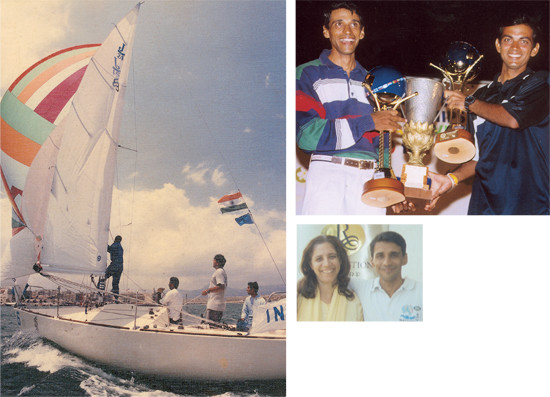
Smooth sailing in the J24 (far left) ; Tarapore and Kapila (above) with world championship trophies in Portugal; Anahita and Farokh
"In the lives of sports persons who have carried their sport to the extreme, there are often imbalances. You need to balance the three legs of the tripod — family, finances and your sport. Take one leg away and the tripod falls. I certainly would not like to suffer the fate that has befallen some veteran sportsmen in India — don’t want to be sitting on the roadside with a vegetable cart, the Arjuna Award and contents of the trophy case!” Tarapore’s dry humor surfaces. While money is important, there should be no compromise, asserts the seasoned campaigner who strongly supports drug testing to keep the sport clean and prevent what he terms "blatant cheating.”
Farokh and his wife Anahita teach people the principles of success and its application to life and work. "In order to succeed you have to decide you want to succeed. My passion is winning, yachting is just a vehicle. I would have found a way to excel in Formula I, if I were in it!” he declares, admitting however that people’s perceptions change with the passage of time. Anahita touches upon Farokh’s even keel: "Win some, lose some, Farokh takes everything in his stride. I get more happy about his victories and unhappy about his losses than he does!” Accompanying him to competitions whenever possible, Anahita smiles: "When I married him I didn’t know the front of a boat from the back.” Now, spinnakers, luffing, tacking, hiking are everyday acquaintances! Farokh’s parents Faramroze and Coomi have emigrated to New Zealand and live in Auckland where his brother Porus also resides. Sister Silloo lives in Sydney.
Steering clear of community controversies, the seafarer remarks that he is "nobody to comment on” issues like inter- marriage, dokhmenashini, etc which he terms "personal matters.” He believes there are few Parsi boys today who join the IN; the numbers in the merchant navy may be slightly higher. His philosophy for youth is: "If you want to win you have to get out of the comfort zone. You win at your inconvenience, not convenience. Winners are not born, they are made.”
◆ ◆ ◆
From the archive