
Sports
“The best seat in the game”
A member of the International Cricket Council’s panel of umpires, Shahvir Tarapore recently officiated in the Men’s and Women’s T20 World Cup in the West Indies
He is on the Emirates International Panel of ICC (International Cricket Council) Umpires, officiating at One-Day International (ODI), Twenty20 (T20) and Test matches. "I umpired in 12 matches in the Men’s T20 World Cup in the West Indies in April-May, as well as the Women’s ICC World T20 tournament, as on-field and TV umpire,” says Shahvir Tarapore of Bangalore. "An international tournament provides a great opportunity to experience different pitches, partner with umpires from different parts of the world and learn from their experiences.” Umpiring gives you the best seat in the game! he chuckles.
The Emirates International Panel comprises two officials nominated from each of the 10 Test playing cricket boards. The ICC website icc-cricket.yahoo.net mentions Amish Saheba and Tarapore as the two umpires from India, with Sanjay Hazare designated as the third (TV) umpire. Tarapore was first appointed to the ICC panel as TV umpire in 2008 and elevated to on-field umpire in 2009. He has officiated in all the three IPL (Indian Premier League) tournaments held respectively in India, South Africa and India. In Tests, he has umpired so far as TV umpire. Tarapore is also a level two umpires educator with the Board of Control for Cricket in India.
Umpires in their hats and coats standing stoically for long hours in the sweltering sun are very much a part of cricketing legend, but the arrival of the omnipresent television camera has infused their task with unexpected bouncers! Decisions arrived at in a split second with the naked eye, amidst the din and distraction of screaming spectators, often go for a toss when giant screens replay and dissect events of a millisecond! Tarapore believes all umpires will make mistakes some time or the other as to err is human, but the important thing is to learn from one’s mistakes and not repeat them. "The challenges are many in all formats of the game (Test, ODI and T20). The umpire’s physical fitness, the playing conditions, application of rules and many other aspects are important for the smooth conduct of the matches,” he declares.
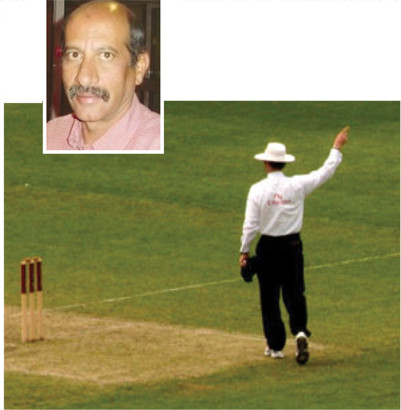
Shahvir Tarapore (inset and in action): standing inter-nationally Photo courtesy: Zee news
Close views also mean taking tough calls! On May 6, 2010, Pakistani player Javeria Wadood "was reported during the Women’s World T20 in St Kitts for having a suspected illegal bowling action,” states the ICC website. The right-arm off-spinner was reported after the Pakistan v Sri Lanka match by on-field umpires Rod Tucker and Marais Erasmus of the Emirates International Panel as well as third umpire Tarapore. "We believe that Wadood straightens her arm during her delivery and appears to be more than the allowable 15 degrees. It is in all deliveries, not one specific delivery. We therefore request the necessary action be instituted to deal with this matter,” the three umpires’ report stated. Wadood later left for Australia to have her action scrutinized by an independent ICC approved authority.
In December last year, "the on-field umpiring pair of Tarapore and Erasmus deemed the pitch to be ‘dangerous’ due to its ‘extremely variable bounce,’” and stopped the fifth ODI between India and Sri Lanka at the Feroz Shah Kotla ground in New Delhi, casting a cloud over its suitability to host the 2011 World Cup matches, reports www.cricinfo.com
With the media oscillating from praise to prejudice and controversy almost becoming cricket’s second name, umpires’ tasks have become that much more difficult. Tarapore does not think it is a thankless job. "It is a job like any other with the same challenges. I like doing it and yes, correct decisions are never given credit and mistakes get excess attention but that is part of the job and I accept it,” Tarapore had told The Hindu reporter back in November 2008. His role models, he says, have been well-known umpires David Shepherd, Harold "Dickie” Bird and S. Venkataraghavan.
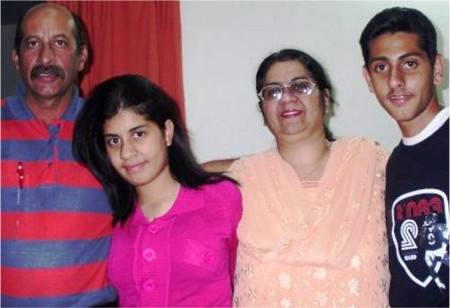
The Tarapore family (from left): Shahvir, Mahafreen, Hutoxi and Behzad
A player himself, Tarapore bowled leg-spin but with his home state Karnataka fielding a strong squad in the ’70s and ’80s, finding a place in the team was tough. He quit playing at the first class level in 1987. "I took to umpiring so that I could stay in the game,” he states. In the early ’90s he became part of the Ranji Trophy umpires panel and later the all India panel. His first opportunity of officiating at an international series in India came in 1999. "Shahvir, like his father the late Keki, came up the hard way. Keki had represented the then Mysore state in a few Ranji Trophy ties but soon took over the mantle of a coach and helped shape the careers of well-known Karnataka and India players like B. S. Chandrashekhar, Syed Kirmani, Roger Binny, G. R. Vishwanath and Rahul Dravid,” Phiroze Bharda, honorary secretary of the Bangalore Zoroastrian Association, the cultural wing of the Bangalore Anjuman, wrote to Parsiana. "The Parsis of Bangalore were delighted to see one of our own officiate in the India-Australia series (ODIs held in October-November 2009 at various centers like Baroda, Nagpur, Delhi, Hyderabad, Guwahati...) Plaudits poured in as Shahvir’s on-field duties were appreciated and favorably commented upon by no less a person than Sunil Gavaskar, as well as Ravi Shastri. Two other cricket umpires, Piloo Reporter and Dara Dotiwalla, have served the cause of national and international cricket with great distinction and this, considering our small numbers (Parsis in India), is truly remarkable, Bharda adds. The Bangalore Zoroastrian Association accorded Tarapore a fitting felicitation at their Pateti celebrations last year.
Tarapore expresses his appreciation of the role played by his parents, wife Hutoxi and children Behzad and Mahafreen. "They have had to bear my absence from home for long periods of time. They have accepted the fact that it is part of my job,” he declares.
Tarapore is grateful to his home state’s and other cricketing officials as well as his umpiring colleagues for their encouragement and support. A logical step forward is the elevation to the Emirates Elite Panel of ICC Umpires and Referees, subject to training and regular reviews of work by the ICC. If he can get there, he believes, it will be a great moment in his life.
◆ ◆ ◆
From the archive