
Sports
Cricket and camaraderie
The XVII Jiji Irani Challenge Cup Pentangular Cricket Tournament organized by the Nagpur Parsi Gymkhana from November 2-6, 2002 provided five days of interesting cricket and sporting camaraderie between hosts Nagpur and teams from Jamshedpur, Calcutta, Secunderabad and Surat.
Instituted in 1975 in memory of Jijibhoy Irani, a keen cricketer and hockey player in his day, in the first year the Tournament had just two competing teams, Nagpur and Jamshedpur. Four years later Secunderabad joined, making it a triangular. Then came Calcutta and the last to join was Surat in 1991, making it a ‘Pentangular.’ Feelers have been sent from Bombay to join the jamboree but ‘Hexangular’ doesn’t sound quite as sporty as ‘Pentangular!’ Whether or not to include Bombay is a decision the Tournament committee will make.
Director of Tata Sons Dr Jamshed Irani and his wife Daisy came to Nagpur, the city of his birth and early upbringing, to inaugurate the Tournament on November 2, 2002 making the occasion a very special one. It was not just another cricket match; it was cricket with a ‘P’ — Parsipanu and perfection. Jamshed, Daisy and Jamshed’s sister Diana Hormusji were escorted to the festive pandal by Shiraz Gimi, president of the Gymkhana and Shiraz Doongaji, Tournament secretary. Mazda’s Children (tots to pre-teens) in white T-shirts emblazoned with the seven ameshaspands sang a welcome in Gujarati, after which Ervad Sohrab Bharucha led the gathering in hambandagi. Khursheed Dalal, the mistress of ceremonies, introduced the Iranis.
In his brief speech, Dr Irani thanked the organizers for the hard work put in to keep the Tournament going through the years. "Youth and the game of cricket were two things closest to my father’s heart. Holding these matches in his name must really please him.” Declaring the Tournament open by lighting a divo, Irani said, "Let the games be played in healthy sportsmanship.”
Five pretty girls bearing team placards led each team whose members were then introduced to Irani. Cricketers of yesteryear, most over the age of three score and 10, were introduced and honored with a bouquet of flowers.
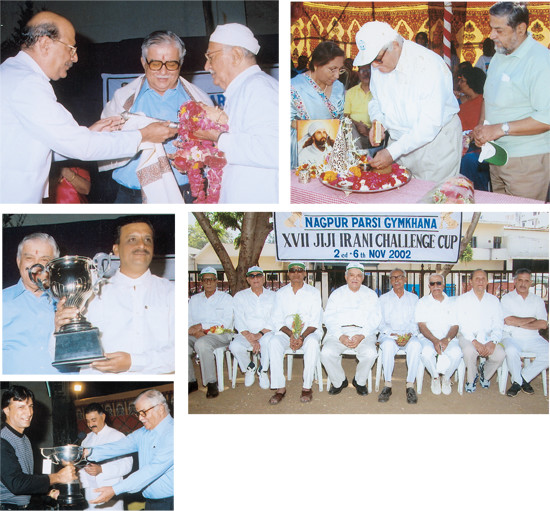
From left, top row: Edul Bhagwagar (left) presenting Irani the silver scroll as Pavri (right) assists; Irani lighting the divo at Tournament inauguration as Mehroo Watchmaker and Gimi look on. 2nd row: Chipia (right) raises the Jiji Irani Cup; Irani (fourth from left) with cricketers of yesteryear. 3rd row: Noomi Mehta (left) receiving the Aibara Trophy (Right bottom) Former Indian women’s cricket captain, world record holder in women’s Tests and present selector Diana Edulji (below, right) receiving the Castrol Lifetime Achievement Award for contribution to women’s cricket from Brijesh Patel, chairman of the selection committee of the Board of Control for Cricket in India. Edulji received the Castrol Trophy and a cash award of one lakh rupees at a function on October 16, 2002 in Madras
As Irani strode to the field to bowl the first ball, a black and yellow aero model plane flew in graceful circles around the guests before showering the opening bowler and players with red rose petals. The aero model was precision-flown by Zubin Khambatta who handled the remote control. Simultaneously, gas balloons were released into the morning sky in a colorful opening ceremony.
The matches were played on an "all-play-all” basis, each side playing 30 overs per match. On the opening day Nagpur made a winning start beating Secunderabad by nine runs. Man of the Match Jamasp Bapuna took three wickets and scored 17 runs. In the other match, Calcutta beat Jamshedpur by nine wickets, Jehan Mehta top scoring with 74 runs.
Surat outplayed Nagpur by eight wickets, racing to the target in 11.3 overs. Batting first, Nagpur made 114 runs before being all out. Danush Doongaji top scored with 40 runs. Rustom Sethna of Surat was declared Man of the Match.
Secunderabad defeated Jamshedpur by 175 runs. Man of the Match Varzavand Debara cracked a century as Secunderabad made 287 runs for the loss of six wickets.
In the last two matches, Calcutta defeated Nagpur by six wickets while Surat snatched victory over Secunderabad by a mere seven runs.
Surat romped home with the coveted Jiji Irani Challenge Cup, securing 16 well earned points by winning all their four matches. Calcutta, Secunderabad and Nagpur scored eight points each but Calcutta was adjudged second by virtue of a better run quotient, edging out Secunderabad and Nagpur, who stood third and fourth respectively. Jamshedpur lost all their matches to end up fifth.
The Iranis came to Nagpur once again for the prize distribution and felicitation function on November 6. Gimi, after welcoming the chief guest and other dignitaries, requested the gathering to observe two minutes’ silence in memory of Beji Bulsara, who passed away a few months ago. Bulsara was the popular and much loved president of the Calcutta Parsee Club and an enthusiastic member of the Calcutta cricket team.
Shiraz Doongaji announced the names of the prize winners. The captain of the Surat team Mehernosh Chipia was the proud recipient of the Jiji Irani Challenge Cup, Calcutta team captain Noomi Mehta received the Eddie Aibara Runners-Up Trophy. Homiar Dumasia was awarded the late Eruch Pundole shield for the Man of the Series. Rayzad Bulsara of Calcutta and Burzin Mehta of Nagpur received Best Batsman of the Series. Noshir Mehta of Secunderabad was adjudged Best Bowler of the Series, while Zarayus Sethna of Surat bagged the prize for the Best Wicketkeeper of the Series. Danush Doongaji of Nagpur and Yim Dotiwalla of Jamshedpur were given the Aibara trophies for the most promising youngsters of the Tournament.
Starting from this year a special trophy has been instituted by Calcutta in memory of Bulsara, to be given to the most sporting team. The trophy in its first year went to Secunderabad.
Later the same evening, the Shree Nagpur and Kamthi Parsi Zarthosti Anjuman and the Nagpur Parsi Gymkhana felicitated Irani. On the Dharamshala lawns he was welcomed with a traditional aachu meechu by the honorary secretary of the Gymkhana, Mehroo Watchmaker. Presenting Irani a shawl and silver scroll, Nagpur Anjuman president Edul Bhagwagar stated that when Queen Elizabeth II bestowed the title of Sir on Irani it was "not just Jamshed who rose in pride. It was his family, his friends and the Parsi community around the world that rose in pride.” The accompanying citation read by Anjuman honorary secretary Yezdi Bhagwagar noted, "We are immensely proud of Jamshed who has grown up with us but grown taller than all of us.”
Despite his multifarious achievements Irani is a "totally unpretentious man,” said Shernaz Daver in her introductory remarks. "What endears him to the people of Nagpur is the way he reaches out to old friends and neighbors, respects and remembers his teachers... and is ready to help people if he can.”
While Gimi honored Irani on behalf of the Gymkhana, Dr Mehru Dadachanji, managing trustee of the J. N. Tata Parsi Girls High School offered felicitations on behalf of the School. Ervad Hormuzdiar Pavri, fomer panthaky of the Napgur agiary, released the special souvenir.
Apart from cricket and camaraderie, the Gymkhana put up varied programs every evening of the Tournament. Aali Fui Aaya a three-act Phiroze Antia natak in Gujarati, ably directed by Daver, had the audience in the packed Tata School Hall rollicking in their seats. It was a comedy of errors, of hen-pecked husbands and dominating wives, of Behram the inevitable Irani house boy and the grand entry of Aali fui from Karachi into their ordinary, everyday lives. While every member of the cast played their role to perfection, Khursheed Dalal as the imposter Aali fui and Narges Major as the real fui could be nominated for an Oscar!
One evening was given to a presentation of dances by as many as 50 members of the community, ranging in age from five to 85 years. Part of the program featured Western dances down the ages. It had grandparents doing the graceful waltz, followed by square dancing, jiving, cha-cha and the limbo by the little ones. Tauby Bhagwagar, Jerestine Watchmaker and Delzad Chinoy choreographed the dances. Nine-year-old Rukshin Watchmaker gave a flawless commentary.
The medley of Hindi film dances started with Saigal’s slow and sedate Diya jalao and went on to foot-tapping numbers like Mera naam hai Chin-chin-chu, Sara zamana hasino ka divana, Koi kahe, kaheta rahe and many more, choreographed by young Parizad Daver. The program ended with a vibrant and colorful Rajasthani folk dance "Dholna.” Other evenings were enlivened by team games and cooking and rangoli competitions.
Dilnavaz E. Bhagwagar
◆ ◆ ◆
From the archive