
Books
Feedback On Fiction
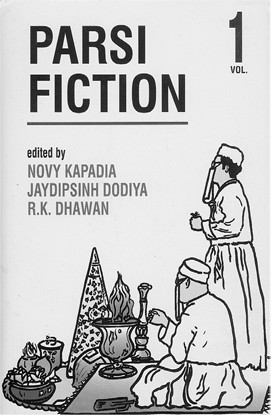
Parsi Fiction Volumes 1 and 2 edited by Novy Kapadia, Jaydipsinh Dodiya and R. K. Dhawan. Published in 2001 by Prestige Books, 3/28 East Patel Nagar, New Delhi 110006. Pp: Vol 1-268, Vol 2-270. Price: Rs 1,000.
Parsi Fiction edited by Novy Kapadia, Jaydipsinh Dodiya and R. K. Dhawan is a collection of critical essays in two volumes dealing with the contribution of Parsis to literature. The essays fall into three sections: the first provides the reader with valuable information about the community and the Zoroastrian faith; the second, with the broader aspects of Parsi fiction; and the third, which constitutes the largest section of the book is devoted to individual critical essays on different Parsi novelists. The main novelists discussed at great length are Firdaus Kanga, Rohinton Mistry, Bapsi Sidhwa and Dina Mehta; Boman Desai, Ardeshir Vakil, Meher Pestonji and Keki Daruwalla are given somewhat summary treatment.
Parsi writers have been a constant feature in the landscape of Indian-English literature. The poet Behram Malbari’s The Indian Muse in English Garb was published as early as 1877 and Cornelia Sorabji’s collection of short stories, Sun Babies, in 1904. Whereas these writers expressed themselves in a conscious manner and were generally interested in home-spun ideas and Indian characters, the second generation of Parsi novelists who have started writing in the last two decades of the 20th century are more concerned with the Parsi sense of identity; they use the language with a verve and vitality and occasionally with a great deal of linguistic experiment. In the Foreword, Lt Gen Adi M. Sethna speaks about the "technical craftsmanship and facility of prose which have caught the modern reader’s fancy.” Though most of the novels have been very competently written and the literary craftsmanship is sometimes innovative as in Desai’s The Memory of Elephants, one has to unwillingly admit that the main interest of the reader more often lies in the idiosyncrasies and the touch of exoticism associated with the community. Most writers have exploited this in their work with varying degrees of success.
The first section of critical essays deals with the Parsis and their religion. Kapadia’s "The Parsis: An Introduction” gives the reader who is unfamiliar with the community a basic background of its beginnings in Fars, an ancient province now in southern Iran. He dwells at great length on the life and teachings of Zoroaster and the arrival of the Parsis in India. The religious belief and the historical perspective are cogently examined. However, much of the religious background covered by Kapadia in the introduction is repeated in succeeding essays with minor variations or in greater detail. A chapter entitled "Getting to Know Parsi Zoroastrians” is very comprehensive, but while reading it one feels that the same ground has already been covered in the previous essays and that much of the information is needlessly repeated.
A much-needed change of focus is provided by Amalendu Guha in his essay "The Role of Parsi Entrepreneurs:1750-1850,” which describes how the Parsis congregated in Bombay, initially as a means of trade and commerce and later for industry and the role they played in the flourishing opium trade. He attributes their rapid success in business not only to the absence of the caste factor but also to their phenomenal ability to adjust to changing political scenarios free from social constraints. As a result family businesses blossomed into partnerships with Europeans, Hindus and Muslims.
No information on the Parsi community would be complete without an essay on its dwindling numbers and Rustom Gae examines this in "Causes and Effects of Decline in Parsi Population.” The statistics are used selectively and alarmingly: the population which in 1930 was 110,000, is less than 70,000 in the year 2000 and by 2025 there will be only 25,000 Parsis accounting for 0.02 percent of the expected population of India. The problem of interfaith marriages, the status of children of Parsi women married outside the community, marriage at a late age have all been cited as causes for the decline in the population. It is not merely the causes and the effects of the population problem which are thoroughly discussed, but a serious effort has been made to suggest steps which have to be taken to improve the situation. Drawing attention to the problems the community is facing, Gae makes a fervent plea for reform and particularly for abandoning old customs and traditions, especially those which have become redundant over a period of time.
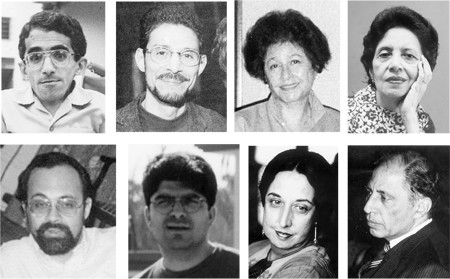
L to R (1st row): Kanga, Mistry, Sidhwa and Mehta (2nd row): Desai, Vakil, Pestonji and Daruwalla
In "The Theme of Marriage in Parsi Fiction,” the same problem is discussed with reference to novels written by Parsis. The theme of interfaith marriages is examined in different novels from Perin Bharucha’s The Fire Worshippers (1968) to Sidhwa’s An American Brat (1994). In an early novel like The Fire Worshippers mixed marriages are objected to, as these were the harbingers of the total disintegration of the community. Kapadia shows how Ava Khullar’s view that among the Parsis there is a complete lack of societal censure or shock at the unmarried state is prevalent in a character like Sera, in Kanga’s Trying to Grow. Sera is not bothered by the fact that she has a working daughter who is old enough to be a bride and is yet unmarried. In an analysis of "Exercises” (Tales from Firozsha Baug) by Mistry, he shows that very often parents themselves push their children into interfaith marriages by not being supportive of the choices they have made within their own community. Coupled with this is a morbid and predominant fear of sex as in the case of Jeroo who is so protective of her daughter in Trying to Grow that she unwittingly pushes her into the arms of a Hindu boy, Rohit.
In his essay on "Power, Politics and Politicians in the Parsi Novels” R. S. Pathak attempts to evaluate the Parsi response to great national events and political movements and their attitude to some well-known politicians. The essay, based on a close study of selected novels, comes to the conclusion that on account of their minority status and the fact that they were so outnumbered by the Hindus and the Muslims, the Parsis were by and large non-political. However, A. K. Tripathy divides post-Midnight’s Children authors into two groups: one concerned with fictional technique and another with historical and social realities. Though he places Kanga in the first group, Kanga does not really fit into either as he neither experiments with form nor does his vision encompass any political point of view. After a lengthy analysis of the characteristics of the two groups, Tripathy sensitively depicts the political background in Mehta’s And Some Take a Lover, where he poignantly presents Roshni’s struggle, tracing her development from a romantic girl to a woman who after the loss of her lover prepares to face life with the challenge of having nothing, not even hopes.
Most of the essays on individual authors examine the writers from a postcolonial point of view. These essays examine the cultural displacement of the community from Persia to India in the 1300s and then the second dispersion from India to foreign countries. Both these contributed to a sense of angst and an identity crisis which the novelists explore and this is an area which has been examined very thoroughly in many of the essays in this book. Latha Ren-gachari examines An American Brat from the complexities of being a Parsi, being a Pakistani and then migrating to the West burdened by both these identities. The confusion between the land of birth and the land of habitation has been examined in the fiction of Mistry as well. Of the short stories, the one most prominently studied is "Lend Me Your Light” (Tales from Firozsha Baug) and the position of the immigrant writer portrayed as Tiresias "throbbing between two lives” is used as a classic case of post-colonial angst in "The Mystery of Mistry as Tiresias” by S. Rama-swamy. Savita Goel studies the theme of displacement and the need to forge a sense of identity in "Lend Me Your Light,” "Swimming Lessons” and "Squatter” (Tales from Firozsha Baug) where characters try, often unsuccessfully, to achieve a new sense of identity in their adopted countries. Goel also draws our attention to the same theme of displacement and the need to belong in Mistry’s A Fine Balance, reflected in the plight of the two cobblers who have been forced to leave their villages and migrate to the city, and to abandon their profession of cobblers to become tailors. Goel analyzes the character of Dina Dalal who chooses to be displaced from her home to assert her individuality and sense of self and of Maneck Kolah who is displaced from his quiet home in the hills and has to make a new life in the urban and bustling metropolis of Bombay. The postcolonial and dia-sporic element in Mistry’s fiction is once again carefully examined in essays by Charu Chandra Mishra and by Sumita Pal, and in essays by Suman Bala, Dodiya and Indira Bhatt in Sidh-wa’s novels.
Rahul Sapra examines Sidhwa’s novel from a postcolonial perspective particularly from the point of view of Parsis and their involvement with the politics of Pakistan. He also discusses the question of a postcolonial writer using the language of the colonizers and quotes the Kenyan novelist, Ngugi wa Thiongo who believed that an author should enrich his own language. Like the Nigerian Achebe, Sidhwa alters English by the introduction of local words and expressions, thus subverting the language for her purpose.
N. S. Dharan sees ethnic atrophy as a predominant theme in the novels of Mistry, an atrophy expressed in the depiction of the dwellings, the crumbling ceilings, the leaking toilets, peeling plaster and the cultivated insularity of the community. Mishra sees a pattern of resistance in the work of Mistry, particularly in the efforts of the main characters in Such A Long Journey to subvert the workings of the powerful, which is likened to Edward Said’s second stage of anti-colonial resistance.
However, not all the essays are filled with postcolonial diasporic dilemmas and literary jargon. Many essays discuss broad themes and portrayal of character and eccentricities in the novels. K. V. Surendran sees Trying to Grow as a vibrant depiction of Parsi life and traditions with their eccentricities, passion for food, innocence in matters of sex, custom of celebrating two birthdays and love marriages. Purvi Upadhyay concentrates on the entertaining aspects of Sidhwa’s The Crow Eaters and stresses the serious crisis of identity at the same time. V. L. V. N. Narendra Kumar examines Vakil’s Beach Boy as a bildungsroman, a rites of passage tale where the protagonist grows up from childhood to maturity, finally achieving a recognition of his identity. The novel ends on a note of optimism and affirmation with Cyrus ready to face life after the death of his father. Alka Saxena studies the structure of And Some Take a Lover and examines the growth of the protagonist Roshni who, at the end of the novel, no longer subjugated by lust, is finally free from passion and romantic obsession.
Chelva Kanaganayakam draws attention to the two titles The Ice Candy Man and Cracking India by Sidhwa and interprets the story from two angles: the character-oriented narrative as well as the postmodernist political angle. He also draws attention to the various personal strands in the novel and Sidhwa’s skilful use of the story of Ranna to achieve a sense of distance. G. D. Barche interestingly applies a couplet from the Chhandogya Upanishad to show how the experiences of Feroza in Sidhwa’s An American Brat lead to expansion and ultimate maturity whereas Olivia in Ruth Prawar Jhabwala’s Heat and Dust suffers from a narrowness and contraction resulting in ultimate death.
What most of these writers are dealing with today are contemporary issues and the struggle of what it means to be a Parsi. Kapadia discusses a little known novel Discovering Ashavan written by a Karachi based author Farishta Murzban Dinshaw and published by the Zarthosti Banu Mandal in Karachi in 2000. The novel deals with the friendship between Ashavan, a deformed, outcaste stable boy and Zarathushtra and is set in pre-Zoroastrian times in Persia. Zarathushtra is shown in his adolescent and questioning phase and Dinshaw makes clever use of history and legend and deconstructs truths and legends and presents a fascinating fictional account of the early life of Zarathushtra.
There are a few mis-statements: Farokh and Tehemton Udwadia have wrongly been mentioned as famous jurists instead of doctors, Ruth Prawar Jhabwala does not belong to the Parsi community, Chowpatty Beach has acquired the strange name of Charles Beach, while a sentence about Mistry’s use of opposition and contrasts has been repeated on pg 123 and 124 of Vol. 2. Despite this, the editors have certainly made a serious and laudable effort to put together significant criticism of Parsi fiction in two volumes. Since the thrust of the essays has been in keeping with the current fashions of literary theory and criticism towards postcolonialism and the diaspora, the volumes will be of greater use to students than to general readers interested in reading about Parsi fiction. What is interesting to note is that most of the essays have been contributed by non-Parsis. Is this, one wonders, yet anotherindication of the disappearing and diasporic com-munity?
◆ ◆ ◆
From the archive