
Books
Fair fare
Ticket to Minto: Stories of India and America by Sohrab Homi Fracis. Published in 2002 by Indialog Publications Private Limited, 0-22, Lajpat Nagar II, New Delhi 110024. Pp: 214. Price: Rs 250.
It is a commonplace practice among Parsis to lament their dwindling numbers. However, the community can now boast of one more star in the literary firmament of Parsi fiction. Into this arena dominated by expatriate writers like Rohinton Mistry, Bapsi Sidhwa and Boman Desai enters Sohrab Homi Fracis with his collection of short stories Ticket to Minto. Fracis, originally from Bombay, now teaches literature at the University of North Florida and has been awarded the 1999-2000 Florida Individual Artist Fellowship in Literature/Fiction and the 2001 Iowa Short Fiction Award.
The title of this collection has been expanded to Stories of India and America, and Fracis alternates between the two countries skilfully using characters like Pesi Screwvala, Veer Paintal and Zubin Commissiariat who appear in stories set in both countries. The common themes and motifs which he employs create interesting parallels and resonances between the two cultures.
Most of the stories have a poignant and sympathetic tone; however, underlying this is a strange and uncanny streak of violence as the protagonists try to come to terms with themselves. Most of them fail to pull themselves out of the morass into which they have fallen. They seem to be caught in a vise-like grip of inactivity. Noshir is one such character in "Flora Fountain.” Fat, wheezing and prematurely old, he waits endlessly at Flora Fountain for the woman in a slate grey Fiat to reappear. He has caught a glimpse of her just once and has allowed her to speed away. His resourceful father, on the other hand, saw a pretty girl shopping, followed her home, obtained information about her by bribing the liftman and immediately got the family to make an alliance which resulted in his eventually marrying the girl. Noshir mistakenly believes Flora is the Goddess of Plenty only to realize at the end of the story that she is the goddess of Spring and once the fleeting moment of life has passed, opportunity seldom comes again.
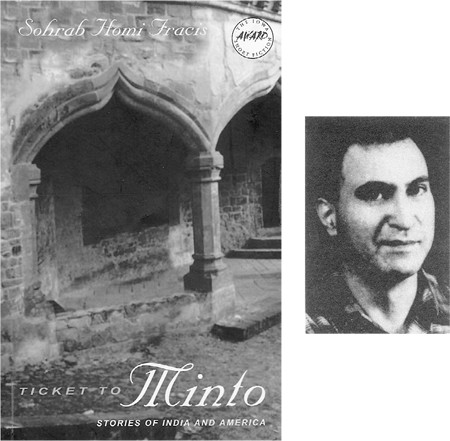
Fracis: creating parallels between two cultures
In "Keeping Time,” the protagonist is an aging and penniless Parsi spinster, Ms Davar, who is an unsuccessful music teacher. She is another of Fracis’ characters who is caught in a time warp. She regrets the departure of the British and is unable to come to terms with the cruel present where she is addressed as Bawaji. In her prime she had suitors who have married and moved on. She has one solitary pupil whom she strictly instructs to keep time to a metronome and who decides to discontinue the music lesson by the end of the story.
However, some characters do manage to extricate themselves from the impasse in which they find themselves. In "Fire,” Pesi Screwvala, a timid boy recovering from typhoid, is constantly tortured by two of his classmates, one of whom even pierces his skin with a compass point drawing blood. Fracis uses the motif of fire very adroitly in this story. Apart from the religious significance of fire, it is also seen as a symbol of regeneration and renewal: the farmers of Khandala burn the under bush leaving a fertile ash in its place. Pesi uses fire to subdue the boys who are bullying him and symbolically renews himself with courage and fortitude.
The strange streak of violence which emerges in "Fire” once again makes a reappearance in "Ticket to Minto.” Fracis presents the students of Minto College as polite and extremely polished in their use of language and full of courtesy to the visiting team of badminton players. There are subtle indications though that this is merely the external facade. There is an underlying coarseness which Fracis presents in the lewd remarks the students of Minto College make when the visitors bathe in a semi-open space reserved for washing clothes. The entire process of Maal Darshan when they watch college girls on the way to their hostel and indulge in obscene comments and crude sexual innuendos is a further example. However, the visitors are totally unprepared for the violence which is planned when a student of Minto College is asked to pay 15 paise for a bus ticket which shows a totally different facet of the students as they plan a demonstration the next day and burn buses as a mark of protest.
A similar deadlock between action and inaction and between peace and violence is reflected in the colliding worlds of the immigrant and the manner in which he seems to constantly live in limbo between two worlds. In "Rabbit’s Foot” through the skilful use of flashbacks, Fracis describes the transformation of Veer Paintal, a strict vegetarian Brahmin who comes to the USA where he not only eats rabbit but also cruelly hunts them himself with his air pistol.
One of the most powerful and compelling stories in the collection is "Stray” in which Fracis poignantly captures the plight of the immigrant in an objective yet compassionate manner. The very first sentence of the story is an indication of the author’s concerns: "Hullo! And where do you belong?” This is addressed to a cat which waylays Pesi one evening in Harrison, USA. The cat stays comfortably in Pesi’s home throughout the winter but when summer arrives and Pesi tries to get him indoors, he scratches and bites him, and scampers into the open countryside. This episode is repeated and the cat, stray though it may be, manages to strike a balance between the warmth of Pesi’s home and the necessity to find its freedom and independence. Pesi on the other hand seems to be in a limbo. He does not seem to have many friends in USA yet he does not want to return to India after his studies. He faces a similar impasse even in his relationship with his girlfriend Shenaaz who wants to return to India after her studies. At the end of the story, Pesi seems undecided about his future. He is unwilling to make a commitment to Shenaaz; yet he is unable to make a clear break.
There is a certain unevenness in some of the stories and the writing does not always seem to flow easily. However, one must admit that Fracis seems to be at great ease with the form of the short story and his characters are etched with a piercing insight as well as a warm and compassionate understanding of human nature. This is an admirable first attempt and one waits for his next work with eagerness and curiosity.
Firdaus Gandavia
◆ ◆ ◆
From the archive