
Business
The Tata drive
The Tata drive
Come September and gearing up for speed on bumpy Indian roads will be the Tata Sedan, the mid-size new addition to car maker Tata Engineering’s fledgling family. The Sedan will have to take head-on the challenges posed in India by strong international competitors like Hyundai Accent, Ford Icon, the new version of the Fiat Siena (expected later this year), the Opel Corsa and the Maruti Esteem.
The yet-to-be-named Sedan, a three-box variant on the Indica platform, was unveiled in January 2002 at the Sixth Auto Expo 2002 in Delhi, reputed to be the largest auto exhibition in Asia.
Determined to expand its product portfolio, Tata Engineering sprang a surprise at the 72nd Geneva Motor Show in early March 2002 by debuting the Indiva, a seven-seater multi-purpose vehicle (MPV), reports Overdrive editor Adil Jal Darukhanawala in a cover story in the April 2002 issue. This "people mover” or mini-van, one of the shortest MPVs available in the market, is also designed by the Italian design house IDeA (which designed the Indica), has a car-like exterior and is very Euro-contemporary, he notes. The Indiva is slated to be launched by 2004 in Europe and India simultaneously, reports the Business Times section of The Times of India (TOI) of March 6, 2002.
Unveiling the car at the Geneva show, chairman Ratan Tata termed it a momentous day for India, "a living fact that an Indian product participated shoulder-to-shoulder with the international ones,” adding "now history will tell whether the Tatas were courageous or foolish.” Designed mainly for the European market, the Indiva has amongst its other features multiple airbags, internet connection, permanent sunroof, CD audio and passenger DVD entertainment, according to Overdrive.
In its cover story of February 2002, Autocar India describes the Tata Sedan: "We drove a couple of prototypes on Tata Engineering’s test track to get a feel of the Sedan and the first impression is that it is a huge jump ahead of the Indica... The most impressive aspect of the Sedan is in the way it rides, especially at high speeds. Tata engineers have worked wonders on the suspension to make the Sedan feel bigger than it actually is... Tata is still tweaking the engines to smoothen the power delivery and further reduce NVH (noise, vibration and harshness) levels.”
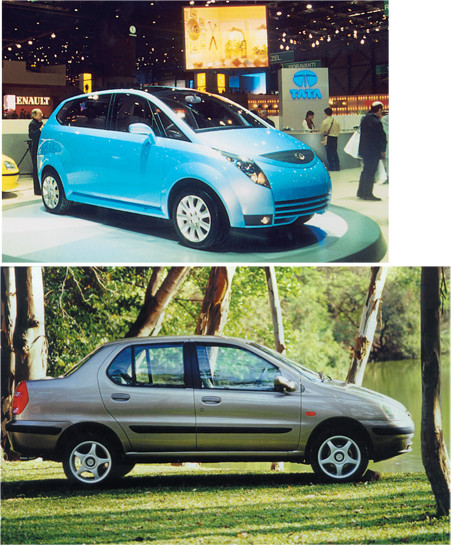
The Indiva, Tata’s new MPV at the Geneva Motor Show (top); the mid-size Tata Sedan (alongside)
The Sedan will come with both petrol and diesel options. "The 1.4 liter petrol engine has been modified to bump power up from 75 bhp (brake horse power) to 85 bhp,” states Autocar. Though no official price has been fixed as yet, the Sedan is expected to roll into the market at a price tag of between five-and-a-half to seven lakh rupees, depending on the trim level. At least two trim levels for each engine option are expected, adds the magazine.
Though the passenger car market registered a minus two-and-a-half percent growth rate between April-December 2001 as compared to the corresponding period in 2000 (see Business Today, February 17, 2002), Tata Engineering has been buoyed by the success of its Indica V2 and the fact that the Indica is now the largest selling car in India in the small car segment, with one-and-a-half lakh cars sold by December 2001, according to the TOI report. With the V2 picking up the award for the "most improved car of the year” at the Auto Awards India 2002 sponsored by Autocar and CNBC television, the magazine sees "a refreshing air of optimism within the company. The last three years have been a trial by fire for this fledgling car maker which has grown up fast to find its feet among strong global players.”
The Indica Sport too could soon make the jump from show car to showroom probably by the end of the year, predicts Autocar. Coincidentally, the Indica Sport (displayed at both the motor shows) is finished in a similar shade of bright yellow as its main rival and ideological sibling, the Fiat Palio S10 edition.
Also exhibited for the first time at the Delhi show was the nifty little Aria Coupe (a two-seater sports car). "Tata has been mulling over the development of a two-seater sports car with at least 140 bhp for the European market. With the Aria Tata hopes to change its image — of a producer of economy cars to more exciting ones,” believes Autocar.
Under the Tata bonnet is also an Estate version of the Indica with a good export potential, particularly in the European market, though the launch was still some time away. A total of Rs 370 crore has been put into developing the Indica variants, which is a fraction of what it cost to develop the Indica. "We cannot survive with just one product and need an entire range to achieve the economies of scale,” said Tata.
Quoting Chandra Kant Birla, chairman of Hindustan Motors, Business Today notes him as saying: "I give credit to Tata for what he has done. But car making is a difficult business. We have to compete with the world’s best.”
◆ ◆ ◆
From the archive