
Books
Family affairs
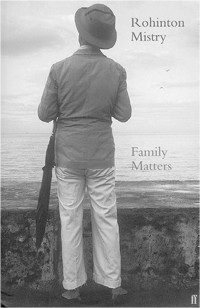
Family Matters by Rohinton Mistry. Published in 2002 by Faber and Faber Limited, 3, Queen Square, London WC1N 3AU. Pp: 487. Price: UK £ 10.99 (In India UK £ 5.50).
In his latest novel, Family Matters, Rohinton Mistry returns once again to the world he knows so well, the world of middle-class Parsi families. They struggle, often desperately between trying to make both ends meet in decaying Bombay apartment blocks on the one hand and to contend with their loss of status on the other hand in a city in which they are being marginalized. The title is ambiguous: the word "Matters” could either be a noun denoting "affairs” or it could also be a verb in the sense of "being important.”
The protagonist of Family Matters, Mistry’s third novel, is Nariman Vakeel, a retired professor of English, close to 80, suffering from severe osteoporosis as well as Parkinson’s disease. He lives with his middle-aged stepchildren, Jal and Coomy, in a large apartment in a building facetiously called Chateau Felicity. An accident on the uneven roads of Bombay where a road has been dug up for the laying of a telephone cable renders Vakeel immobile as he fractures his ankle and is confined to his bed.

Mistry: steadfast gaze
Coomy deviously conspires to shift her bedridden stepfather from their spacious apartment to a cramped one bedroom flat in Pleasant Villa where Roxana Chenoy, Nariman’s daughter, lives with her husband, Yezad, and their two sons, Murad and Jehangir. On Roxana’s shoulders falls the onus of coping with the daily routine of bedpans and urinals, sponge baths and eventually bedsores. Mistry describes the "excretions and secretions” of Vakeel’s body in vivid and compelling detail, from the offensive odors of his bowel movements which permeate the living quarters to "little gobs of mucus” floating in his washbowl.
Though Yezad refuses to touch either the urinal or the bedpan and strictly admonishes the boys from doing so, Roxana manages her filial duties without a single word of complaint or impatience. Mistry seems to suggest: "Can care and concern be made compulsory? Either it resides in the heart, or nowhere.” Even Yezad finally realizes that all human beings become "candidates for compassion, all of us, without exception.”
Coupled with attending to Vakeel’s bodily needs is the question of meeting additional expenses of medicines which at best are only partially subsidized by the pension he earns. The family is forced to economize: first sugar is reduced in tea, then butter vanishes from the table, later meat disappears from the meals and finally there is a shortage of bread. The monetary concerns plague not only the parents but the children as well. The elder boy, Murad, walks home to save his bus fare and give his brother, Jehangir, a Christmas gift. In a touching scene Mistry depicts the shame and the disgrace which are cast on nine-year-old Jehangir, the homework monitor, who is forced to accept bribes from his fellow students in return for his giving them good grades. His ill-gotten gains have merely gone into the various envelopes which Roxana maintains to run her household in an economical and efficient manner.
While Vakeel lies in bed his thoughts move between the past and the present and he dwells on his unhappy love affair with a Catholic girl, Lucy and the tremendous parental objections which are raised when he wants to marry her. In his treatment of this theme of religious bigotry and rigid traditionalism, Mistry poignantly captures the unhappiness and the ensuing disaster which follows when Vakeel is forced to abandon Lucy and instead marry Yasmin Contractor, a widow with two children, Jal and Coomy. He succumbs to the belief that "No happiness is more lasting than the happiness that you get from fulfilling your parents’ wishes,” and his subsequent loveless marriage blights not only his own happiness but that of Coomy and Jal as well.
At the center of the family is Jehangir, and Mistry portrays the development of this boy who sensitively responds to every situation whether it is the tension between the parents, their financial condition or the tender and devoted care of his grandfather. As Roxana watches her nine-year-old son feeding Vakeel and wiping a stray grain of rice from his lips, "she felt she was witnessing something almost sacred.”
Whereas the description of several Parsi customs are skillfully and seamlessly embedded into the plot of the novel, Mistry’s concerns on the dwindling population which takes place in the form of a discussion between Inspector Masalavala and Dr Fitter seems a bit out of place and contrived. Though the reader notices the parallels between Yezad’s insistence on Murad marrying a Parsi and Vakeel’s happiness which was destroyed by the same religious bigotry, the transformation of the sceptic Yezad into a religious fanatic is too sudden and lacks conviction. Where the novel fails is in its sub-plot which centers on Yezad’s outlandish plan to convince his temperamental boss to run for political office. Political analysis has never been Mistry’s forte and the entire episode of the Shiv Sena’s insistence to alter the names of establishments from Bombay to Mumbai is clumsy and almost puerile.
At a time when the contemporary novel is in the throes of verbal ingenuity and magical realism, one cannot help but notice how carefully and studiously Mistry avoids subscribing to recent fads and fashions. Mistry hearkens back to the great 19th century novelists and with his steadfast gaze and his keen powers of observation creates a world with which we can easily identify, and characters who are realistically conceived and compassionately presented. The reader is also struck by the extreme economy of his prose style which captures and powerfully conveys emotion in a few words as is seen in the scene where Roxana watches Jehangir feed Vakeel spoonful by spoonful and comments: "My son, my father, and the food I cooked.”
The novel is populated by a host of minor characters who briefly flit through the pages. Whether it is the inept Edul Munshi with his passion for repair, or the concert violinist Daisy Ichhaporia, or Villie Cardmaster, the spinster with her erotic dreams who entices Yezad to play matka (gamble), or Soli Bamboat, who continuously interchanges his vowel sounds or Mr Burdy, with his never ending store of proverbs — all remain with us and continue to populate the reader’s imagination long after we have completed the novel.
◆ ◆ ◆
From the archive