
Law
Guardian of the Law
Chief Justice of India Sam Bharucha brooks no impingement on the independence of the judiciary
"I have done nothing extraordinary. I have only abided by the oath which I took to do justice without fear or favor, affection or ill will.” Even as the Chief Justice of India, the honorable Justice Sam Bharucha filed a disclaimer to the many compliments paid to his legal astuteness and constitutional grasp of the law, his words underscored his fierce independence and total dedication to the propriety of office which have distinguished his career.
Senior advocate Tehmtan Andhyarujina, former solicitor general of India, had described Bharucha’s style of functioning at the felicitation organized by the Delhi Parsi Anjuman on November 10, 2001. Recalling the tribute paid by the famous Greek historian Herodotus to the Achaemenian Persians of Darius’ court, as excelling in archery, horsemanship and in keeping promises, Andhyarujina noted of Bharucha, "Like a good rider he is quick in the disposal of cases; he speaks straight from the shoulder in his court, sparing no one, big or small; and he is true to his oath of deciding cases without fear or favor, affection or ill will.” Andhyarujina then went on to add, "He is a bit impatient at times in court... but today if there is one quality which marks him out as a judge, it is the confidence of the public in his court. You may be the cleverest and most learned judge but if the public (has) no confidence in you, it is of no use. Justice Bharucha instills a confidence in the court from lawyers and laymen, the government as well as his colleagues in the judiciary.”
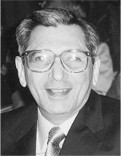
Four of Bharucha’s landmark judgments were referred to by his contemporary lawyers. Solicitor Dadi Engineer mentioned that Bharucha’s "passion for the letter of the law and clean public life was very much in evidence” when he ordered the removal of popular Tamil Nadu chief minister Jayalalitha from office noting that the people’s mandate could not override the constitution of the country.
Senior Supreme Court advocate Anil Divan explained the Veerappan Case to Parsiana. After kidnapping the well known movie star Rajkumar, bandit Veerappan sought a package of concession from the chief ministers of Tamil Nadu and Karnataka, including the release of certain jailed criminals, in exchange for the life of the hostage. When the two state governments wanted to yield to Veerappan’s terms, the father of a police officer who had died in the process of capturing these brigands petitioned the court. When it reached the Supreme Court, Bharucha, heading a three judge bench, pronounced the unanimous decision that no compromise with lawless elements could be accepted. When the governments spoke of riots and blood baths, he told them it was a law and order problem which it was the government’s duty to handle. Bharucha’s stern stand "paid off: nothing happened, and the kidnapped man was released,” noted Divan.
Andhyarujina referred to Bharucha’s tough stand on the Ayodhya case. Bharucha had declined to answer the President of India’s reference to the Supreme Court on the constitutionality of the Ayodhya Acquisition Act as it offended the principles of secularism. Andhyarujina said that Bharucha had argued that the Indian state has no religion and is bound to honor and to hold the scales even between all religions. According to Andhyarujina, Bharucha had stated, "The Act and the reference favors one religious community and disfavors another. The purpose of the reference is therefore opposed to secularism and is unconstitutional.”
In his profile on the Chief Justice of India titled "Guardian of the Letter” in Outlook (November 12, 2001) Bhavdeep Kang had quoted Bharucha’s dissenting judgement in the Narmada Bachao Andolan case of 1999 when writer Arundhati Roy and others were pulled up by the Supreme Court for their statements against its judgement on the contentious dam. "While I record my disapproval of the statements... I am not inclined to take action in contempt against Medha Patkar, Shripad Dharamadhikari and Arundhati Roy because the Court’s shoulders are broad enough to shrug off their comments and because the focus should not shift from the resettlement and rehabilitation of the oustees,” he observed.
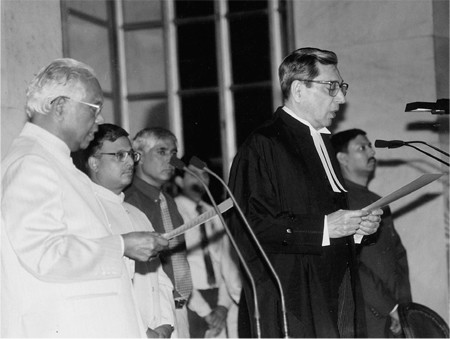
President of India K. R. Narayanan (ext left) administering the oath of office to Bharucha
Enrolling as an advocate of the Bombay High Court in 1960, Bharucha practiced mainly on the original side of the Bombay High Court and also represented his clients at the Supreme Court, his speciality being tax law. According to Andhyarujina, Bharucha’s name was first suggested for judgeship in 1975 "but then those were the days of the Emergency and the powers that ruled did not want judges who would turn out to be too independent for their liking. It was on September 19, 1977 after the Emergency was lifted that he was appointed a judge of the Bombay High Court.” Transferred to the Karnataka High Court as Chief Justice on November 1, 1991, Bharucha was elevated to the Supreme Court on July 1, 1992, becoming Chief Justice of India on November 1, 2001. Bharucha is married to Perin (née Kharas), author of a book on the community titled The Fireworshippers.
Supreme Court judge Sam Variava had noted in the course of his response to the felicitations in Bombay, "By the time Sam became a judge I was already established as a lawyer. I had the privilege of appearing in his court on a number of occasions. Even though we were from the same chamber and I had been working under him, there was no favoritism. I won or lost a case on its merits. Before Justice Bharucha it made no difference who appeared. Watching him on the bench made one proud to have been his junior.”
Divan saw Bharucha’s short term as the main stumbling block to his ability to translate his ideas into action. "If the Supreme Court has to go forward with long range issues, two or three successors have to band together to work out the direction in which they want to take the Court,” he noted.
Referring to Bharucha’s fearlessness and the consequently high respect in which he was held even by his brethren on the bench, another Supreme Court lawyer spoke to Parsiana of the nine-judge bench constituted to decide whether the appointment and transfer of judges rested with the Chief Justice alone or be the decision of the collegium. "There was only one judgment (favoring the collegium concept),” he noted. "It is an achievement to carry your colleagues with you.”
Bharucha is perceived as a lawgiver in the traditional mold: very correct, quick in perception and disposal. Not only is the oral judgment quickly delivered, even "the written judgment would be delivered faster than others who keep it back for six to nine months,” noted a lawyer who declined to be identified.
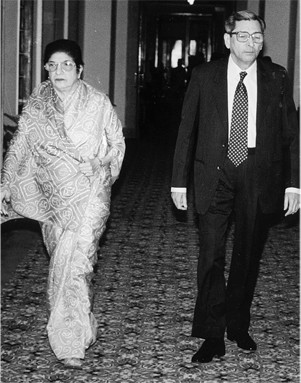
Perin and Sam Bharucha: walking the corridors of power
Supreme Court advocate Lalit Bhasin told Parsiana that he had appeared frequently before Bharucha in Bombay. "So far as the standard of the judiciary and the legal profession is concerned, Bombay is a role model,” said Bhasin, noting that "Justice Bharucha fits in with the reputation that the Bombay judiciary has got. He is in the same mold as the first Chief Justice of Bombay M. C. Chagla. I have always found him to be a correct judge, i.e. his mind is open, not made up until he has heard every aspect of the case.” Commenting on Bharucha’s emphasis on court etiquette Bhasin says that this judge "won’t tolerate irresponsible conduct on the part of anyone, regardless of the status or stature of the counsel appearing before him... I have found him a man of profound legal knowledge and of a fair application of common sense which is so vital for those who administer justice.
"He was like this in Bombay and when he came to the Supreme Court, he continued to flourish with these attributes. But sometimes people think he’s got a touch of aristocracy or sahib (British) mentality. I find such comments wholly misplaced,” noted Bhasin, describing Bharucha and his wife Perin as sociable, hospitable people. (Ignorant of judicial propriety that shuns personal publicity, this reporter had hoped to interview Bharucha while in Delhi in 1994. Gaining an appointment through a mutual friend, the Bharuchas welcomed us to a high tea and showed us around their home, introduced us to their dog, but, said the judge, "No interview!”)
Reverting to Bharucha’s legal accomplishments, Bhasin said, "He is one person who encourages junior members of the profession to argue before him without inhibitions, has a deep feeling for the underprivileged and comes down very heavily against any violation of human rights.”
Commending Bharucha’s effective spread of the legal network throughout the country as chairman of the National Legal Services, Bhasin noted, "It speaks volumes for his care and concern for underprivileged people.” In one of his first addresses as Chief Justice of India Bharucha expressed his assent toward the setting up of a National Judicial Commission to look into the appointment of judges and for taking action whenever there is judicial misconduct, Bhasin told Parsiana, amplifying that "the legal profession has taken it up as an issue though the judiciary is by and large opposing it.” The power of appointment now vests with the judiciary. Bharucha, as head of the bench had opined that the collegium of three judges should be extended to five.
Though Bharucha’s short tenure may prevent him from seeing his agenda through, Bhasin saluted the judge for upholding the "larger perspective of litigation,” and hoped that his successor may be able to carry it forward.
While Bharucha has not been involved with community issues as such, his keynote address to the Federation of Parsi Zoroastrian Anjumans of India at Jamshedpur in December 2000 bore the same ring of fearless outspokenness as he urged the "trustee sahebs” to respond positively to the needs of the community in terms of education, the acceptance of the offspring of Parsi women married to men of other communities and a rational adjustment to the ailing system of dakhmenashini (see "Thus spake Bharucha,” Parsiana, January 2001).
From the cut of the jaw to the crease of his trousers, Bharucha today is a maturer version of the young man with dark-rimmed glasses who presided with a combination of wit, sang froid, outspokenness and courtesy over the mock trial of the late Rev Edward D’Cruz, then the formidable vice principal of St Xavier’s College. For two or three consecutive years in the late 1950s the St Xavier’s quadrangle echoed with delighted laughter during the fun-filled mock trials of the Jesuit fathers who were the College’s executive authorities on the festive annual College Union Day. The occasions this reporter recalls saw BSc student Bharucha on the bench, a peculiar precursor of his later judicial stand-offs with the nation’s executive wing. The judge had noted at the Cusrow Baug felicitations on December 15, 2001, "I am where I am as a result of chance occurrences or perhaps predestination.”
◆ ◆ ◆
From the archive