
Cover Story
The night of the judges
The Bombay Parsi Punchayet in conjunction with the World Zoroastrian Organisation felicitated Chief Justice of India Sam Bharucha and Justice Sam Variava of the Supreme Court of India on their high appointments
Parsis in and around Bombay converged in strength on the central lawn of Cusrow Baug on December 15, 2001. The appointment of the first Parsi Chief Justice of India (CJI) on November 1, 2001 was a legitimate cause for euphoria. That the government and collegium of senior judges had earlier nominated a second Parsi to the Supreme Court (SC) bench heightened the feel-good factor — this hadn’t happened before. At last there was something to celebrate instead of the long, bewildering, depressing debates about Doongerwadi! The only flaw in that cup of cheer was CJI Sam Bharucha’s short tenure of six months. He will retire on May 6, 2001 on reaching the age of 65.
The combined felicitation of the two jurists had been announced by the Bombay Parsi Punchayet (BPP) and the World Zoroastrian Organisation (WZO) over a month in advance. As linchpin of the combined hosts BPP trustee and WZO India president solicitor Dadi Engineer and his team shouldered the protocol requirements of the celebration. Although the Cusrow Baug lawn has been the site of glittering World Zoroastrian Congress inaugurals in the past, there were probably more lawyers and judges assembled there that night than ever before, including members of the Bombay High Court’s Goa, Nagpur and Aurangabad benches and two former Chief Justices of India, Justice Yeshwant Chandrachud and Justice Madhukant Kania.
"Sam” was the most toasted name that evening. The archetypal Sam was the grandfather of the Pishdadian hero Kersasp celebrated in the Shah Namah. Sharing in the glory with CJI Sam Bharucha ("big Sam”) and Justice Sam Variava ("little Sam”) that evening was the original Sam whose name became a household word in India three decades ago — India’s first Field Marshal Sam Manekshaw ("aapro Sam”). And for a few brief minutes they were joined on stage by the Surti Sam, Surat Parsi Panchayat (SPP) president Dr Sam Bhacca who felicitated the scions of neighboring Bharuch and Variav on behalf of Surat, the "ancient hub of the Parsis.”
Perhaps a little bewildered by the euphoric community but graciously accepting the well-meant congratulations was Justice B. P. Singh who was invited to the stage by the organizers. The well-loved former Chief Justice of the Bombay High Court had just the prior day been administered the oath of office as judge of the Supreme Court. While Ashima Singh was not present on the occasion, Perin Bharucha and Dilnavaz Variava shared in their husbands’ felicitations.
Voicing the community’s "pride and joy,” BPP chairman Jamshed Guzder described Bharucha as one of the SC’s "youngest judges ever.” The "no-nonsense” judge was never unkind or unjust, was known for his tongue-in-cheek humor and respected for his "total honesty in supreme measure... His judgments as judge of the Bombay High Court had seldom been overruled (on appeal),” noted Guzder, hoping "like fellow Zoroastrians, that you will get a new governmental position equal to your august status.”
Remarking on Variava’s "burning desire to do justice as he saw it,” Guzder praised the "fair and just solution” he had evolved in the Harshad Mehta scam case and commented on the sense of discipline and work ethic he had instilled as Chief Justice of the Delhi High Court prior to his promotion to the SC.
Welcoming the judges on stage and in the audience, Engineer provided a historical backdrop to the legal profession in Bombay, particularly the Parsi notables who had ruled the roost. Noting that the minuscule community currently had two representatives among the 26 stalwarts of the SC, Engineer described them as the late Murzban Mistree’s "devils” (as junior lawyers are known in the lingo of counsels). Mistree himself had grown to full stature as senior counsel in the chambers of the legendary Sir Jamshedji Kanga. Kanga, whom Engineer described as over 6’2” tall always wore a black coat and white pugree in court because he was an athornan, though in his chambers he would be clad in a lounge suit. "He insisted on the world knowing that he was a Parsi,” noted Engineer.
Kanga’s chambers spawned a wealth of legal heavyweights including Hor-musji Seervai, Rustom Kolah, Khar-shedji Bhabha and Nani Palkhivala. Tracing the legal lineage further, Engineer noted that Kharshedji’s juniors included India’s two-term attorney general Soli Sorabjee and preeminent counsel Fali Nariman who has been nominated to the Rajya Sabha. Seervai’s juniors included senior counsel Atul Setalvad and former solicitor general of India Tehmtan Andhyarujina; counsel Bomi Zaiwala and Justice Rohinton Vachha of the City Civil Court were Nariman’s juniors. Several Parsis had been Supreme Court judges, "but” declared Engineer, "no Zoroastrian in the history of the community had risen to be Chief Justice of India.”
Quoting a supreme court lawyer who had described Bharucha as being "as upright as his posture... genuinely believes in the rule of law and is least bothered about political equations in the country,” Engineer added that Bharu-cha’s "outstanding quality was his unimpeachable integrity. (He is) never swayed by public opinion or extra legal considerations.”
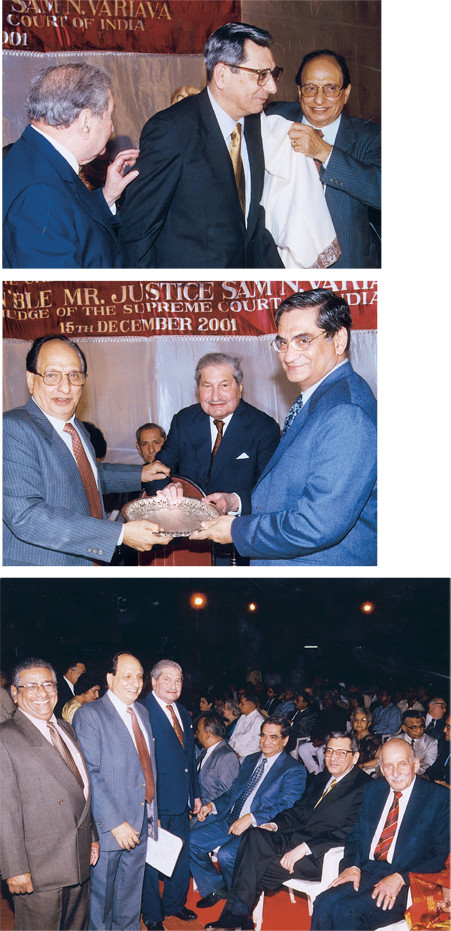
Top 1: A shawl for Bharucha (center) from Guzder (left) and Engineer (right) Top 2: A silver salver to Variava (ext right) Alongside (L to R, standing): Dinshaw Mehta, Engineer, Guzder (seated) Variava, Bharucha and Manekshaw
Remarking on Bharucha’s penchant for brevity, both oral and written, Engineer commented on the judge’s "short and terse orders,” adding that with his sense of dignity and decorum Bharucha was cast in the mold of Lord Denning, the celebrated British judge, "whose judgments were known for their brevity and clarity.” Referring to the firm and forthright manner in which Bharucha presides over his court, the irrepressible Engineer added, "Every time I was in his court in Bombay or in Delhi, I was reminded of a little story about an English magistrate at the Old Bailey. The accused in the dock looked up to heaven and said: ‘As God is my judge, I am not guilty.’ The magistrate looked sharply at the accused and said: ‘God is not your judge; I am. You are guilty. Six months’ rigorous imprisonment.’ I would not be surprised if Justice Bha-rucha passed such a brief sentence if he was trying a criminal matter.”
Sharing with Bharucha "many of his fine qualities as a judge,” Variava was hand-picked to try the breathtakingly complicated business scam perpetrated by broker Harshad Mehta (since deceased) because "it was necessary to appoint a man of high integrity and scrupulously clean reputation,” noted Engineer. So involved was Variava on this case from June 1992 onward, toiling to unravel its many facets, making "bold and courageous pronouncements (which) earned him the respect of the bar and the public at large,” that the legal denizens of the Bombay High Court dubbed him Justice Scam Variava with roguish good humor, recalled Engineer. Commenting on Variava’s love of the outdoors including rock climbing, Engineer added with a straight face "I’m also an expert at rock climbing, along with my BPP fellow trustees, because of the number of rocks and boulders thrown at us!”
Engineer quoted the Greek philosopher Socrates according to whom "Four things belong to a judge: to hear courteously, to answer wisely, to consider soberly and to decide impartially,” adding, "Our two distinguished judges have all these qualities.” But there can be no greater compliment paid to a judge at the end of his career than for the public and his peers to say of him, "He was a just judge,” noted Engineer, declaring "We have (here) two just judges.”
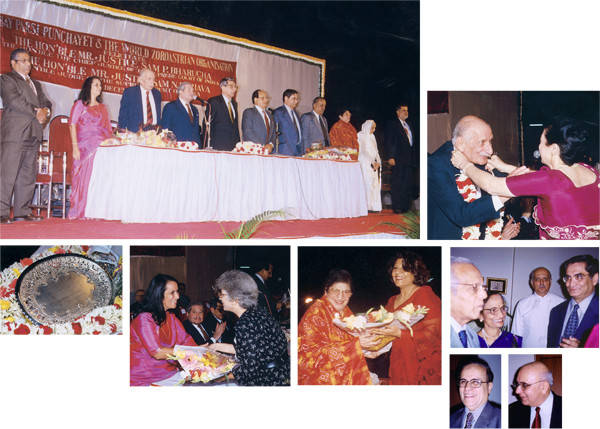
L to R (clockwise from left) Standing for the national anthem: Mehta, D. Variava, Manekshaw, Guzder, Bharucha, Engineer, Variava, Singh, P. Bharucha, Silloo Kavarana and Tirandaz; Manekshaw and Modi; Y. V. and Ms Chandrachud, B. Hansotia and Variava; Tamboly; senior counsel Rafiq Dada whose opinion was sought by the BPP regarding Doongerwadi; P. Engineer with Pansy Mehta; D. Variava with Armaity Tirandaz; silver salver
Looking forward to the day when Parliament consults the SC so that the laws and ordinances it promulgates pass the scrutiny of the courts, BPP trustee Rustom Tirandaz opined that Bharucha’s qualities of head and heart could lead to such a happy fusion. "As member of the largest Parsi-Irani conglomerate i.e. the Parsis of Bombay,” Tirandaz prayed to God "to give (the two judges) strength against all odds at all times.”
Starting with garlands, shawls and silver salvers from the BPP and the WZO, the two legal eagles were deluged with enough flowers, shawls and mementoes from 39 all-India Zoroastrian anjumans and institutions [briskly moving under the direction of KRCOI (K. R. Cama Oriental Institute) trustee-secretary and social worker Homai Modi], to set up a retail outlet! Among those who greeted the judges were the Agra Parsi Anjuman; Ahmedabad Parsi Punchayet; Allahabad Parsee Zoroastrian Anjuman; Bardoli Zarthoshti Anjuman; Borivli and Suburban Zoroastrian Association; Iranian Zoroastrian Anjuman; Jamshedpur Parsi Association; Jhansi Parsi Anjuman; Lonavla-Khandala Parsi Zarthosty An-juman; Lucknow Parsi Anjuman; Parsi Zoroastrian Anjuman of Mhow; Shree Nagpur and Kamthi Parsi Zarthosti An-juman; Poona Parsee Panchayat; Zoroastrian Anjuman of Secunderabad and Hyderabad; SPP; Shri Udwada Nine Families Athornan Mandal; Vesu Zoroastrian Parsi Anjuman; Shree Parsi Punchayet Vadodara; B. D. Petit Parsee General Hospital (PGH); Sir Cowasji Jehangir Navsari Zarthosti Madressa; P. K. Patel College of Commerce, Navsari; S. B. Garda College of Arts, Navsari; B. P. Baria Science Institute, Navsari; Dinshaw Daboo Law College, Navsari; D. K. Tata High School Trust, Navsari; Jam-e-Jamshed; KRCOI; Cusrow Baug United Sports and Welfare League; Seth Nusserwanji Hirji Karani Agiary; Rustom Baug Association and Sir Ness Wadia Club; Zoroastrian College; Salsette Parsi Colony, Andheri; Young Ratheshtars; Farohar Films; Navroz Baug Play Centre; Godrej Baug Residents’ Association; Parsi Chief Matrimonial Court and Muncherji Edulji Joshi Memorial Trust, Dadar.
The response of the judges marked the high point of the event (and an object lesson in how youngsters without connections can make it to the top). Never expecting "all these associations to join in with the BPP and the WZO,” an "overwhelmed” Bharucha said he was "immensely grateful for the tribute paid to both of us.” Bharucha noted how, as an only child, he was expected to follow in his father’s footsteps and become a doctor. "(I was) not terribly keen but I didn’t put up any resistance.” However when he failed to secure the requisite marks at the interscience exam, Bharucha declared he would go into law. Wondering how he would access the profession without a "godfather” Bharucha nonetheless "was extremely keen to join Sir Jamshedji’s chamber because I had heard of all the stars it had produced.”
Availing of a slight acquaintance with Kharshedji Bhabha, the hopeful Bharucha asked to join but was told by Bhabha that he had no place. On returning from a lukewarm response in another chamber, he bumped into Bhabha again. When the latter learnt from Bharucha what he had done, "I heard from Kharshedji in very explicit language what a fool I was!” recalled Bharucha. He was told to go to the chambers and meet Murzban Mistree on August 8, 1960 at 11 a.m. He found "Murzban, a very senior counsel, very imposing” and was terrified. He had gone wearing a tie and jacket and "Murzban said, ‘Why are you not wearing bands?’” When Bharucha demurred, saying he did not know if he would be accepted, Murzban voiced the words that must have been music to Bharucha’s ears: "Of course you are accepted!”
Bharucha recalled that he was asked to work on an opinion for the PGH and be ready for a conference within a day or two. He went to the library, researched, "wrote out the opinion and gave it to Murzban to check. On the day of the conference (Murzban) gave that handwritten opinion to the solicitor saying ‘It’s been drafted by my junior. I have read it. It’s absolutely correct.’ That sort of thing happened again and again. I asked him how I can ever repay what you have done. He said, ‘Treat your juniors in the same way!’ Fortunately or unfortunately, I was appointed to the High Court far too young in 1977 to acquire many juniors.”
When Bharucha was the senior-most judge of the SC he had expected that Variava, then chief justice of the Delhi High Court, would succeed him onto the SC bench. "I had never thought that the Indian community would contemplate that there should be at one and the same time two Parsi judges of the Supreme Court. Therefore his name was not proposed by me. It was proposed by one of my colleagues and it went through without a hitch. It went through the court without a hitch. It went through the Government without a hitch. It is an indication of the very great respect that the Parsi community enjoys in this country. Friday before last I was at a semi-official dinner, we both were, and people kept asking how is it that a community as minuscule as this can produce so many people who have rendered such service to the country and the two names repeatedly mentioned that evening were J. R. D. Tata and Sam Manekshaw.
"I will end by saying that we belong to a great community. We should be proud of it. We should maintain the respect which the country gives us and we should build on it.”
Having grown up in the vicinity, with Cusrow Baug as his "regular haunt,” the evening made Variava nostalgic. He too came from a family of doctors, the first to go into the legal profession. Though "disappointed when he learnt that I wanted to become a lawyer,” Dr Variava took his son to Murzban Mistree to ask, "Will you take my son?” Variava recalled his mortification when his father added, "‘I’ve told him all lawyers are liars, but he still wants to join!’... Being accepted in that chamber was the most fortunate thing that happened to me, except meeting my wife,” added Variava gallantly.
Recalling Sir Jamshedji, then over 80 years old, "a giant in the profession, yet humble and simple,” Variava noted, "You could talk to him about anything and everything. If he saw you he would call and ask if you were busy! His memory even at that age was phenomenal. He could tell you not only the book but the page number and very often the line where one would find what one needed.” Variava recalled that Bhicku Gandevia and Sam Bharu-cha were Murzban’s other juniors and that’s where their "big Sam” and "little Sam” titles originated. "Our legal colleagues still refer to us that way!” laughed Variava, adding, "When I joined, Sam Bharucha was a counsel and much in demand.”
Variava said he soon realized that his degree had not equipped him to argue in court. He regularly attended trials and conferences with Murzban, watched him build up the plaintiff’s evidence and the finesse with which he cross-examined the defendant’s witnesses in the defamation case filed by Thackersey against Blitz. Even though the compilation was bulky and there were a lot of documents, Murzban had all the facts at his fingertips. He knew exactly what was stated in which document and where to find that document, remembered Variava. Despite being so busy "he was an understanding and concerned senior. He suggested I work with Sam and I started tagging along with him. It must have been a nuisance to have a fresher asking silly questions and making a hash of drafting work,” smiled Variava, adding sadly that he had learnt that lawyers in Delhi avoided taking juniors nowadays and when they did, spent little time in training them. "I was very lucky. Both Murzban and Sam were very patient and never hesitated in providing their valuable time on training a raw junior and converting him into a successful lawyer.”
Contrary to his father’s perception, Variava said he learnt that "this was not a profession of liars and swindlers but a very noble profession. They taught me that the duty of a lawyer was to represent his client to the best of his ability and that it was not part of a lawyer’s duty to make up or put forth a false representation... My seniors ingrained in me the fact that there is no substitute for honesty and fair play.”
Variava ended advising the commu-nity’s youth to pursue business or the professions instead of plumping for the security of service. "The Parsi community made its name and has come to be respected because its members chose to do business or take up a profession” and urged more and more young people to do likewise.
"The community has had the opportunity to honor two Zoroastrian Indians who have reached the pinnacle of their chosen careers,” noted BPP trustee Dinshaw Tamboly who is also chairman of WZO Trust Funds, India. His vote of thanks encompassed the many dignitaries present as well as the plethora of community individuals and institutions represented that day in the well-orchestrated felicitation. Their participation "affirmed the solidarity that exists within the community. Long may it remain so,” he noted fervently.
The VVIPs were expected for cocktails at the well-appointed residence of Dr Mehroo and Dara Hansotia and Gool and Bomi Hansotia. But for quite some time there was no sign of the judges either on the main lawn, the Hansotia home or the pavilion where the first dinner sitting was in progress. And then they emerged from behind the Agiary, strolling casually in the balmy night, having put the length of Cusrow Baug between themselves and their security staff! After the banquet, where caterer Tanaz Godiwalla had outdone herself, the official cars swiftly whisked their precious passengers away.
◆ ◆ ◆
From the archive