
Law
The law-full legend
The hallmark of the legal profession schould be judicious self-control, believes Fali Nariman
Known for his expertise in constitutional law, international law, human rights and international arbitration, an audience with Fali Nariman is eagerly awaited by members of the legal fraternity as also political and business circles. From the time he was conferred the Padma Vibhushan a year ago in recognition of his "exceptional and distinguished service to the nation” in the field of public affairs, Parsiana too had been hoping to meet him. The opportunity came nearly a year later on one of his professional trips to Bombay.
Not one to mince words or clothe his responses in technical jargon, Nariman expresses his views candidly. "I have always been forthright,” he declares, referring to the respect he has earned over the years from leaders of opposing political camps, be it the Bharatiya Janata Party which nominated him to a six-year stint in the Rajya Sabha in 1999 or the Congress Party which was then in opposition. He is also realistic enough to admit, "I would never have been elected to Parliament. It is only because I was nominated.” On the same logic he states, "Zoroastrians need to join politics. But unfortunately they won’t get votes.”
One of the founding members of the Peoples Union for Civil Liberties, Nariman has been a votary of free and fearless expression, regardless of the government in power. A counsel for Gujarat in the Narmada dam dispute case, he decided not to represent the State in the Supreme Court because of the Government’s alleged failure to protect minorities in the State.
During his tenure at the Rajya Sabha he introduced a bill in Parliament seeking to cut allowances of all Members of Parliament on days when they disrupt the sessions to the point of adjournment. He believed this step was necessary to restore credibility of Parliament and to prevent "vast amounts of public money (being) needlessly thrown away.” Among those whom he had impressed during his term at the Rajya Sabha was the Prime Minister of India Dr Manmohan Singh who, when releasing Nariman’s book on legal reforms at his residence in 2006, had acknowledged, "I will always cherish our time together in the Rajya Sabha. Whenever he spoke, he spoke from the core of his heart. Truth as he perceived it to be. And it was for me a great educational experience listening to him…Nariman is one of our most respected legal luminaries…I have always greatly admired his wit, his wisdom, his humanism and his sense of humor, his profound understanding of our Constitution and his legal acumen. It is the combination of traditional Indian wisdom mixed with European rationalism and liberalism that gives the Indian legal system a unique character…”
In a relatively recent development, the Prime Minister had remarked that the judiciary was stepping on the toes of the executive and legislative arms of the nation, describing it as "judicial over-reach.” This prompted Nariman to comment in his Guest Column in the Hindustan Times of April 29, 2007, "The judicial over-reach the Prime Minister spoke about is the direct result of legislative and executive neglect or under-reach; poor performance in the making of laws and their execution. If judges need to introspect, politicians also need to introspect and ask themselves whether they have fulfilled the aspiration of the people who put them at the wheel of governance… Freedom for citizens like you and me can only be secured through courts, not through Parliament or through executive governments…”
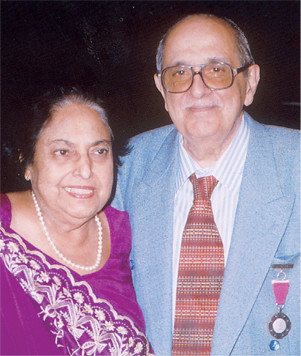
Bapsi and Fali Nariman
In the course of a speech delivered at The Telegraph Calcutta Club National Debate in 2005, Nariman had remarked, "I am not a Hindu or a Muslim. I’m just a poor fish in a shoal of political sharks.”
What are his views on the laws applicable to the community? An issue close to the Rangoon born Nariman’s heart is the well known Bella case when Bella, a Goanese Christian child, presumably born of a Parsi mother was brought up by the Cowasjis, a respectable family in Rangoon. At the age of 14 she was initiated and taken to the fire temple thereafter which offended some orthodox members of the community. A suit was filed barring her entry, which eventually went up to the Privy Council. Their ruling was similar to the earlier landmark case of Petit vs Jejeebhoy where it was held that the fire temple was intended for Zoroastrians of Parsi descent. As conveyed by Nariman in his discourse on "Zoroastrianism — the faith of the Parsis in India” (in 1999 under the auspices of the Foundation for Universal Responsibility initiated by the Dalai Lama), "The consequence of this decision — a decision personally regrettable to me — was that Bella (though married to a Parsi, Dhanjisha Kolapore) turned her back on the community in Rangoon. She abandoned her wardrobe of saris, donned Burmese clothes, became a Buddhist, spoke only Burmese and never once attended any of the functions organized by the Parsi Anjuman.” To this day Nariman has memories of people armed with sticks guarding the entrance of the fire temple with a stance "khabardar andar aavé (dare she come in)…” of Bella in later life smoking her Burmese cheroot… "Naturally she took such an abhorrence to the community.”
Believing that the Parsi community "should have a system of adoption, it’s a step forward,” Nariman recalls the time when he was additional solicitor general and asked to give his views on a uniform Adoption Bill for all communities that he fully supported. As notes Nariman, "The Muslims rejected it on religious reasons. The Parsis feared ‘dhéra/dubra né andar laavo tau nahi chalé (you can’t give entry to any outcaste).’”
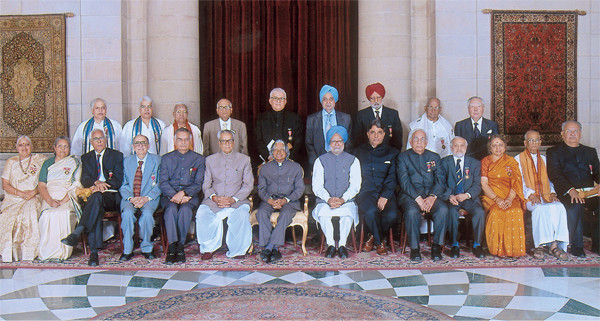
Fali Nariman (seated 4th from left) with Dr A.P.J. Abdul Kalam and Dr Manmohan Singh (7th and 8th from left), Dr Jamshed Irani (standing 5th from left) and other awardees
Likewise when the provisions in the Indian Succession Act as applicable to Parsis were being considered for amendment in the early 1970s the divided opinion in the community had made Indira Gandhi comment, "You are such an enlightened community, but unless you come with one unanimous voice, I can’t do anything,” Nariman remembers her words.
With regard to the Parsi Marriage and Divorce Act and the Parsi Matrimonial Court, the only known jury system in the country, Nariman observes, "It is not very successful… but it perhaps fulfils some purpose… Everybody is a little afraid of it.” He refers to the case for restitution of conjugal rights which had come up before Justice Coyajee when Nariman was still a junior. Since the jury insisted that a ruling be given in favor of the husband, Coyajee granted the decree, much against his personal views. A jubilant mother-in-law dragged the wife to her house, physically assaulted her and sadistically declared: "mooee noo naak kaapiu (cut her nose).” Six months later the daughter-in-law came again to the court, praying for divorce, and this time Coyajee was able to rule in her favor.
Although happy that progressive provisions like divorce by mutual consent have now been incorporated in the Parsi Marriage and Divorce Act, Nariman expresses a greater concern: "My regret is that such few are marrying within the community…We are much sought after…” Hearing statements like "My daughter-in-law is a Parsi,” announced with pride in respectable non-Parsi households, has given Nariman the impression that a Parsi daughter-in-law is considered "a prize, and rightly so. We are highly regarded for our truthfulness, integrity.”
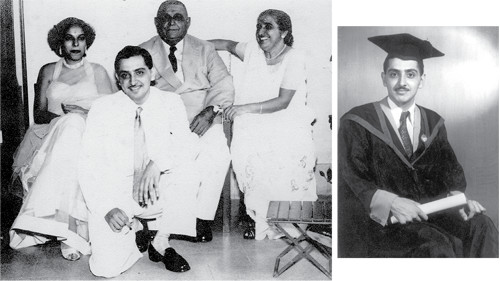
Fali Nariman (center) with (from left) Bapsi, father Sam and mother Bhanu. Right: At the threshold of a legal career
Nariman may be happy to be associated with the progressive Delhi Parsi Anjuman, one of the few in India which welcomes the non-Parsi spouse of a Zoroastrian man or woman who has married out of the community as also their children, but unabashedly declares, "I’m a bit of a traditionalist also. I have imbibed this from my parents and my senior, Sir Jamshedji Kanga.” The need to maintain protocol, to respect customs was reiterated time and again by Kanga. Nariman referred to the demise of Chief Justice Chainani at a time when "there was a blackout in Bombay. Jamshedji did not know Chainani but insisted that when the chief justice dies you have to go the funeral. He could not see but insisted on walking ahead.”
The traditionalist respects the dakhmenashini mode of disposing the dead saying, "You must go the way your forefathers went.” The furor over the condition of decomposed bodies lying in a dakhma makes him wonder whether exhuming a buried body would show any different results. Although he does not think "cremation is anti-religious,” the lackadaisical approach at the crematorium, he feels, is not in keeping with the solemn occasion. He refers to the late jurist Homi Seervai’s observation that Zoroastrian funerals are so well organized that it is impossible to think of anything else.
"Certain things which should be done, must be done,” proclaims 79-year-old Nariman who describes himself as "quite orthodox.” As a family "we pray from the Avesta. Wearing the sudreh-kusti is very necessary. If you miss your prayers, you find something is missing. I don’t pray for myself. I do believe that you have to keep your channel of communication to the Almighty open at all times. In myriad ways you are helped.” Sharing his views is wife Bapsi. Son Rohinton, also a practising lawyer, was initiated as a priest and having studied the religion, "knows a great deal about it.” Daughter Anaheeta is a speech therapist based in Bombay. He notices a gap in his own thinking and that of his granddaughters but maintains, "We are an affectionate family where everyone has their own views… and they must express them.”
Referring to the "resurgence in India” and advocating "faith in the young,” Nariman continues, "I don’t believe in reservation of seats. It would do more harm than good to the community.” He is glad that the liberal-minded Sir Homi Mody, when speaking on behalf of the Parsi community, had the foresight to assert in the Constituent Assembly, "We don’t want a separate representation. We will come up on our own.” Happy that the current chief of the Air Force, Air Chief Marshal Fali Major is a Zoroastrian, Nariman observes, "The Parsi community has done reasonably well. We have bright people. We have a very fine battery of young lawyers just as we have of doctors. Their caliber is as good…I do think our religion helps us (maintain a certain standard). It is a kind of generational handing down. The way people are brought up…”
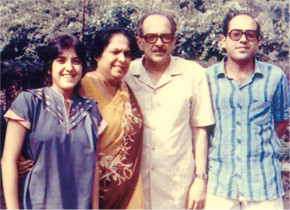
From left: Anaheeta, Bapsi, Fali and Rohinton Nariman in the late 1970s
Nariman’s early days were spent in Rangoon where his mother’s family, the Burjorjees, ran the postal service for King Theebaw (the last Burmese royal who was deported to India following the end of Third Indo-Burmese War in 1887). After the Japanese invasion in 1941, Nariman, then 12 years old, had fled with his family to India. At the age of 21 he enrolled as an advocate in the Bombay High Court after completing his graduation from St Xavier’s College and the Government Law College. Twenty-one years later he was practising as a senior advocate in the Supreme Court. In 1972 he was appointed additional solicitor general of India but resigned from the post on June 26, 1975, the day after the infamous Emergency was declared, to express his opposition to the curtailment of civil rights.
Highly respected in legal circles, Nariman served as president of the Bar Association of India, of the International Council for Commercial Arbitration, of the Law Association for Asia and the Pacific, and as chairman of the executive committee of the International Commission of Jurists… The International Bar Association had named him a "Living Legend of the Law” and in 2002 he was selected for the Justice Prize by the Peter Gruber Foundation. More than the titles and prizes, Nariman values the subject for "law is not merely about cases, nor about legal rights. It is also about hard work and integrity. The judiciary of the 21st century, along with the legal profession, needs to set an example in exemplary self-discipline; discipline in approach, discipline in lifestyle; discipline in thought, word and deed…” as he states in his book.
In the course of their travels, Nariman and Bapsi, a cookbook writer and social worker who has served as vice chairperson of the Commonwealth’s Delhi Women’s Association, try to meet up with Zoroastrians in different corners of the world. To him the "Parsis are like a banyan tree…the branches are far more religious minded. We need to grow…”
Would he support acceptance of converts? "We have to draw a line,” he maintains, repeating what he jocularly tells his non-Parsi friends, "We are God’s chosen few/All others will be dammed/There is no place in heaven for you/We can’t have heaven crammed.”
◆ ◆ ◆
From the archive