
Cover Story
With strings attached
Dadi Pudumjee’s puppet shows with GEMS Modern Academy enthralled audiences in Dubai yet again
World-renowned puppeteer Dadi Pudumjee floored his Dubai fandom once more. In a wondrously magical but incredibly realistic performance, he and his Ishara Puppet Theatre Trust teamed up with junior students of the city’s flagship Indian school, GEMS Modern Academy, to host a production, Hulm Mumkin (The Possible Dream), which left the audience spell bound. Speechless would be a better word to express the mood of the moment, actually. The success of the show was reflected in the enchanted faces of the spectators, many of them children. And, when the lights came on as the ginormous puppets popped up in the aisles and on the stage, all eyes popped out in total disbelief. It was as if a mesmerized auditorium awoke — the trance had ended, perhaps a tad too soon.
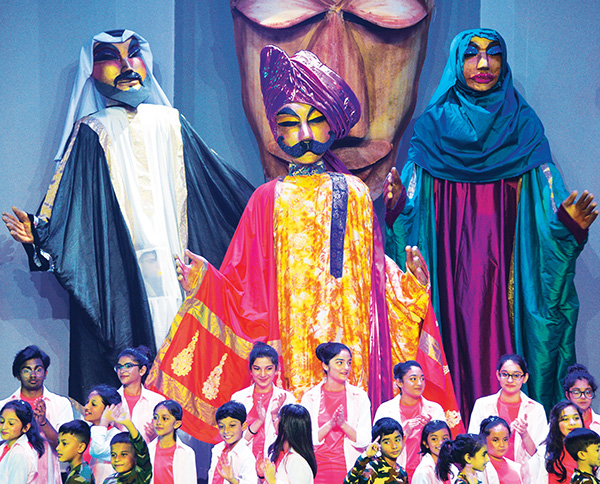
Three of the eight giant puppets from the final scene of Hulm Mumkin

Dadi Pudumjee (l) and Nargish Khambatta
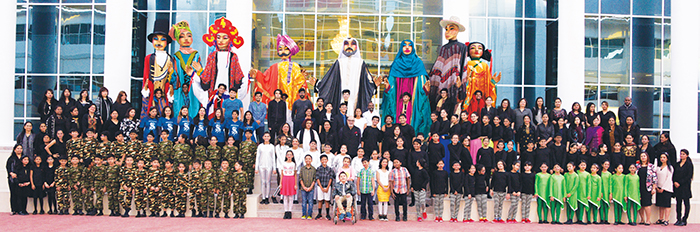
The cast of Hulm Mumkin pose with the giant puppets depicting the various communities
that live in peace and harmony in the UAE
.JPG)
Students manipulating giant fighter puppets in a war scene from the World of Violence
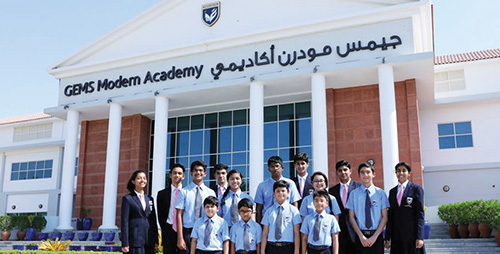
Students outside the GEMS Modern Academy
Pudumjee lit up the stage with his repertoire of modern, contemporary and traditional puppetry to gasps of awe and delight. Blending art, dance, drama, music, masks, visuals, expert choreography and lighting and even a couple of drones that excitingly hovered over the audience, he created a stylized sketch of several relatable themes in a sterling 50-minute production. Using small and mammoth puppets depicting flowers, grasshoppers, butterflies, ladybugs, snails, sea waves, jellyfish and emojis, among other objects, the children dexterously tackled issues like the triumph of good over evil, the futility of wars, water pollution, the preservation of the earth, tolerance, discrimination and the youth’s obsession with technology. As Ishara had to involve as many as 60 "sometimes over-enthusiastic” students — all those interested in performing were taken, as the school was not in favor of auditions — it decided to hit upon the idea of different worlds with each having a narrator. "One world likes violence, another likes fantasy, one is mechanical…. And they all argue,” describes Pudumjee, adding that he brought the audience into the picture by asking which world was perfect or if it was possible to bring all of them together. Skillfully woven within the script were sayings from Mahatma Gandhi, American pastor and best-selling author Timothy Keller, Persian poet, scholar and Sufi mystic Rumi and last but not the least Sheikh Zayed bin Sultan al Nahyan, the much-loved and revered founder of UAE, as the emirate observes the ‘Year of Zayed.’
Pudumjee and his band of co-workers from Ishara — India’s foremost contemporary creative puppet company which he founded in 1986 in Delhi — worked on the hectic three-day, seven-show spectacle for five long weeks. All the puppet figures were prepared by his team with the assistance of the school’s art teachers but the costumes were made by designer and textile artist Gunjan Arora in Delhi and brought to Dubai by a few teachers when they returned from their winter break; couriering costs would have been prohibitive. This was the second successful performance by the group at the same institute — in January 2016, the middle and senior school students had a performance labelled, Rihalat Al Hayat (The Journey of Life). A big hit then as now were Pudumjee’s trademark and unbelievable giant puppets, no less than 12 to 14 ft high, attached to actors’ backpacks. They represented different nationalities and towered over everything and everybody in the auditorium which had the crowd in raptures and craving for more. To my left, Ariana Wright, a six-year-old kindergarten student, who was glued to her seat all through the hour, loudly exclaimed "Wow!” several times during the performance. To my right, Dr Mauli Mahajan, in-charge of the school’s careers department, clinched it: "It gets better every time.” In the wizard’s own words, "Our techniques are simple but we stress on movement, emotion and bringing puppets and objects alive.”
How did the Poona-Delhi performer land up in Dubai? The link goes back as far as 2007 to the golden jubilee celebrations of Dehradun’s Welham Girls’ School where Ishara was invited to perform. In the audience was Nargish Khambatta, a Welham parent who also happened to be the first female House Master at the prestigious Doon School. The educationist says she was "blown away by the absolutely magnificent performance” that day. She got in touch with Pudumjee through a common friend and invited him to collaborate with the school a few years later when she took over as principal and chief executive officer of Dubai’s GEMS Modern Academy which teaches the Indian curriculum and offers the International Baccalaureate diploma. She thought it was a good idea to have Ishara come over and do a one-month workshop with the school children and teachers before the actual production. "I didn’t know who she was then,” recalls Pudumjee about that fateful phone call.
The first production was a "huge success,” according to Khambatta, who was born in Deolali and did her schooling at Barnes. "It was absolutely fantastic. Everybody loved the show, and it was a case of ‘We want more.’” And, so, round two followed, but this time with more parental engagement, including a few mothers even being on stage for the first time. She says the theme ‘The Possible Dream’ resonated "very deeply with both our parents and children.” The school has a group of eight dedicated mothers which has, over the years, been pushing for the cause of saving the world’s oceans. They successfully made GEMS Modern Academy, where Khambatta has been the principal since 2014, plastic-free. The team goes every weekend to Dubai’s Kite Beach to collect cigarette butts. "So, we decided to link the United Nations’ Sustainable Development Goal 14 (to protect the oceans) with this fabulous production. One of the scenes was a wave going over the audience, and that was phenomenal,” says the educationist.
Khambatta points out that the school also gave Pudumjee some thematic recommendations on the lines of the ‘Year of Zayed’ values which the late Sheikh Zayed embraced like tolerance, sustainability and the noble act of giving. Priyansh, a special needs pupil from Grade 4, was part of the cast for both the productions. "He absolutely came alive on the stage. He believed he was the star of the show! We were fascinated by the transformation that we saw,” gushes the principal, who recently won the first ever $ 75,000 GEMS Exceptional Head of School Award given by the GEMS Education private school network in the UAE. The microbiology postgraduate has pledged to set up a staff welfare fund at the school with half of the prize money.
"This is basically for the staff which wants to draw on when they need extra cash. Educators always go the extra mile to look after the welfare of the students, so this award is actually for them.” In March 2014, she, along with 10 student adventurers, undertook what she terms "the journey of a lifetime” to Antarctica with the first person to walk to both the Poles, Sir Robert Swan, and his 2041 team, which he established for the preservation of the frozen continent. Back in Dubai, the spirited Khambatta was promptly promoted — "I often joke that I went to Antarctica as the school vice-principal and returned as the principal!”
Two big productions in an Arab country in two years have come with lessons for Ishara. The ace puppeteer came face-to-face with the cultural norms of the country during rehearsals for their first show in January 2016. "We had planned a nice dance with girls and boys against the backdrop of Rumi’s poem, Who is at my Door? It started with two kids growing up, progressing into their teen years and then adulthood. Suddenly, we were told we couldn’t have boys and girls touching each other,” he recounts. "So, we had to keep a gap of one inch between them!”
So, it was no surprise that he had doubts about the use of the word ‘abuse’ when he included Annie Lennox’s hit song, Sweet Dreams, the lyrics of which go, "Some of them want to use you... some of them want to abuse you.” "I got mixed opinions about this when I enquired from the school staff but principal Khambatta said this was a reality and we could go ahead,” notes Pudumjee.
After two long recent stays in the country, the puppeteer par excellence, who is the first non-European to be the president of the world puppet organization, Union Internationale de la Marionnette (UNIMA), feels things are changing. "Last time, we had to even check the use of Rumi in our show. I was also told not to use words and themes with sexual connotations. But now, they are even talking about how children should be able to distinguish between bad touch and good touch…I read about this every day in the UAE newspapers.”
After decades in this creative field and countless performances across the world, he is accustomed to accommodating and understanding his host. A last-minute poem to be added to the presentation, a suggestion to change a costume…these come and go. "I suppose that’s the call of the school. When permissions are involved, then you try and go along with a lot of the things that they want. Also, when you are working for somebody, you have to be able to adjust and be flexible.”
There is a message in all his stories although the master says he likes this to be "intrinsic, not too obvious, except where small kids are the target audience.” Many of his performances are conceived for children but his themes stretch across generations; his work is popular with both the young and the old. He has handled social topics like AIDS and substance abuse with panache.
Pudumjee first fell in love with puppets as a seven/eight year old in Poona, where he grew up, after a relative gifted him two Pelham puppets — string-puppet toys made by a British firm which goes back to 1947. Soon, he was putting together his own simple string-puppets. "Maybe my parents were happy, thinking, ‘Aé chup-chaap bèsiné puppets banavéch (He is sitting quietly and makes puppets),’’’ he laughs. One thing led to another. Ahmedabad’s famed National Institute of Design beckoned in 1971, followed by his interest getting formalized at Darpana Academy of Performing Arts under the late Meher Contractor. The year 1976 saw him headed on a UNIMA scholarship to Stockholm, Sweden, to train with the iconic German-Swedish puppeteer Michael Meschke at the Marionette Theatre Institute. This was a life-changing experience: "The world of puppets opened up for me.” On his return, he was invited to start the Sutradhar Puppet Theatre, a permanent puppet theater repertory at Shri Ram Centre of Art and Culture in Delhi. Many accolades have come along the way from the Sangeet Natak Akademi to Sanskriti Pratisthan to the Delhi Natya Sangh with the Padma Shri, the country’s fourth highest civilian award — being conferred on him in 2011. This February, Ishara staged its 16th International Puppetry Festival in Delhi, a prominent annual gathering bringing puppeteers, artistes and performers from around the world to celebrate story-telling through this art form.
A bachelor, does this puppeteer, puppet-maker, director, writer-conceptualizer and workshop tutor eat, live and breathe puppets? Far from it. "Sometimes, I tell my co-workers I want to throw all this up and leave. It’s enough!” The field is far from lucrative, sponsorships are difficult to come by, state support is limited and life in the creative arts can be unpredictable and tough. "I don’t like to romanticize what I am doing – puppetry is my work,” he clarifies. "I argue with my Ishara colleagues that this is something we all chose to do. Why should an artiste be different from anybody else? I like what I am doing and I am glad I am not in a nine-to-five job. But then somebody would like to be an engineer and take home a good salary. That too is fine,” he reasons.
This modern-day kathputhliwala (puppeteer) could well be apologizing to playwright William Shakespeare and saying, "All the world’s a stage and all the men and women merely puppets.”
◆ ◆ ◆
From the archive