
The road well traveled
The ancient trade route that connected the Orient with the West was the subject of a two-day seminar at The K. R. Cama Oriental Institute
"The Silk Road, properly speaking Silk Roads, refer to those trading and transport networks that carried besides silk, several wares from Imperial China, via southern Central Asia and northern Iran to the Levant (eastern Mediterranean regions) through ancient Iraq and Syria,” according to Burzine Waghmar of the Centre for Iranian Studies of the School of Oriental and African Studies, author of the theme paper of the conference. The Road continued across the Mediterranean and "terminated at the emporium of the classical world, Rome,” according to the historian. Giving a modern context, he placed "Nisa in Russian Turkmenistan and Niya in Chinese Turkmenistan.” The route fell into disuse about six centuries ago, according to some historians.
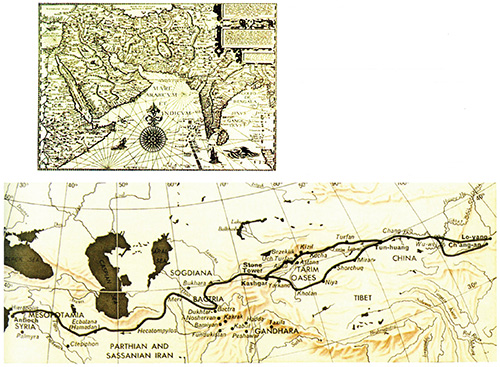
Top: map of Indian Ocean, Persian Gulf and Bay of Bengal; above: The Silk Road from China to the Mediterranean
In June 2014, the United Nations Educational, Scientific and Cultural Organization (UNESCO) named the Silk Road a world heritage site. Though the term "Silk Road” was coined in 1877 by geographer Baron Ferdinand Richthofen (1833-1905), multiple routes that comprise it have been in use from the beginning of the Chinese Han dynasty (207 BCE). The southern or Karakoram route ran from China through the Karakoram mountains and proceeded westwards, with southward spurs enabling journeys to be completed by sea from various points in the Arabian Sea.
The Road, which passed through "high mountains, deserts and the steppes,” made the regions it traversed "economically prosperous,” according to Bannerjee Sarkar whose talk was titled "Silk Road to Dharmaratna Marg.” Rome’s trade with India along this route was more, volume wise, than its trade with China, according to her. Detailed accounts of the Road and its cultures are available through monks who traveled from China to India between the third and 10th centuries. They referred to "destinations where the wind erupts in cold waves,” she said. Artifacts found along the Road include illustrated manuscripts in various languages: Sogdian, Chinese, Syrian and Tibetan. For many decades from the second century onwards, Sogdiana dominated the region and was "partly responsible for the spread of Manichaeism and Zoroastrianism,” in the region according to the historian. However, it was Buddhism that gave Central Asia "a stabilized culture,” and is still "an integral part of these regions,” she said.
Referring to various manuscripts found in the Tarim Basin in China, the professor said that region could be called a "mini India”... Brahmanical traditions, gods and goddesses became part of Buddhism in this region, each philosophy complementing the other. Indian medical systems, grammar, logic and science were known in Central Asia. Art forms in the region fused Greek and Oriental styles, and even included Zoroastrian motifs, said the scholar. "The long lasting legacy of the Road has been in bringing distant cultures and peoples in contact with each other,” she said.
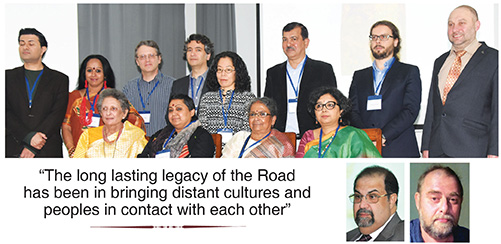
Professor in the department of ancient Indian history and culture of Calcutta University, Prof Suchandra Ghosh believes that the Road, "which consisted of many arteries and capillaries” caused a lot of "outward movement from South Asia.” Speaking on "Indo-Iranian borderlands and Central Asia: exploring their commercial connectivity (300 BCE — 300 CE),” Ghosh defined the borderlands, "which one could call the cross roads of Asia,” as the area from Afghanistan to North West India. Listed as one of the conquests of Achemenian King Darius I, who annexed it to the Persian Empire, this "international hub” was the center of the bamboo trade. Begram, an archeological site in the area revealed the existence of ivory furniture from Amravati in India, Roman goblets and knickknacks of lapis lazuli. Copper and nickel alloys reached India from this area; pepper from the Malabar coast reached Central Asia via Ujjain and Mathura in the Indo-Gangetic plain, said the professor.
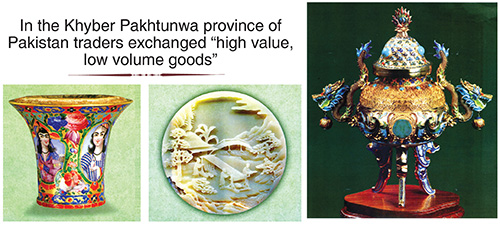
Why was there such a concentration of culture in the borderlands? queried Dr Jason Neelis. The associate professor in the department of religion and culture at Wilfrid Laurier University in Canada was describing the Shatial Bridge across the Indus River in what is now the Khyber Pakhtunwa province of Pakistan. Traders in this area exchanged "high value, low volume goods… it was the place where Indian merchants met their Sogdian counterparts.” Shatial has over 1,000 inscriptions in Indic and Middle Iranian languages, and 700 rock drawings from the third to seventh centuries, Neelis described, in his talk titled "Shatial: trading post, religious shrine, and node of cultural exchange on the upper Indus river.”
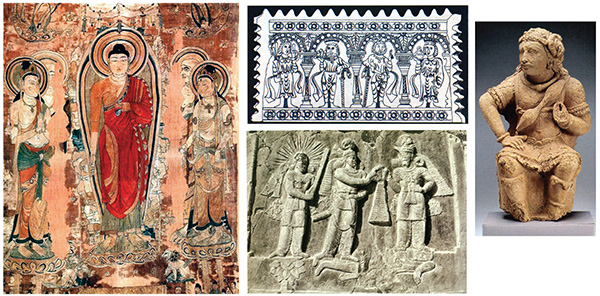
The spiritual aspects of the Road were the subject of Dr Radha Kumar’s talk "Silk routes leading to Buddhist roots.” The associate professor in the department of ancient Indian history, culture and archeology earned her doctorate for her thesis on the impact of the Buddha on ancient Indian polity. While there was material prosperity along the Road, there was also dukkha (dissatisfaction). "We see a synergy between trade and Buddhist thoughts here… merchants had to learn traditional (Buddhist) values,” Kumar said.
The working sessions on "Indo-Iranian borderlands” on the morning of January 6 were chaired by Dr Chhaya Bhattacharya-Haesner who completed her doctoral thesis on wooden objects in the Central Asian art collection of the Free University, Berlin.
The second working session was built around the regions of Sogdiana and Khwarezmia (also known in some records as Chorasmia). Waghmar described the former as comprising the areas now under Tajikistan and Uzbekistan in Central Asia; Khwarezmia extended over parts of Uzbekistan, Turkmenistan and Kazakhstan. He was reading the paper titled "Iconography of Sogdian ossuaries: origin, transformation, meanings” from Prof Alexandr Naymark, professor of art history, Hofstra University, New York. Naymark could not be present on account of bad weather on the eastern coast of USA. The professor believes that "the native form of Zoroastrianism practiced by the Sogdians remains practically voiceless” as surviving remnants of Sogdian literature comes only from Sogdian colonies where Buddhism, Manichaeism and Christianity were prevalent. According to Naymark, the differences between the Sassanian and Sogdian branches of Zoroastrianism were "very significant.”
Ossuaries (bone depositories), according to him, provide valuable clues to the interactions the Sogdians had with other neighboring cultures. The majority of these depositories were made from ceramic by local potters, the longest being 20” to be able to accommodate a shin bone. "Decorations were fluid and ever changing (over the centuries),”
according to the scholar whose slides showed many designs including those with multi petalled rosettes and upward-pointing arrows. Naymark believes that "no samples of Sassanian art depicting Zoroastrian ritual was available in Sogdiana, despite the presence of certain Sassanian seals being used by Sogdian artists as patterns.”
Speaking on "Indian styles and Indian subjects in the art of Sogdiana,” Dr Pavel Lurje, head of the Middle Asia, Caucasus and Crimea section of the Oriental department of the State Hermitage Museum, St Petersburg elaborated on the Sogdian inscriptions found in the upper Indus valley and the depiction of Sogdian traders in the Ajanta caves. There is archeological evidence of "Indian features in the floral and geometrical ornaments of Panjakent (the best known Sogdian town),” he said. Vahanas (vehicles) of Sogdian gods had Indian features… elephants were a recurring motif in wall paitings and wooden reliefs, according to Lurje. The worship of Hindu deity Shiva and his associates like Parvati and Kartikeya was incorporated into the religion of Sogdiana, "and became an integral part of the local Sogdian version of Zoroastrianism,” according to the historian.
Dr Michele Minardi, co-principal investigator of an archeological project supported by the Australian Research Council focusing on Zoroastrianism in Khwarezmia believes there is "a strong Achemenid influence in the art of Central Asia.” Speaking on "Wall paintings and modeled sculptures from Central Asia,” Minardi revealed that Zoroastrian elements appear in the figurative arts "centuries earlier” than other well known representations from pre-Islamic Sogdiana. However, from the second century onwards, the art demonstrates connections with the Kushan world (encompassing Afghanistan, modern Pakistan and northern India). Minardi’s talk was illustrated with the 2,200-year-old tower of silence of Chilpyk in Karakalpakstan (an autonomous republic within Uzbekistan), which, talking to Parsiana on the sidelines of the seminar, he called the "oldest standing dakhma… discovered in 1948.”
Earlier, welcoming the delegates and the scholars present, Dr Navaz Mody, joint honorary secretary of the Institute described the preparations for the seminar "a very long journey,” and acknowledged the role of Waghmar in preparing the theme paper and helping in locating the speakers for the two-day event. In the foreword of the elaborate conference brochure Institute president Muncherji Cama acknowledged the "relentless” efforts of Mody to conceptualize and organize the proceedings, and that of committee member Kersi Treasurywala, volunteers Surabhi Subramonian, Mansi Chandna and the Institute’s staff members.
The second day’s proceedings will be covered in a subsequent issue of Parsiana.
Resurrecting the road
The Eurasian Land Bridge (a railway through China, Kazakhstan, Mongolia and Russia) is the "New Silk Road,” according to business journalist Keith Bradsher’s July 2013 article "Hauling new treasure along the Silk Road” in The New York Times. "Now the overland route is being resurrected for a new precious cargo: several million laptop computers and accessories made each year in China and bound for customers in European cities,” he wrote.
Starting in July 2011 the line has been used by a freight train service that connects Chongqing, China with Duisburg, Germany, cutting travel time for cargo from about 36 days by container ship to 13 days by freight train. In September 2013, during a visit to Kazakhstan, Chinese President Xi Jinping introduced a plan for creating a New Silk Road from China to Europe. The latest iterations of this plan, dubbed "One Belt, One Road” (OBOR), includes a land-based Silk Road Economic Belt and Maritime Silk Road.