
Business
Harnessing hydropower
A lull in shipping two decades ago prompted Capt Percy Master to venture into renewable energy
"Are you mad?” was the family’s response when 20 years ago Capt Percy Master announced that he wanted to venture into hydropower. "What do you know about this subject?” they asked the chairman and managing director of the Master Group of Companies that includes Master Marine Services Private Limited, Prudential Global Logistics Private Limited, Prulogic, Meher Container Terminals Private Limited, Master Industries Private Limited.
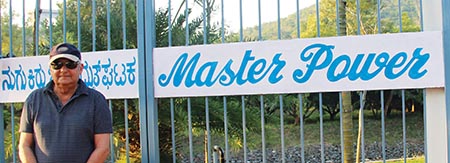
Capt Percy Master
"I didn’t then know anything about electricity,” candidly admitted Master when briefing the busload of delegates from the World Zarathushti Chamber of Commerce (WZCC) who had accompanied him to the Master Power plant in the Sargur district of Mysore on the afternoon of December 17, 2017. What he did know in the late 1990s was that "shipping was in depression and I had a staff of over 2,000.” Once he understood the pros and cons of setting up a hydropower project he had to worry about raising funds. He approached the World Bank that was willing to help, knowing there was acute shortage of power in India and Master Power would be promoting renewable energy. Construction of the plant commenced in 2000 and within two years it was commissioned.
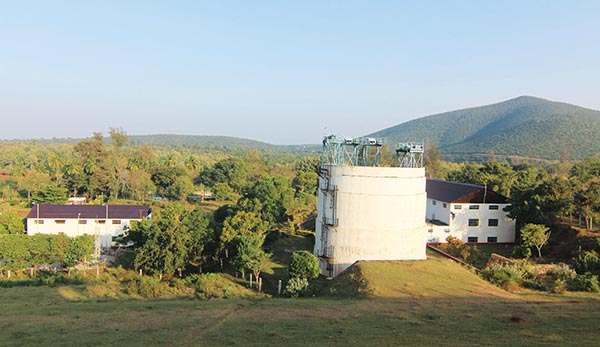
Fifteen years later when visiting the 3000 KW Nugu Mini Hydel Power plant along with the WZCC delegation, he showed us the working of two power houses of 750 KW each erected by Master Power. Water from the Nugu Dam (at a height of 110 feet) is supplied to the two power houses — high level and low level — in close proximity. "There is no wastage of water. The rain water that is collected goes back into the canal,” Master takes pride in generating renewable energy. The power houses are operated by Japanese turbines that Kirloskar imported and supplied to Master Power. The energy of falling or flowing water helps turn the blades. The rotating blades in turn spin a generator that converts the mechanical energy of the spinning turbine into electrical energy.
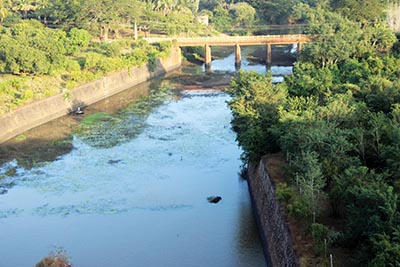
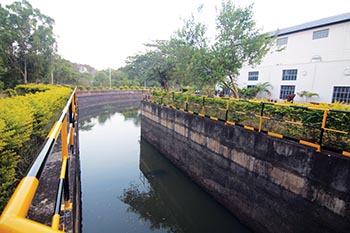
Nugu Dam water facilitates energy and greenery
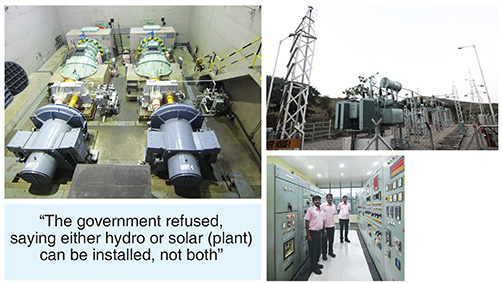
Clockwise from above: turbines; transmission towers; meter room to control power generation
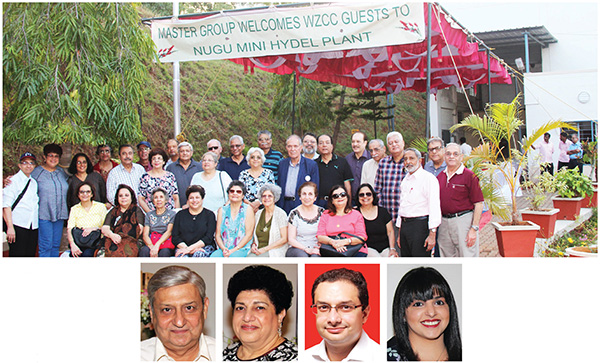
Top: WZCC contingent; (above, from l) Capt Percy, Arin, Xerxes and Zeenia Master
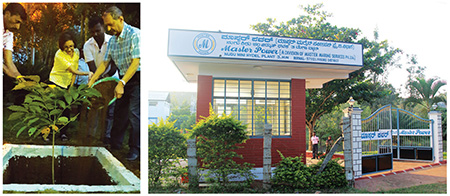
Above l: Shernaz and Feroze Bhandara plant a sapling on the Master Power
property on behalf of the WZCC delegation
Generating approximately eight to nine million units per year, the power from the plant is evacuated 7.5 kms away to the Sargur sub-station from where it is connected to the Karnataka Electricity Board (KEB)’s grid for distribution to their various clients. Master Power has entered into a renewable power purchase agreement with KEB and is certified as a greenfield project that earns carbon credits. "KEB are very good paymasters. They pay within 30 days,” appreciates Master.
"There is a big advantage of starting a small hydropower project,” states Master, for it requires limited investment and the government gives incentives per mega watt. There is a 10-year tax holiday on renewable energy. Master Power has undertaken the nearly Rs 20 crores project on a 40-year BOT (build-operate-transfer) agreement with an option to renew it. As per the agreement they had to install 30 transmission towers along the 7.5 km route.
The turbines that require regular maintenance are known to have a life span of 30 years. But Master faced a major setback in the early days when one of the turbines developed a snag and engineers from Japan were required to camp on the site for nearly 10 days to get it functional. For Master, this meant that the cost of installation doubled, but he was ultimately able to repay his loans in seven years. The World Bank loans have to be repaid on the due date; non-payment attracts a lot of penalties, revealed Master.
The purchase of rights to install a hydropower project was merely the first step. The subsequent pursuit of obtaining mandatory permits and certificates to start a plant in India, Master considers as "obstacles in doing business” as versus the much touted "ease of doing business.” For Master Power, the return on investment worked out to 15%.
Using his experience "of over 45 years in the maritime industry,” the website of the Master Group gives its founder chairman credit for fueling the Group’s growth with "the highest code of conduct and ethics.” Supporting him in his endeavors are his son Xerxes who is the joint managing director, wife Arin and daughter Zeenia who are both directors of the Group.
Whilst the bus was speeding on smooth tarred roads, Master related the scenario two decades ago when only bullock carts plied the dirt tracks. Subsequent to the installation of the plant, an entire township developed in the neighborhood with a school and college. "There have been a lot of pluses from this project,” summed up Master. The plant has generated employment for approximately 40 local engineers and officers and is helping irrigate a vast expanse of hinterland. In fact, the plant works for only seven months in a year when water in Karnataka can be used for agricultural purposes, the state being known as the food basket of south India.
"Except for some pockets, energy is now supposed to be at a comfortable stage” in the country, states Master who would have liked to set up a solar plant too on their property but "the government refused, saying either hydro or solar can be installed, not both.” In the meantime they have obtained a permit for a second hydropower plant on the Hemavati River. Earlier there were a lot of Zoroastrians generating wind power to avail of depreciation benefits in the first year. Currently, wind power is not a lucrative avenue, believes Master.
"We are firm believers in long-term relationships, be it with our clients, employees, business partners, and our investors,” notes their website. "We want our clients to benefit from the solutions we have to offer. We want our employees to be satisfied with the growth and the opportunities they receive within the organization. We want our business partners, especially our vendors, to grow with us as we do. Finally, we want our investors to be secure in the knowledge that their investment is in a sound company that adheres to the highest levels of financial and corporate governance and delivers a reasonable rate of return on capital employed.”
Even one-time visitors to the Master Power property are given privileged treatment. Master being the president of the WZCC India region, for his fellow members he had arranged a special welcome banner that fluttered in the breeze. Before leaving the premises, they were invited to plant a sapling as a memory of their trip and of Master Power’s perpetual endeavors to add greenery to their environment.
◆ ◆ ◆
From the archive