
Travel
Community connections
Even in the remote regions of North Western India Parsis have left their imprint
It was the start of a perfect "7-11” of family bonding. Seven cousins meeting for 11 days, visiting places most of us had not seen before...Amritsar, Dalhousie, McLeod Ganj and Dharamshala.
We took the early morning Shatabdi from New Delhi station for the eight-hour train ride to Amritsar. It was a most comfortable and pleasant journey. Wide, reclining seats, plenty of leg room, the morning newspaper followed by tea, coffee and a breakfast tray with a fresh, hot omelet, toast, butter, jam and fruit. I decided to walk down the corridor to stretch my legs. The train was full of good looking, well fed sardarjis, their wives and children. Kirtans and bhajans were being sung or being shown on television.
The drive from Amritsar station to the Hotel Regenta Central had us in a state of dismay. The city was crowded, the traffic chaotic and the sidewalks littered with garbage. But once we entered the hotel to "namastés (Indian hand folded courtesy)” by turbaned doormen, things improved. The rooms were large and comfortable, but claustrophobic, as not a single window or balcony door opened.
We took the early morning Shatabdi from New Delhi station for the eight-hour train ride to Amritsar. It was a most comfortable and pleasant journey. Wide, reclining seats, plenty of leg room, the morning newspaper followed by tea, coffee and a breakfast tray with a fresh, hot omelet, toast, butter, jam and fruit. I decided to walk down the corridor to stretch my legs. The train was full of good looking, well fed sardarjis, their wives and children. Kirtans and bhajans were being sung or being shown on television.
The drive from Amritsar station to the Hotel Regenta Central had us in a state of dismay. The city was crowded, the traffic chaotic and the sidewalks littered with garbage. But once we entered the hotel to "namastés (Indian hand folded courtesy)” by turbaned doormen, things improved. The rooms were large and comfortable, but claustrophobic, as not a single window or balcony door opened.
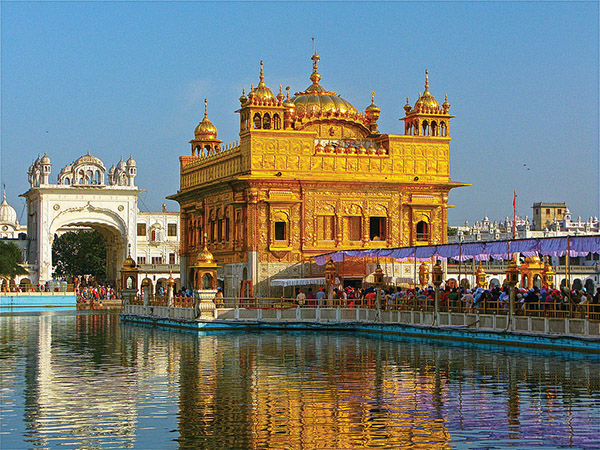
Golden Temple in Amritsar: holiest pilgrimage site for Sikhs Photo: Wikipedia
That first evening we decided to visit the Golden Temple (GT), the holiest gurdwara and the most important pilgrimage site of Sikhism, built in the 16th century by the fifth Sikh Guru Arjan. The temple is surrounded by a colorful but noisy marketplace selling garments, jutees (footwear), cheap jewelry, toys, eats and non-alchoholic beverages. Shawls sold for Rs 300 while elsewhere in the city the price could be Rs 600.
The GT is set in a gigantic manmade pool. Thousands of devotees, mostly Sikhs with an intermingling of others and groups of foreign tourists, thronged the carpeted pathways. But the place was spotlessly clean. Not a single piece of paper, plastic or a dry leaf could be seen. In the sanctum sanctorum, devotees were sitting mesmerized, kirtans were being sung. Currency notes of all denominations were offered as donations.
A free lunch and/or dinner is available to any visitor at the langar (community kitchen), manned by volunteers. Cutting, cooking, serving, washing-up, is done with quiet efficiency. Foreigners seated on their haunches helped in the washing of plates. We partook of prasad (consecrated food) comprising a generous dollop of sweet, tasty halva dripping with ghee.
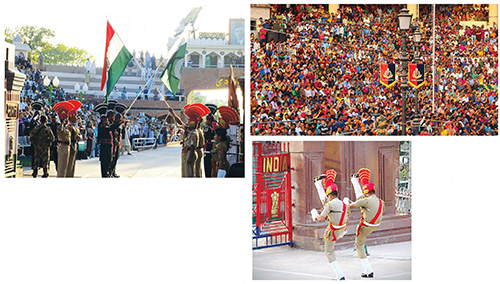
At the India-Pakistan Wagah border: tourists throng to witness the
ceremonial lowering of flags at sunset Photos: Wikipedia
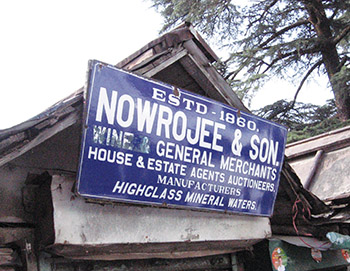
Nowrojee & Son shop in McLeod Ganj
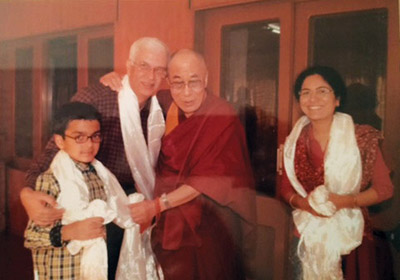
(From l) Yaosh and Parvez Nowrojee, the Dalai Lama, Keity Nowrojee
Uncle’s photo
We visited the Wagah Border the next day. Our good friend from Nagpur, Supriya Chaudhuri, wife of Maj Gen Sandip Kumar Chaudhuri (who had died in the line of duty) had arranged passes for the VIP enclosure and an army person to meet and accompany us. As we were being escorted inside, to our great surprise and pleasure we saw a large screen with the photograph of our uncle, Khusro F. Rustamji, the chief and founding father of the Border Security Force (BSF). All of us were thrilled. Jal Kanga informed one of the officers walking with us that Rustamji was the mama (maternal uncle) of my cousin Hilla and myself. The officers of the BSF were thrilled to meet someone from Rustamji’s family.
There were thousands of people on the Indian side but fewer Pakistanis on the other side close by. Even an hour before the ceremony of lowering the flags began, there was much shouting and singing with cries of "Hindustan zindabad (Long live India)!” Youngsters danced waving the Indian flag.
Half an hour before sunset at 5.30 p.m. a hush fell over the audience and everyone took their seats. Then started the exaggerated marching and stamping of feet and theatric daring and glaring between the soldiers of each side. After about 20 minutes, the bugles sounded the Retreat. The flags of each country came down ceremoniously and were carefully folded. Soldiers on each side saluted each other and the ornate iron gates were shut. Since word of our connection to Rustamji had spread, at the end of the Retreat ceremony, we were invited to a carpeted tent for tea with a few other VIPs.
On our third and last day in Amritsar we drove to Sadda Pind, a popular tourist attraction which means "My Village.” The entrance fee of Rs 650 per person was worth a morning of entertainment, fun and food.
There were mehendiwallis (women to decorate palms with henna) and malishwallas (masseurs), jadugars (magicians) and tight-rope walkers. You could join in the lively Bhangra (traditional regional dance) or traditional Gidda (a popular folk dance). The Gatka, a traditional martial arts dance with swirling swords was fascinating. Among the delicacies were fresh, hot makkai ki roti (Indian corn bread) and sarso-ka-sag (cooked mustard leaves) followed by freshly churned lassi (yogurt based drink).
We visited the Wagah Border the next day. Our good friend from Nagpur, Supriya Chaudhuri, wife of Maj Gen Sandip Kumar Chaudhuri (who had died in the line of duty) had arranged passes for the VIP enclosure and an army person to meet and accompany us. As we were being escorted inside, to our great surprise and pleasure we saw a large screen with the photograph of our uncle, Khusro F. Rustamji, the chief and founding father of the Border Security Force (BSF). All of us were thrilled. Jal Kanga informed one of the officers walking with us that Rustamji was the mama (maternal uncle) of my cousin Hilla and myself. The officers of the BSF were thrilled to meet someone from Rustamji’s family.
There were thousands of people on the Indian side but fewer Pakistanis on the other side close by. Even an hour before the ceremony of lowering the flags began, there was much shouting and singing with cries of "Hindustan zindabad (Long live India)!” Youngsters danced waving the Indian flag.
Half an hour before sunset at 5.30 p.m. a hush fell over the audience and everyone took their seats. Then started the exaggerated marching and stamping of feet and theatric daring and glaring between the soldiers of each side. After about 20 minutes, the bugles sounded the Retreat. The flags of each country came down ceremoniously and were carefully folded. Soldiers on each side saluted each other and the ornate iron gates were shut. Since word of our connection to Rustamji had spread, at the end of the Retreat ceremony, we were invited to a carpeted tent for tea with a few other VIPs.
On our third and last day in Amritsar we drove to Sadda Pind, a popular tourist attraction which means "My Village.” The entrance fee of Rs 650 per person was worth a morning of entertainment, fun and food.
There were mehendiwallis (women to decorate palms with henna) and malishwallas (masseurs), jadugars (magicians) and tight-rope walkers. You could join in the lively Bhangra (traditional regional dance) or traditional Gidda (a popular folk dance). The Gatka, a traditional martial arts dance with swirling swords was fascinating. Among the delicacies were fresh, hot makkai ki roti (Indian corn bread) and sarso-ka-sag (cooked mustard leaves) followed by freshly churned lassi (yogurt based drink).
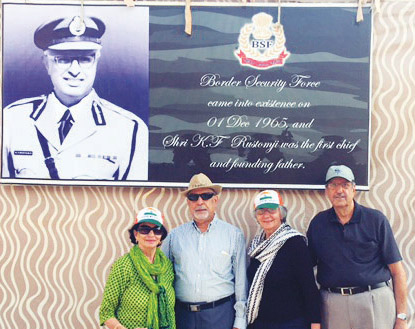
L to r: Dilnavaz and Edul Bhagwagar, Hilla and Jal Kanga at the
Wagah border where Khusro Rustamji is remembered by the Border Security Force
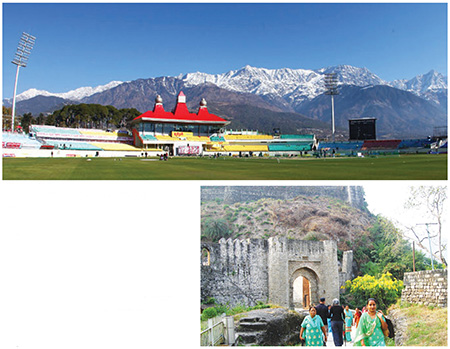
Top: Dharamshala Cricket Stadium Photo: Wikipedia; above: historic Kangra Fort Photo: Dilnavaz Bhagwagar
"Dull and lousy”
Our next stop was Dalhousie in Himachal Pradesh. By the time we completed the five-hour drive and reached our hotel, we were feeling queasy and nauseous. The winding drive up the hills and the dhaba (wayside stall) lunch en route with generous blobs of butter in the dal makkhani (buttered lentils) must have been the cause.
The weather was exceedingly cold (for late October) and few guests ventured out. The local tourist sites mentioned were overrated. The Kalatop Wildlife Sanctuary had no wildlife left. The Khajjiar Plateau touted as a mini Switzerland was nothing more than a saucer shaped meadow with a small pond of dirty water surrounded by hills. The Satdhara Falls, described as "the seven springs that fall from a great height, down majestic mountains and cliffs” did not have even a trickle of water. The St John’s Church was the only well preserved place we saw here. We renamed Dalhousie — Dull-and-lousy.
After two days, we drove to Dharamshala. McLeod Ganj and Dharamshala are conjoined towns. The former was named after David McLeod, governor of Punjab under the British rule. Today the twin towns are the home of the revered Dalai Lama and the administrative headquarters of the Tibetan Government in exile. Buddhist monks — both men and women — with shaven heads and orange-red robes are seen everywhere. Tourists, both Indians and foreigners, throng the place.
The Main Street leading to the Buddhist Temple and the Dalai Lama’s residence is crowded with people, shoe-box sized eateries and shops selling Tibetan jewelry, scarves and shawls. We enjoyed lunch at a Tibetan restaurant serving thupka (soup with noodles and chicken) and fresh steamed momos.
Being cricket buffs, we had always envied cricket lovers seeing matches at the Dharamshala Cricket Stadium. The Stadium is built at a height of 4,780 ft above sea level, against a backdrop of the Himalayas.
The next day we drove 62 km to visit the centuries old Jwalamukhi Devi Temple that has no deity or statue inside. A blue flame coming out of the rocks is considered a symbol/reincarnation of Jwalamukhi Devi. People believe that every wish made by a true devotee will be fulfilled.
On the drive back, we stopped at the Kangra Fort. It is of massive size and historic significance. At the entrance, a museum displays photos of the Fort prior to the devastating earthquake of 1905 and some valuable idols and artifacts that were saved.
The Chinmaya Tapovan Trust and Ashram founded by Swami Chinmayananda in 1977 comprises a temple, a massive statue of Hanuman (the monkey God), satsang (prayer) halls, classrooms and dormitories for serious students of Chinmayananda.
We spent our last morning at Norbulingka, the Tibetan monastery where 1,173 images of Buddha decorate the 44 ft high temple hall. The gilded 14 ft copper statue of Shakyamuni (Gautama) Buddha, is the largest of its kind. We were lucky to witness a prayer and training session for the monks in the temple. Sounded very much like our Avesta prayers being chanted.
A big signboard over a shop in McLeod Ganj read "Nowrojee & Son” which was established in 1860 and is one of the oldest shops in the vicinity. The establishment catered to the daily requirements of the British officers and their families, retailing liquor, arms and ammunition, tobacco, toiletries, newspapers and magazines.
Five generations of the Nowrojee family worked there. Nauzer Nowrojee, the last of them,was a close friend of the Dalai Lama and played a significant role in the settlement of the Tibetan refugees who fled to India from Tibet in 1959 and onwards. "Dad was proud of his excellent relationship with the Tibetan spiritual leader,” his son Pervaze wrote. Nauzer looked after the store-cum-residence set up by his great-grandfather for over 60 years, till he expired at 85. When he died, all the shops located on the street downed their shutters, as a mark of respect for him.
To find a K.F. Rustamji being idolized at the Indo-Pak border and a Nowrojee revered and respected on the Himalayan slopes of northern India, are reasons for retrospection and respect for those who came before us and left their imprint.
◆ ◆ ◆
From the archive