
Seminar
Trade and textiles - II
The second day of the textile seminar at the K. R. Cama Oriental Institute zoomed into communities and their effects on trade
"Textiles play an important role in the Zoroastrian religion. Especially two of them, the sacred girdle (kusti) and undershirt (sudreh), were considered a sign of the Zoroastrian identity and belief,” the abstract of Dr Miguel Angel Andrés-Toledo’s paper states. The garments’ importance has been referred to in the Vendidad as well as the Nerangestan stated Andrés-Toledo whose research interest is old and middle Iranian languages. He lectures at the University Of Copenhagen, Denmark as the Marie Curie fellow. The scholar specified that details about the weavers, raw material, number of threads, length, breadth and color are only available in the Pahlavi translations of the Avestan text or in later Pahlavi texts. The professor added that Avestan is the oldest Iranian language preserved and takes its name from the Avesta: "The Avestan sources explicitly mention from what age, who, when, where exactly and how one must wear it (sudreh), as well as with what it was symbolically connected.”
Andrés-Toledo specified that from age 15 after the navjote, one is legally responsible for one’s deeds as per the Vendidad. He drew a parallel between two threads of life — the Hindu sacred girdle, janoi, and our own kusti. Delving into Indo-European languages to go to the very fabric of what is the written word, he proclaimed "the text is final — only interpretations are different.”
Andrés-Toledo was speaking at the "Textiles, Collections, Communities, Culture and Trade” seminar at the K. R. Cama Oriental Institute (KRCOI), which dealt with three sessions on Communities and Trade on the second day, January 10, 2016. Each focus had five speakers.
Andrés-Toledo specified that from age 15 after the navjote, one is legally responsible for one’s deeds as per the Vendidad. He drew a parallel between two threads of life — the Hindu sacred girdle, janoi, and our own kusti. Delving into Indo-European languages to go to the very fabric of what is the written word, he proclaimed "the text is final — only interpretations are different.”
Andrés-Toledo was speaking at the "Textiles, Collections, Communities, Culture and Trade” seminar at the K. R. Cama Oriental Institute (KRCOI), which dealt with three sessions on Communities and Trade on the second day, January 10, 2016. Each focus had five speakers.


Left: A weaver at a pit loom in Assam; Printed muslin from Lepakshi, Andhra Pradesh
Prof Archana Shastri from the Maharaja Sayajirao University (MSU), Baroda, and other premier educational institutes, dwelt on the unstitched clothing of Rajasthan and Gujarat. She conjectured that due to constant migration and links the indigenous folk conserved their garments without external influence, especially in the Dang region of north-west Gujarat. The langot (narrow piece of cloth worn between the legs), kachchha (forked dhoti drape) and uttariya (unstitched upper garment) remained unspoilt by external influences as garb for men. Shastri also referred to the seedha palla sari (draped over the right shoulder) which lent itself to the Parsi gara embroidery. Dang women dressed in two-piece wear, making no attempt at matching the lower and upper garments!
Contrarily, in Rajasthan there has been a lot of adaptation in dress and language due to constant migration, she enlightened the gathering. The professor termed it "cultural cannibalization” and alluded to the Rajasthan royal Maharani Gayatri Devi who wore saris in chiffon and sleeveless fashionable blouses with strong western influences as an example of adaptation to outside influences.
Dr Monisha Ahmed gave her talk on weaving amongst the nomads of Ladakh where she has been researching from 1987. The doctor, who is associate editor of Marg Publications, cited a legend according to which a lama had taught weaving to demonesses as a healing agent. Legend has it that anyone who ceases to weave is under threat to return to her demonic form. The government has tried to introduce the foot loom, but it has not caught on as the tribe believes that a sacred object with religious associations cannot be woven with the feet. The nomadic pastoralists raise sheep, pashmina goats and yaks. Men and women weave on separate looms and men inherit woven tents with a specific pattern of stripes and blocks (yud) which are passed on from father to son. A woman is expected to weave a woolen cloth (nambu) for each of her family members. The choice of wool and technique vary between the cloth for a male and female wearer. Caves have been excavated with weaving motifs, the researcher apprised participants. Half the inhabitants here are Buddhists and the other half, Muslim; but they thread their lives together as one mountain people.

L to R: Krishna Amin-Patel, Prof Archana Shastri, Dr Miguel Andrés-Toledo,
Dr Monisha Ahmed, Dr Ivy Dhar and Prof Prapassorn Posrithong

L to R: Dr Jasminder Kaur, Prof Ishrat Alam, Dr Lotika Varadarajan, Dr Chhaya Goswami,
Dr Radhika Seshan and Dr Meha Priyadarshini

Above: Amin-Patel, Dr Orit Shamir and Varadarajan examining
a Thai textile; A part of the audience
Dr Ivy Dhar from the Ambedkar University, Delhi spoke of the Khasis of Meghalaya. "Each tribe and sub-tribes’ clothing pattern differs from the other,” her research reflects. Every Jainsem, dhara or nara traditional piece worn by the Khasi women is unique and tells a story in color, pattern and motif. Colors at specific festivals indicate a message e.g. yellow during Nongkrem festival depicts the woman to be a virgin; an old woman makes a statement of her age by wearing "the old color.” The intricacy of weaving is markedly in the border but as the indigenous moga silk gets rarer, the natives opt for alternatives — even the Benarasi zari.
Looming large at the seminar was Dr Lotika Varadarajan who stitched together the two-day seminar. She concluded the third session with her own paper on Indian weaving traditions with special emphasis on Gujarat. Varadarajan is familiar with tribal culture in Assam, has pursued French cultural studies and been resource person for textile exhibitions, consultant to museums and design institutes of all hues and is currently cataloging the textile collection of the National Museum, New Delhi.
Author of 12 books, 77 professional articles and specialist in the Asavali loom, Varadarajan set the canvas to explain that Asavali was a place near Ahmedabad as well as a method of brocade weaving with fabric ornamentation. The scholar regretted that we have no archeological evidence of weaving traditions, but only ethnological evidence. Weavers, she said, had no dedicated space for weaving. The horizontal loom was stored vertically at night so that that space may be used for domestic activities. She displayed knowledge of variances in weaving techniques displaying her best samples on the table.
The next two sessions on trade were chaired by Prof Ishrat Alam of the Aligarh Muslim University who had delivered the inaugural address the previous day. After a box-lunch, Dr Radhika Seshan spoke on longcloth and muslin in the 17th century of the East India Company. The Poona University associate professor, with her expertise in economic medieval Indian maritime and urban history, focused on increased demand for textiles in exchange for spices; on various kinds of cloth ordered by global customers and on the impact this had on Indian textiles becoming integrated with world economy.
Projecting a photograph of the French queen Marie Antoinette wearing a muslin dress, Seshan explained that Indian muslin was famous and fashionable in 18th century Europe. She specified, "It was also a world in which there was virtually no demand for European products…” Similarly, chintz was another type of cloth made for the European market with its broad floral patterns and glazed finish. The very word is derived from Sanskrit chitra meaning spotted or bright. Author of several books, Seshan talked at length on longcloth where looms were set up outside the house in the shade of trees as the loom was of unusual length.
Dr Chhaya Goswami spoke about trade with Muscat and Zanzibar from Kutch and highlighted Kutchi use of threads, weaving and printing techniques. A research fellow at the University of Exeter, UK specializing in business and oral history, Goswami emphasized how Mandvi and Bhuj, cities of Gujarat, "emerged as the most important centers of textile production for Arabia and Africa.”
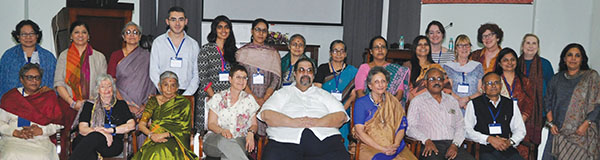
Speakers of both days with Muncherji Cama and Dr Nawaz Modi (seated 5th and 6th from left)
Dr Meha Priyadarshini threw light on trade of Indian cottons with Latin America, as the route fell between the Philippines and colonial Mexico. Though there is little documentation, whatever is available from ship manifests, inventories and paintings suggested great diversity of all kinds of textiles going from India to Latin America. Evidence of casta paintings indicates that not only the Spanish but also mulattos and negros wore Indian textiles. The volume of trade was limited to one ship a year. There is evidence of local produce which looked like Indian textiles and was termed indianillas. The post-doctoral fellow at Kunsthistorisches Institut in Florence, Italy spoke of the high demand of porcelain, ivory, spices and beeswax paid for with silver.
The fifth and final session was addressed by Prof Prapassorn Posrithong, an independent scholar formerly from the MSU, and Dr Jasminder Kaur from the Benares Hindu University (BHU), who now teaches textile designing there. Posrithong quoted the Treaty of Friendship, signed between Thailand, Britain and its colonies around 1855 states that Abdul Tyeb Maskati founded the oldest existing Indian firm in Thailand. Maskati traded in chintz or phalai (chintz in Thai). The traders’ blocks are still preserved and reflect Thai taste.
 Maskati popularized phalai as traditional Thai hip-wrappers. In fact, Indian textiles were reserved for use by royalty and courtiers — distributed as per rank — as also shoulder bags for Buddhist monks. A cook-turned-entrepreneur, Maskati also popularized saudagiri, which was phalai with different designs of Islamic geometric grid including more floral motifs, in Cambodia and Burma.
 BHU stalwart Kaur spoke on the Chambal rumal (handkerchief) of Himachal Pradesh which was gifted and often offered as a token of goodwill or as a greeting to guests. She distinguished between folk and classical styles. The classical, which had royal patronage was sober with soft colors and sharp figures. Classical themes revolved around Radha-Krishna, scenes from the epic Ramayana, Gods from the Hindu pantheon and shikar or hunting scenes. The folk representations had uneven stitching and bright, eye-catching colors. Silver gilt wire was used occasionally to produce a glittering effect. Originated in the folk style, the rumal was later adapted to the classical as miniature styled Pahari rumal embroidery.
Krishna Amin-Patel chaired the session on Communities as she is a design educator at the National Institute of Design (NID), Ahmedabad and is currently documenting the textile traditions of the North-East. Amin-Patel delivered the valedictory address: Survival of Indian Weavers, their Craft: Challenging Times. The NID faculty informed the audience that "applying fast colors to fabric was in itself quite an achievement when other nations were struggling with this particular problem.” The professor aired two main reasons why the handloom industry got a setback — the speed of mechanized looms in comparison to handlooms and poor payment to weavers as compared to mill workers. The death knell was sounded in free India when handloom was defined as "any loom other than a power loom,” wherein only one (of several) processes would be done by hand.
Amin-Patel recommended that "craft taught in schools also needs to be completely revamped in content and approach” to inculcate respect for heritage and handmade products. A more hands-on approach through field visits to crafts villages, she believes, may lead to innovating new methods, fabrics, productivity and pride in one’s creations.
Concluded
◆ ◆ ◆
From the archive