
Genesis of Godrej Baug
A behind-the-scenes story of the creation of Godrej Baug
During my professional visits to Mount Napean, the palatial building belonging to the Dubash family at Napean Sea Road, I could see the vast vacant Doongerwadi lands from the third floor as also the municipal garden at the far end. On going through the BPP’s records, I realized that the land where the bunglis and dakhmas are located had been gifted by the British Government to the Punchayet for "disposal of the dead.” The rest of the land, it seemed, had been purchased by some sethias and donated to the BPP.
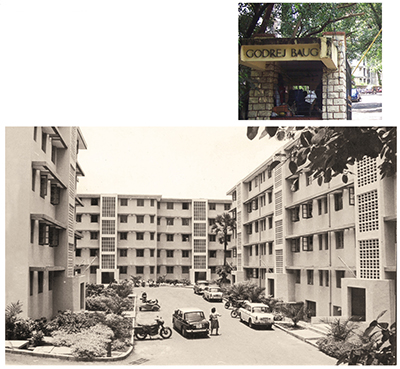
The colony, circa 1980; above: current entrance gate
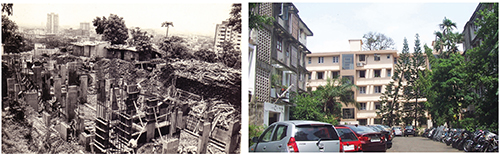
Above (left): buildings under construction; (right): Godrej Baug today
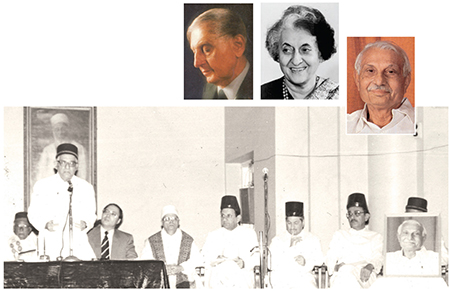
During one of my professional visits I asked Bomanji Dubash whether it would be possible to create an entrance to these lands through the wall of the adjoining building, West Hill. He was of the opinion that an approach from Napean Sea Road was not feasible for more than one reason. I later took some of my co-trustees to the terrace of a nearby building so they could have a clear view of the vacant plots belonging to the Punchayet.
My friend, the late Rusi Kuka, being friendly with the then municipal commissioner, M. W. Desai, we approached Desai regarding a possible entry through a break in the wall of the municipal garden adjoining the land. Desai was good enough to visit the site on a Sunday morning with Kuka and myself. He suggested that if the BPP could give 15% of the land abutting the garden wall to the Bombay Municipal Corporation (BMC) he would put up before the standing committee the issue of the BPP constructing residential buildings after obtaining necessary permissions from the state government.
Soon thereafter I prepared a detailed note on this favorable development for the BPP chairman and co-trustees. Unfortunately, today very few papers are available with the Punchayet but I found a copy of a 10-page note submitted by senior trustee, the late B. K. Boman-Behram dated April 12, 1976 with reference to my submission. This stated in conclusion: "We should go ahead with our scheme of constructing dwelling houses on the abovementioned plots marked O, M and P. Already the expectations of the community have been raised high and it will furnish a serious setback to the reputation and prestige of the Parsi Punchayet if one failed and did not implement the scheme before us. I would only say that the days of inaction are over and unless we have a fairly big housing program and start to implement it, we shall be failing in our duty to the community which is already in bad shape. Petty or even technical considerations should not be allowed to stand in the way of greater good for the community.”
Now the problem was funds which the BPP did not have even to begin implementation of the project which was conceived as far back as 1978. A ladies committee of which Jer Bardi became the most active member was set up and named itself "Spenta.”
Under the chairmanship of Boman- Behram, the BPP trustees approached the Pirojsha Godrej Foundation, of which I had the good fortune to be a trustee. A meeting was held at Godrej Bhavan on the evening of May 3, 1978, when all seven BPP trustees met Naoroji Godrej and Phiroze Lam who is executive director of Godrej today, and also a trustee of the Godrej Foundation.
Since Desai had by now obtained sanction from the municipal standing committee, an approach/entrance was possible by breaking a part of the wall. It was therefore decided to hand over 15% of the adjoining Doongerwadi land to the BMC to expand its garden.
The BPP had succeeded in getting Urban Land Ceiling (ULC) clearance after a request to the charity commissioner for Plot O. The planning and building work on Plot O was to be carried out by the construction department of Godrej and Boyce Manufacturing Company Limited at cost, under the supervision of their structural engineer Maneck Engineer.
Though Plot O was fully built upon in about four years’ time, development and construction of dwellings on the larger M and P plots was not possible because the BPP had not succeeded in getting ULC clearance from the state government despite written requests for more than five years. It was therefore decided by Naoroji that his brother Sohrab Godrej and I, as chairman trustee of both the BPP and Pirojsha Godrej Foundation, should travel to New Delhi and meet the then Prime Minister Indira Gandhi who knew the Godrej family fairly well.
Sohrab had fixed an appointment for the afternoon of July 15, 1982 and the lady was good enough to meet us at her residence. I submitted the application for exemption from ULC for the Doongerwadi plots and explained the purpose of the visit. I still recall her words, "I am worried that an intellectual community like yours is going down in numbers. Leave the application with me and let me see what I can do.”
It was in late 1984 that the commissioner of the Konkan region V. Sundarum released the lands in question under his order dated January 19, 1984. Incidentally, Sundarum was a friend of BPP trustee Jamsheed Kanga who played an important and useful role in the setting up of Godrej Baug.
I had earlier met Khurshed Bardi, chief accountant of Godrej and Boyce and a senior trustee of Pirojsha Godrej Foundation to ask for a donation to initiate construction on Plot O. Since the development cost had not been finalized, the Punchayet had to spend some of its own funds as the expenditure increased to Rs 58 lakhs.
In the meantime, by his letter dated December 3, 1981 addressed to the BPP trustees, Khurshed emphasized some terms and conditions to be laid down for future tenants, stating that "you are all aware, we have been actively involved in the construction of Godrej Baug and the immense manpower, labor and effort which our representatives put in over the last two years cannot be calculated in monetary terms.”
Also, by another clause, it was stated that "all construction activity will be undertaken with the assistance and supervision of the Godrej Foundation. In the event of the Foundation expressing in writing their inability to do so, the trustees of BPP shall be at liberty to have the same constructed by such person or persons they may deem fit.” One such building was built on Plot M by Dinshaw Mehta in memory of his late father, Rusi.
I had the privilege of laying the foundation stone of the mobed quarters building with 20 flats constructed by the BPP at a cost of Rs 3,88,000 on Plot M.
Agiary at Godrej Baug
In 1985 Engineer mooted the idea of an agiary, which was fully approved by Naoroji. The work began in 1986 and Engineer and his team were entrusted with completing construction at cost. However, due to a lack of funds, they were instructed not to exceed an initial expense of Rs 10 lakhs.
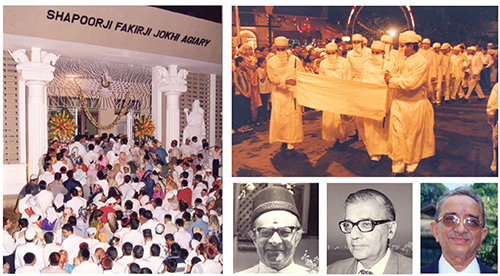
To quote from "A new home for an old fire” (Parsiana, March 1988), "It was a wobbly climb to the site of Godrej Baug’s proposed agairy as Dastur (Dr) Hormazdyar Mirza and six mobeds performed the jashan ceremony in the shelter of a shamiana on January 31, 1988. More than 200 assembled Parsis trailed the Dastur, BPP chairman Dr Aspi Golwalla and trustees Eruch Desai, Jamsheed Kanga, Homi Ranina, Jamshed Guzder and Dr Mehroo Bengalee down an even trickier slope to watch Golwalla lay the foundation stone… Like a hexagonal crown, the agiary will straddle a Malabar Hill peak… The agiary as conceived by Maneck Engineer will cost 45 lakh rupees to complete, noted Golwalla in a formal address in Gujarati after the ceremony.”
Great difficulties were encountered during the construction of the agairy considering the hilly terrain and especially for laying the water line and the drains, by blasting the rocks around the building for which special permissions were sought from the police and the municipal authorities, which took considerable time.
Well water which is essential for religious ceremonies was not available in the present location and after making about two 200 ft bores deep in the near vicinity, it was decided to take advantage of an old well in the Ambawadi area and bring the water to the well within the agairy through an underground pipe. It must be recalled that the advice of the learned Mirza and Dastur (Dr) Kaikhusroo JamaspAsa was taken during the planning of the agiary.
As there was some problem in obtaining permission for a fire temple on Doongerwadi lands, a written opinion was sought from Dastur (Dr) Firoze Kotwal. Finally, the building was completed in 1998 and the occupancy certificate for the fire temple was obtained on July 20, 1998.
The structure on the whole has its own beauty and symmetry in architecture. However, some additions and alterations were carried out by the architects of the philanthropic Jokhi family with added funds to construct other benefits like a prayer hall and residential accommodation for the mobeds attending to the fire temple, day and night.
The two consecrated fires under consideration for relocation at Godrej Baug were from the Langrana (Godiwalla) agiary at Fort, maintained by the BPP and the Ashburner Adarian at Golpitha. However, due to opposition from some Parsi residents, the idea was shelved. Around this time one Hoshang Doongaji, trustee of the Doongaji Agiary at Bharuch met me in the Punchayet office and offered a sum of Rs 10 lakhs from the trust if the holy fire from the Bharuch fire temple could be relocated at Godrej Baug. While this was under consideration by the BPP trustees, some Parsis in Bharuch approached the charity commissioner and successfully blocked the shift.
Ultimately, it was the Tavdi fire at Navsari which was brought to Bombay with necessary rituals and placed at Vachaghandhy Agiary at Hughes Road for a few hours. At the break of dawn the next day about 300 Parsis, led by Ervad Asphandiar Dadachanji walked to Godrej Baug and the fire was installed in the agiary premises.
I cannot end without paying tribute to Naoroji for his devotion to the birth of Godrej Baug as also the Adarian. He used to come to the site once every week in the last 10 years of his life to see that Godrej Baug and the agiary would become a reality. In the last two years of his life, when his health suffered and he had to be hospitalized, on his return home Naoroji instructed his driver to take the car around the Baug during the final stages of construction.
It is unfortunate and a lacuna that the portrait of the late visionary Naoroji does not adorn the walls of the Adarian in the colony, let alone that of Engineer, the most efficient and hardworking structural engineer of Godrej and Boyce.