
Health
“The air borne cancer”
Much needs to be done to counter the growing menace of drug resistant tuberculosis
Welcoming the audience on behalf of the Foundation for Medical Research (FMR) at the National Centre for the Performing Arts "at the Little Theatre for a big problem,” Dr Nerges Mistry launched the event "TB Threat: Lessons learnt from Mumbai’s response” on March 29, 2016. "No chief guests have been invited — you have all to be the chief guests,” Mistry, one of two moderators for the evening, told the 100 odd invitees.
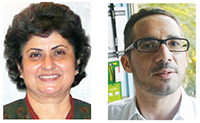
Nerges Mistry (left) and Dr Petros Isaakidis
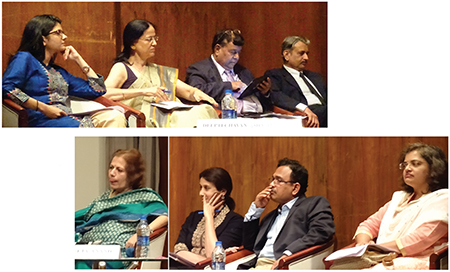
(1st row l to r): Deepti Chavan, Dr Shalini Bharat, Dr Jayant Banthia, Dr Gustad Daver,
(2nd row): Dr Minni Khetarpal, Geeta Anand, Dr Pralhad Prabhudesai, Dr Ira Shah
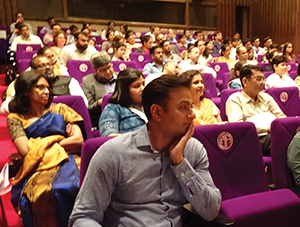
Chapan Mehra (in foreground) as part of the audience
"Tuberculosis (TB) is now termed the air borne cancer,” and affects households irrespective of income, Mistry commenced. Bombay is the TB drug resistant (DR) capital of India as population density is high, especially in the slums. Around 12.5 million live in an area of 437 sq km in metropolitan Bombay, with about 1,00,000 seeking treatment for TB. It widely attacks persons aged between 15 and 40 years. Seven percent of children are DR; 12% drop out of treatment in Maharashtra, we were told. Infection spreads due to poor tracking, misinformation, migrant labor spreading the bacterium and limited communication between public-private medical practices. Added to this was the Municipal Corporation of Greater Mumbai (MCGM) not willing to accept reports from doctors in private practice as also statistics thrown up from semi municipal and municipal hospitals.
Dr Zarir Udwadia from the P. D. Hinduja Hospital encountered 12 totally drug resistant (TDR) cases in January 2012. The bubble burst when Udwadia published a letter in an infectious diseases’ journal and also presented facts at a World Health Organization seminar in Geneva. His stand caught the attention of the Government of India which had denied the occurrence of the condition till then. Udwadia and other practitioners had been highlighting the problem to the authorities for several years without reportedly being heeded.
After the news of TDR TB first broke in the city in 2012, the MCGM asked actor Amitabh Bachchan to be their TB ambassador. They had no clue that Bachchan was a survivor. This revelation and his endorsement of early detection changed the course of the campaign, affirmed Dr Minni Khetarpal, who was then City TB Officer. Her acknowledgment of this when she was at MCGM was the breakthrough needed in Bombay’s official fight against TDR. TDR, the worst form of drug resistance, had been vehemently denied by all other MCGM officials till then. Multi-drug resistant (MDR) TB was already known, followed by its more virulent extensively drug resistant (XDR) TB, but with TDR, the bacillus had become resistant to at least four of six generic TB drugs prescribed.
Khetarpal recalled the fear which then gripped the city. The government Sewri TB Hospital was particularly defamed. There was talk of shifting TDR patients out of Bombay. Today there are 24 full-time dedicated TB officers as opposed to only one four years ago, Khetarpal informed us.
Former chief secretary of Maharashtra Dr Jayant Banthia was in the saddle in the marker year of 2012. Introduced as "a researcher at heart” he stated that lands adjacent to railway tracks, textile mills and slums are breeding grounds for infectious diseases and Bombay suffered the most in the country from communicable diseases, whether TB, malaria, leptospirosis, swine flu — starting with the plague and diphtheria at the turn of the 20th century. The bureaucrat added that Bombay is the only metro city which documents and reports deaths disease-wise. He lamented that the private sector does not participate in knowledge sharing and stressed the urgent need for better classification and research on deaths today. Aside from the financial implications, infectious disease epidemics result in advisories as several consuls general issue directives to their countrymen not to travel to India. The TDR report appeared on January 6, 2012 and the diplomatic directive was issued on January 18 — the dates permanently etched in Banthia’s memory!
It was incumbent upon surgeon Dr Gustad Daver, director of Sir H. N. Reliance Foundation Hospital and Research Centre who was medical director at the Hinduja Hospital in 2012, to manage a government in denial in the face of Udwadia’s medical verdict. Daver stated that surgery for TB patients is a last resort when oral medicine does not reach where it is most needed because the tissue is dead and pus in the chest cavity cannot be treated. Minimal access surgery or laparoscopic surgery (using tiny incisions) is used but surgery is expensive and entails a four-five-hour operation.
Journalist Geeta Anand of the Wall Street Journal chronicled the TB epidemic and received the Pulitzer Prize for her reportage. Co-moderator of the event, Dr Petros Isaakidis, epidemiologist and senior operational research fellow with Médecins Sans Frontières asked Anand how she pursues truth as a journalist. Her response was, "We try understanding what’s happening and what’s the truth.” Anand recounted that when Udwadia said there were 12 TDR cases, public health officials refuted the declaration. "When truth comes out, there is loss of faith,” she said adding that rather than accusing Udwadia of broadcasting the issue first and not approaching government, the MCGM should have suggested a strategy to tackle the outbreak.
A 2013 film on TB produced by Al Jazeera television was shown, which claims 50% of TB patients die of the infection, with1.5 million deaths occurring annually worldwide. Dr Peter Small, managing director of the Bill and Melinda Gates Foundation recalled the quick succession of MDR and XDR-TB in the documentary. New and repurposed drugs are urgently required. Small bemoaned that several countries with a large number of patients should have access to the latest diagnostic tools but in fact have tests which are about 125 years old, delaying reports and, thereby, treatment.
Dr Pralhad Prabhudesai, a pulmonary chest physician in private practice observed that even after four weeks’ treatment, sputum is TB positive for three-four weeks in 50% of patients. If there are multiple chest cavities from TB, which cause progressive lung destruction, patients take a longer time to recoup. In MDR-TB three-four months of aggressive intensive care is required.
In 2007, 32 children at the Bai Jerbai Wadia Hospital for Children (a hospital supported by MCGM funds) were diagnosed with one form or other of DR TB, stated Dr Ira Shah, head pediatrician at the Hospital. By 2013, 2,500 children were similarly affected by DR-TB — whether MDR, XDR or the latest TDR. Shah is troubled that there are still no pediatric doses of TB medicines available in the market. In extreme cases, injections administered over six months are the only recourse, much to the dismay of the children. Shah also shared difficulties encountered in collecting a child’s sputum which is the best effluent for diagnosis. She strongly advocates indigenous research as "At this point we rely on African studies.”
Following a screening of "Deepti’s story: From Survivor to Champion” by Chapan Mehra, the director led a discussion on what can be done to tackle TB. Deepti Chavan shared her unrelenting battle with the disease. Her MDR-TB led to three infected ribs being removed surgically. Having lost hope, everybody was busy dissuading her from fighting a "losing battle.” When Isaakidis asked how she managed to overcome the disease Chavan responded, "I decided to defeat medical science.” In her case, diagnosis was late and then experimentation with drugs led to DR. She commended her parents who stood by her and stinted neither in finance nor physical assistance.
Social scientist Dr Shalini Bharat who teaches at the Tata Institute of Social Sciences (TISS) strongly recommended counseling for TB patients and their families as well. With Khetrapal’s assistance, TISS already has a program for HIV patients. Bharat’s experience verifies that licensed doctors have no time to answer questions and dispel doubts, so counseling takes on most of that role. She enumerated the several social causes for TB — complexity of urban living, slums and slum-like situations, inadequate ventilation, etc. Crowded public transport and air conditioning circulates the bacteria, she cautioned, while poor nourishment, long commutes and travel between work and village aggravate the situation. Women and children patients often have no one to accompany them during sessions and are therefore unable to continue medical or counseling sessions. Bharat also touched on societal prejudices against TB, the stigma and fear of contagion, lack of awareness of coughing etiquette, benefits of open spaces and basic nutrition. There is all round lack of institutional knowledge and "quacks are mostly the first port of call.”
A social worker in Dharavi found that only 10% of all prescriptions for TB patients were correct. A discussion ensued on whether drug legislation, malpractice litigation or criterion for student admission in medical courses would help. This was inconclusive, leaving matters hanging in midair. Tannaz Birdi from the FMR thanked the panel and the audience and called for a multi-pronged approach at every level by every concerned person to fight this "cancer.”
◆ ◆ ◆
From the archive