
Cover Story
A toast to Tabiyat
All chairs were occupied, and some wheelchairs too, in The Ballroom of The Taj Mahal Palace Hotel on March 24, 2018 when friends, admirers and patients of Dr Farokh Udwadia assembled for the launch of his new book Tabiyat: Medicine and Healing in India and Other Essays. Members of the medical and legal fraternity, those in robust and indifferent health, had come to show their respect to the senior physician whose varied knowledge of philosophy, history and the arts have given him rare insights into curing ailments.
"The slim volume of nine essays is related to subjects in medicine but divorced from technical aspects,” summed up the physician before adding, "I am not insisting you buy the book; not at all. But if you do buy the book, please read it!” While the other speakers on the dais — chief guest Justice Rohinton Nariman of the Supreme Court, Cyrus Guzder, chairman and managing director of AFL Limited, V. Sivaramakrishnan, managing director (MD) of Oxford University Press (OUP), India, Sabyasachi Mukherjee, director general of the Prince of Wales Museum (now renamed as Chhatrapati Shivaji Maharaj Vastu Sangrahalaya) and Iqbal Chagla, senior jurist – were privileged to receive copies of the book in advance, the other invitees learnt of its contents during the evening function that lasted for nearly two-and-a-half hours.
As erudite as Udwadia was, Nariman who commented that "a physician needs to be a judge for his clinical judgment encompasses faith, hope and compassion to sustain the shattered morale or seriously ill human being. Likewise a judge needs to be a physician… needs to be diagnostically serious.” To give proof of the senior physician’s "extremely lucid prose,” Nariman chose to read out passages from the book that appealed to him and wove in nuggets of information from his personal storehouse of religious, historical, literary and musical knowledge.
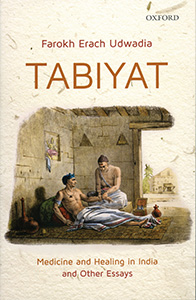 "Although we are formaly releasing this book today, we are already in the third print run of Tabiyat,” revealed Sivaramakrishnan. The publishers had arranged for 150 sale copies of the book at the Taj but only three were remaining when the function commenced, pointed out the MD wishing he could have arranged for more. "This book has come nine years after the physician’s The Forgotten Art of Healing and Other Essays. Many friends and patients insisted the doctor publish another book that covers human nature, temper and disposition,” added Sivaramakrishnan. "This book is meant for everyone. It is meant for a wide audience,” assured the MD. Referring to OUP’s objectives to promote education and research, he said that OUP came to Bombay in 1912.
The title of the book as also one of the chapters was inspired by an off-the cuff talk delivered by Udwadia when invited by Mukherjee for the "Tabiyat” exhibition at the Museum three years ago. "Medicine is not only a science, it is an art where the best of mankind works for the betterment of mankind,” noted Mukherjee, describing Udwadia’s book as "the best contribution.”
He recalled planning for the Tabiyat exhibition when unable to reach Udwadia directly, he approached the doctor’s wife Vera who gave him an assurance that Udwadia would address the gathering. "He spoke for 40 minutes and there was pindrop silence,” said Mukherjee, glad that the contents of the talk have been brought to the public thanks to OUP. Listening to a lecture and reading provide different kinds of experiences but "both are entertaining and enriching,” mentioned Mukherjee who appreciated that Udwadia’s interdisciplinary approach has made him a better physician.
Stressing on the importance of humanities, Mukherjee revealed that when the government or university faces a financial crunch, "they will cut down on the budget for humanities, but not of science or technology.”
"The slim volume of nine essays is related to subjects in medicine but divorced from technical aspects,” summed up the physician before adding, "I am not insisting you buy the book; not at all. But if you do buy the book, please read it!” While the other speakers on the dais — chief guest Justice Rohinton Nariman of the Supreme Court, Cyrus Guzder, chairman and managing director of AFL Limited, V. Sivaramakrishnan, managing director (MD) of Oxford University Press (OUP), India, Sabyasachi Mukherjee, director general of the Prince of Wales Museum (now renamed as Chhatrapati Shivaji Maharaj Vastu Sangrahalaya) and Iqbal Chagla, senior jurist – were privileged to receive copies of the book in advance, the other invitees learnt of its contents during the evening function that lasted for nearly two-and-a-half hours.
As erudite as Udwadia was, Nariman who commented that "a physician needs to be a judge for his clinical judgment encompasses faith, hope and compassion to sustain the shattered morale or seriously ill human being. Likewise a judge needs to be a physician… needs to be diagnostically serious.” To give proof of the senior physician’s "extremely lucid prose,” Nariman chose to read out passages from the book that appealed to him and wove in nuggets of information from his personal storehouse of religious, historical, literary and musical knowledge.
"Although we are formaly releasing this book today, we are already in the third print run of Tabiyat,” revealed Sivaramakrishnan. The publishers had arranged for 150 sale copies of the book at the Taj but only three were remaining when the function commenced, pointed out the MD wishing he could have arranged for more. "This book has come nine years after the physician’s The Forgotten Art of Healing and Other Essays. Many friends and patients insisted the doctor publish another book that covers human nature, temper and disposition,” added Sivaramakrishnan. "This book is meant for everyone. It is meant for a wide audience,” assured the MD. Referring to OUP’s objectives to promote education and research, he said that OUP came to Bombay in 1912.The title of the book as also one of the chapters was inspired by an off-the cuff talk delivered by Udwadia when invited by Mukherjee for the "Tabiyat” exhibition at the Museum three years ago. "Medicine is not only a science, it is an art where the best of mankind works for the betterment of mankind,” noted Mukherjee, describing Udwadia’s book as "the best contribution.”
He recalled planning for the Tabiyat exhibition when unable to reach Udwadia directly, he approached the doctor’s wife Vera who gave him an assurance that Udwadia would address the gathering. "He spoke for 40 minutes and there was pindrop silence,” said Mukherjee, glad that the contents of the talk have been brought to the public thanks to OUP. Listening to a lecture and reading provide different kinds of experiences but "both are entertaining and enriching,” mentioned Mukherjee who appreciated that Udwadia’s interdisciplinary approach has made him a better physician.
Stressing on the importance of humanities, Mukherjee revealed that when the government or university faces a financial crunch, "they will cut down on the budget for humanities, but not of science or technology.”

At the book launch (from l) Dr Khyati Shah, Cyrus Guzder, Sabyasachi Mukherjee, Dr Farokh Udwadia,
Justice Rohinton Nariman, Iqbal Chagla, V. Sivaramakrishnan All photos: Nazneen and Khurshed Vajifdar, Spectravision Labs

A section of the audience at The Ballroom of The Taj Mahal Palace Hotel
According to Chagla, Udwadia could be deemed "a Renaissance man. He combines the qualities of the finest physician in India and beyond… Humanism and humanity is the credo by which he practices the art of healing.” For him, his work as a physician is "not only a profession but a calling.” In the current scenario of "robotic medicine and expensive tests, when physicians don’t use eyes, ears and hands but remember numbers and formulae, Dr Udwadia stands apart. He practices the almost forgotten art of diagnosis. I hope he continues to read and share his experiences of medicine and life itself.”
Chagla commended Udwadia’s romance with music, knowledge of history and appreciation of literature which the doctor likes to believe is "one way of keeping Alzheimer’s at bay.” Wondering how he finds time to pursue all his interests, and sustain his love for adventure, even if it means trekking across a valley in Thailand in canvas shoes, Chagla commented that Vera has "a great role to play. She is his muse, instrumental in keeping a beautiful home in Bombay and getaways in Alibaug, and Coonoor which is his favorite.”
The first speaker to offer insights into the "outstanding storyteller” and his new book was Guzder. He recalled the words of one of Udwadia’s heroes, Alexander the Macedonian, known to be a man of incredibly robust health who in his last lingering moments had reportedly, "I am dying with the help of too many physicians.” Udwadia, believed Guzder, lived up to Voltaire’s description of men occupied with the restoration of health as being "the great of the earth. They even partake of divinity, since to preserve and renew is almost as noble as to create.”
Performing a "physician’s role with knowledge and skill, thoughtfulness and judgment, care and compassion… his instinctive urge to care for the sick comes from his being Dominique Jean Larrey, in a former life,” jested Guzder. In Tabiyat, Udwadia elaborates on Larrey’s commitment as surgeon-in-chief of Napoleon’s French army. Reputed to be an innovator in battlefield medicine when horse drawn carriages that served as flying ambulances helped to transfer patients wounded in war, he is also known to have performed 202 amputations in 24 hours.
To demonstrate how "compassion alone can save the dying,” Udwadia has devoted a chapter to Florence Nightingale, the lady with the lamp, whose shadow, kissed by the British soldiers who lay soaked in blood, is supposed to have infused them with hope and brought down their mortality from 40% to two percent.
Convinced that "only a good man can be a good physician,” Guzder referred to the "ethical and moral quandaries” faced by doctors who he felt should adopt Udwadia’s principle of "beneficence.” In his essay on death, Udwadia has dealt with the "inevitability of death” and explained that "it is not death we fear but dying.” Udwadia also felt reassured when a patient told him that his daily conversation with the senior physician relieved his discomfort far more than the medicines administered to him. To the experienced physician, "technology cannot substitute for the simple tools — of listening uninterruptedly to the history of the patient, asking leading questions but not rushing, examining a patient with care, not attempting to overcure with medicine.”
An unabashed music lover who believes in its therapeutic properties, to him music is "intelligible but untranslatable, the only language in which one cannot say mean and sarcastic things.” A talented violinist who could establish bonds with the young and the old, Udwadia had impressed students of a local school in China when he broke into song with the popular Bollywood number Mera joota hai Japani, recalled Guzder. He ended his address with Cole Porter’s lyrics of The Physician:
Once I loved such a shattering physician,/ Quite the best-looking doctor in the state,/ He looked after my physical condition/ And his bedside manner was great!/
When I’d gaze up and see him there above me,/ Looking less like a doctor than a Turk,/ I was tempted to whisper, "Do you love me,/ Or do you merely love your work?”/
He said my bronchial tubes were entrancing,/ My epiglottis filled him with glee,/ He simply loved my larynx/ And went wild about my pharynx,/ But he never said he loved me…
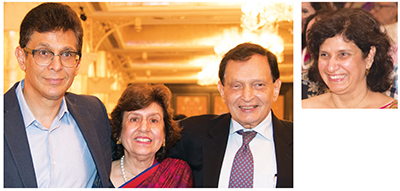
Udwadia family (from l): Dr Zarir, Vera,
Dr Farokh and Shireen Sethna
"Faith is the great healer”
Ayurveda, the knowledge of longevity, is the traditional system of medicine that has as its twin pillars the two texts, Charaka Samhita and Sushruta Samhita, Udwadia informed the audience. In his book, Udwadia refers to the compendium of Charaka that recommends the need to look at man holistically and support a balanced ecology of nature. There is an interrelation between an individual’s mental framework and the external world, confirms Charaka who lived in the third century BC, around the same time as the Greek physician Hippocrates II, considered one of the most outstanding figures in medicine. "These were iconic years in the history of medicine,” noted Udwadia, believing that Ayurveda that was initially practiced by word of mouth probably predates many religious teachers. "But why did Ayurveda lag behind and western medicine march ahead?” asked the doctor before proceeding to answer, "The West was seized with the spirit of scientific enquiry after the Renaissance which this country lacked.”
Conceding that "most illnesses right themselves” and "faith is the great healer,” Udwadia alluded to alternate systems of medicine: Unani, the medicine of choice in the Mughal courts, folk medicine, herbal medicine, bone setters, palmists. However, "in this day and age the traditional system is not adequate to treat illnesses,” he opined. "It is time we brought the fruits of technology and science to the doorstep of our poor India.”
Knowledge of humanities and history makes better physicians, believes Udwadia. He is convinced it "gives an aesthetic sense to the physician… elevates sensibility and sensitivity that guides conduct, creates an awareness of body and mind, increases analytical skills, morals and ethics in a fast changing world… Humanities humanize all professions, resulting in greater empathy, and bonding patients and doctors into a close relationship.”
To the experienced doctor, "the art of medicine is the art of healing… there is a science of probability and art of possibility” that enables the doctor "to detect subtle nuance… with an intuitive ability to reach a possible diagnosis looking at the mind and body… History affects environment and man as much as man affects history… The more backward you look, the more forward you can see.” Ancient Greece believed in Janus as the two headed guardian of time that provides hindsight when looking backward and foresight when looking ahead.

Udwadia signing a book
"War is a curse brought by man on himself. It is stitched in the genome of mankind.” Yet the treatment of wounds over centuries shows us that the seeds of advances in medicine "were sown in the blood soaked grounds of Europe, Asia and Russia. Advances in medicine are accelerated by war.” Medicine "declares war on war.” It is the antithesis of destruction, said Udwadia, likening it to the Zoroastrian philosophy of duality where good and evil coexist. "Good is to be distilled from the cauldron of war,” he advised.
The essay on ethics, Udwadia felt was "most difficult; I had to struggle through.” In his view, ethics is the obligation of a moral nature that should guide medical practitioners. But since the same standard of ethics cannot be uniformly applied, for a medical practitioner it can create "great quandaries in the mind.” Respect for sanctity of life, beneficence and determination to do no wrong should be the guiding principles to resolve the religio-socio-philosophical conflicts that may arise, he recommended.
"Forgive my immodesty, but I think ‘Death’ is one of my best essays,” said the octogenarian, continuing, "I’m well past 80 so it is important to reconcile myself to that certain eventuality, come to terms with it so that when the door opens, I can walk through it.” Regardless of the Zoroastrian doctrine that does not propound rebirth, Udwadia stated, "I personally believe in reincarnation. How else can I explain the inequities when I see a young child suffer miserably and cruel people facing pleasant death?” Referring to the Hindu belief in karma and moksha, Udwadia said he enquired of himself whether he was a fit candidate for nirvana, one who is free from the cycle of rebirths. Realization dawned soon, making him gleefully acknowledge, "I’m no saint. I’m so attached to the people I love… I love the sunrise and sunset. I love good food and wine. How can I ever not come back?”
He recalled lines from Philip Larkin’s poem Aubade: "The dread, of dying and being dead, flashes afresh to hold and horrify.” According to him it is our cultural nemesis "to fight death to the end.” Poet Dylan Thomas’ famous lines were tweaked by Udwadia who recommended: "Go gently into that good night/ Close your eyes, smile/ Whisper a prayer.” Most appealing to him was Walt Whitman’s verse in The Last Invocation, "Let me glide noiselessly forth/ With the key of softness unlock the locks — with a whisper. Set ope the doors, O Soul!/ Tenderly! be not impatient/ Strong is your hold O mortal flesh. Strong is your hold, O love.”
Realizing that philosophizing on death had made his audience pensive, he chose to end his discourse by broaching the subject of music convinced that it has "Charms to sooth a savage breast, to soften rocks, or bend a knotted oak… Next to prayer, there is nothing like music.” The greatest marvel of music is that it is visible but cannot be seen; it is understood but cannot be translated. He referred to the "Mozart effect” that can impact cognition as also the circulatory system and narrated the experience of one patient. His prescription of listening to German composer Amadeus Mozart’s clarinet concerto for six weeks helped the patient fight insomnia, a remedy he has since offered to countless patients. "Great music enthralls, sends you into relaxation… it is a transcendental blessing that enriches, blesses the noble spirit.”
The chapter on music was deemed "most interesting” by Nariman, also a western classical music connoisseur. He described music as "one art that makes us commune with divinity.” An avid votary of Mozart’s Requiem and Johannes Brahms’ German Requiem, he urged the gathering to set aside 15 hours to at least once enjoy Richard Wagner’s Ring Cycle.
Referring to Udwadia’s chapter on death, Nariman assured him, "You are immortal through your work. You will continue to live long after your death.” Quoting poet Samuel Butler, Nariman continued, "Yet meet we shall, and part, and meet again. Where dead men meet, on lips of living men.”
In the context of Udwadia’s chapter dealing with medical ethics, the judge commented, "I feel our country is not ready for active euthanasia.” On the related subject of a living will where a mentally sound person can give directives that all life support systems be removed if he were to land in a vegetative state, Nariman elaborated how the recent five-judge ruling had ensured that it is not misused by weaving in clauses that stipulate that a medical board of three directors from the hospital has to certify that the patient is in a vegetative state as also the office of the municipal collector.
When expressing his gratitude, Udwadia first remembered his "father (Dr Erach) and mother (Perin) for the values they instilled,” and then went on to acknowledge "my wife, without whom I would be nothing.” He also named his children (son Dr Zarir and daughter Shireen Sethna) and grandchildren, and commented that he was proud of the strides Zarir was making in the treatment of tuberculosis "though I worry for you.” He further thanked his research assistant Dr Khyati Shah, the master of ceremonies for the evening, and his secretaries Patricia Albuqurque and Maggie DaCunha "who protect me from angry relatives and impatient patients,” as also the hospitals, assistants and nurses who support his work. The speakers for the evening were felicitated with flowers and the Taj management thanked for their efforts to create an ambience befitting a book launch.
◆ ◆ ◆
From the archive