
Books
“Medicine is about caring”
Noted physician Dr Farokh Udwadia’s latest book is for the layman
When Dr Farokh Udwadia, "India’s most revered and eminent physician” in the words of the managing director of the Oxford University Press Manzar Khan, made his debut as essayist with the publication of The Forgotten Art of Healing and Other Essays, Bombay University’s beautiful Convocation Hall brimmed with various celebrities. It was also awash with the cream of the medical profession and young hopefuls, hopefully imbibing the values the book enshrines, that monsoon evening June 19, 2009. "In Delhi you don’t get this type of dedicated audience at a book launch,” commented Khan.
Maharashtra governor S. C. Jamir who released the publication admitted he had originally been dubious about accepting the invitation because "books by doctors and technicians are filled with tongue twisting terms and diagrams.” He was "pleasantly surprised” with the "gentle style and convincing arguments” of Udwadia’s book and suggested it be compulsory reading for undergraduate students.
Underscoring what Udwadia notes in his book, Jamir spoke of the need for a "fresh look at the relations between the doctor and the patient…the doctor must rise to the trust reposed in him.” Referring to recent incidents in Bombay and other parts of the state where enraged relatives have attacked allegedly negligent doctors and hospital staff, Jamir alluded to an ordinance he had just signed "to protect doctors and medical properties, but they must not look at patients as non-performing organs.” The unnecessary tests leading to inflated medical costs was dehumanizing medicine. "The credibility of the profession is at stake,” noted the governor, suggesting that alternative medical systems be enlisted rather than scorned. He was also of the opinion that serving in rural areas for a specific period should be made mandatory for medical professionals.
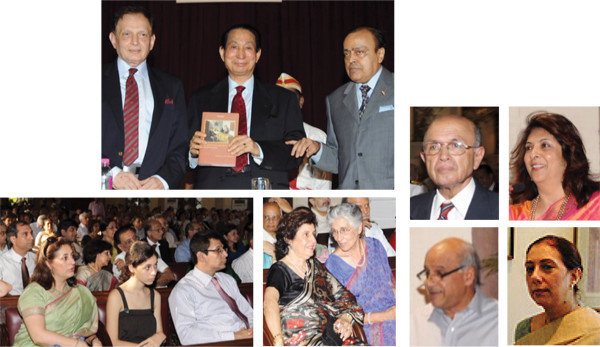
Clockwise from right: Dr Farokh Udwadia, governor S. C. Jamir and GOI minister for oil Murli Deora; Dr Hirji Adenwalla; Dr Indu Shahani; Dina Vakil; Manzar Khan; Gulnar Adenwalla and Vera Udwadia; Zarir, Zarah and Gool Udwadia
Emphasizing the right to education and medical care Jamir invited the distinguished audience to "share his burden as a governor.” Referring to his recent visit to two tribal institutions in Akola where young students had declared they wanted to become teachers, doctors and nurses to serve the country, he asked, "Is there any opening for those poor people? Technical education is so expensive. Have we prepared any way for them? Some of them are extraordinarily brilliant but can’t pursue higher studies. Can we pave the way for them?”
Presenting a synopsis of the book and Udwadia’s central concern that the increasing dependence on the "dazzling new toys of medicine” was undermining the art of diagnosis which "assesses not only the body but the mind,” The Times of India consulting editor Dina Vakil saluted the author’s "daunting familiarity with the worlds of music and poetry.”
Admiring Udwadia’s "personal care for patients that he shows in his writing,” Khan declared that seven of the doctor’s eight books have been published by the Oxford University Press over a period of 20 years. "His book on critical care continues on our bestseller list.” Udwadia’s penchant for detail results in his "involvement with the entire publishing process. He even decides on the font size!” noted Khan.
Acknowledging his "dear old friend (distinguished surgeon) Hirji Adenwalla who works with the poorest of the poor in a mission hospital” for the inspiration to write about "the philosophical aspects of medicine and its connection with other endeavors,” Udwadia spoke about the tremendous advances in technology and science which had revolutionized medicine. However, "the weight of science has buried its art. I call it a forgotten art and only hope it won’t be a lost art. But without art medicine loses its humanism… Doctors relate more to the machine than the patient, the patient relates more to the machine than the doctor. The empathy, the trust is sadly absent…There is simmering discontent against medicine as a profession… ‘Nonhumanistic medicine’… teaches doctors to surf the Internet… Many teachers of medicine have forgotten that medicine is learnt from patients, not from books… Only when art and science join hands is healing accomplished. The patient means much more than the disease he has.”
Udwadia has traced the influence of philosophy, religion, history, geography, art and literature, the rise and fall of civilizations on the practice of medicine. "Did physical deformities, diseases ignite great artists? Would Beethoven have composed the Ninth Symphony if he had not been deaf? Would Milton have written Paradise Lost if he had not been blind? Shelley wrote his Ode to a Skylark even as he was dying of tuberculosis… Agony and suffering have created gems of magnificent transcendence!” noted the doctor, shedding a passing light on a subject that he has examined in detail in one of his essays.
"Faith is the cornerstone of medicine and of religion.” They both act on the mind and the mind acts on the body. The mind-body correlation is the subject of advanced research in various parts of the world, declared Udwadia.
Touching on the topic of euthanasia, "difficult because of its legal overtones,” the doctor said he spends a great number of hours of every working day dealing with the dying. "The doctor cannot draw the line…But it is wrong to prolong the agony of death; wrong to make it ruinous to the patient and his family.”
Udwadia referred to outstanding discoveries and how luck played an important part in bringing them to light. Contemporary medicine has created marvels unthinkable even 30 years ago. He envisaged "great possibilities but also great quandaries — not the Brave New World of Aldous Huxley… Medicine might be a wreck on the shoals and reefs of advancing science” unless it is tempered by human values.
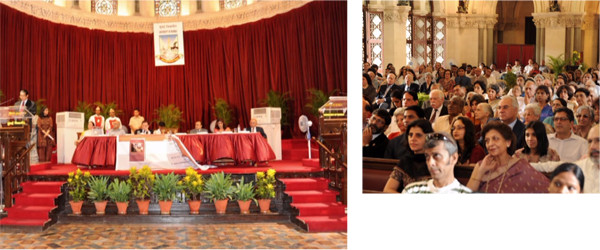
The audience listening to the governor’s address All photos courtesy: Nazneen Vajifdar, Spectravision
The author had a special word of thanks for his parents for the values they had inculcated into him, for the care and support of his wife Vera to whom he has dedicated the book, his children and grandchildren and his faithful secretaries Patricia Albuquerque and Maggie D’Cunha "for screening me from the outside world…”
Adenwalla flew in from Trichur that afternoon to give his friend of 72 years a surprise. Calling Udwadia, the classmate who graduated with a first in medicine and stood at the top of the class overall, "a man of all seasons — physician, philosopher, historian, musician, and most important of all, a caring and devoted friend,” Adenwalla said, "In my opinion (he) is perhaps the last of the great physicians nurtured in the romantic Oslerian mold. Not a myopic dispenser of nostrums nor a man overburdened and constipated with scientific jargon, but a man who has turned the science of medicine into an art and fine tuned it for the relief of mankind. He has shown by precept and example that medicine is not only about curing but it is predominantly about caring…
"The years passed and I saw this friend of mine grow in knowledge, stature and sensitivity beyond compare. I said to myself that here perhaps is the only man I know who can crystallize the wisdom of the ages in a volume — not about the science of medicine for about this he has written many books, but about the art of medicine, about the philosophy that sustains this art, about art itself, about religion, about music, about the good and bad in contemporary medicine and about medicine in the future. I suggested that he write on these lines years ago and he brushed my suggestion aside…Then one night he rang me up and to my surprise and delight read to me a part of the first essay which bears the title of this book, The Forgotten Art of Healing, and I knew then that the work would be on my desk before the year was done. I knew then that the die was cast and he would now write in feverish haste as he is known to do. For there is only one thing and one thing alone that Dr Udwadia does with infinite patience and that is to listen to the history of a sick man. Everything else he does in a frightful hurry. For his is a mind that once on the move, cannot be bridled…”
Dr Indu Shahani, principal of H. R. College of Commerce introduced as the first academician to hold the post of sheriff of Bombay, saw parallels between medicine and teaching, the art and science that both professions embrace. Congratulating the author on his fine turns of phrase, she noted, "The book made me oblivious of my college and admission pressures!”
Udwadia’s focus was the link between time past and time future. The future is now, he concluded, and morality and ethics are man’s best guides in the uncharted seas of scientific discovery.
◆ ◆ ◆
From the archive