
Medicine/Health
Succor for the sick
The Parsi Press and philanthropists were pioneers in ensuring health care for all
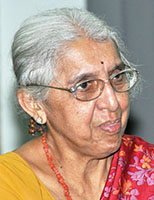 The Parsi Press, when reporting on issues of public health between 1860 and 1920, was "by and large liberal, advocated sanitary reforms and vaccination and supported efforts by other communities in promoting public health,” said Dr Mridula Ramanna at The K. R. Cama Oriental Institute (KRCOI) in Bombay. The Press then was also "constantly vigilant about corruption and about paucity of Government funds for public health,” mentioned the former head, Department of History, SIES College. Having done her PhD in History from the University of Bombay, Ramanna is the author of Health Care in Bombay Presidency, 1896-1930 and Western Medicine and Public Health in Colonial Bombay, 1845-1895. She stated that the Parsi Press was nationalistic in nature and supported the admission of Indian doctors into the higher echelons of public hospitals. This lecture titled "Medical and Health Issues in the Parsi owned Press, 1860-1920” was one of three delivered by her between February 11 and 13, 2015 as part of the Government Research Fellowship Lectures at the Institute.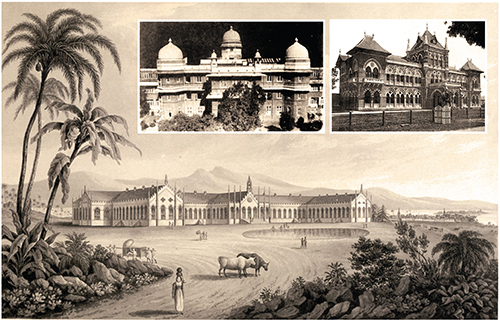
Top: Mridula Ramanna; Clockwise from top left: The Bai Jerbai Wadia Hospital for children;
Cama and Albless Hospital; J. J. Hospital,old view
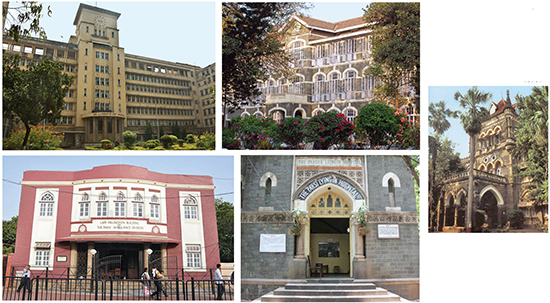
Clockwise from top left: J. J. Hospital, current view; The B. D. Petit Parsee General Hospital;
Cama Hospital; The Parsi Lying-In Hospital; The Parsi Ambulance Division
The lecture series opened on February 11 with a talk on "Parsi Philanthropy in Public Health.” This session was chaired by eminent cardiologist Dr Bomi Icchhaporia who in his opening remarks lauded the "sweat and toil that went into the start, equipping and maintaining the public institutions that are now beacons for the sick and poor.”
Ramanna said that the earliest noted instance of Parsi public philanthropy is that of Framji Banaji who in 1825 funded two aqueducts for clean water to be provided to the residents of Kamathipura and Pydhonie. She mentioned that the then colonial administration had a very narrow view of public health and they "did not believe it their responsibility.” Even as late as 1910, she quoted, the Bombay Presidency government spent only 6.75% of the total revenue on public health, which was "very nominal” considering this was to cover extended territories like Muscat and Aden too.
Referring to the establishment of what was to become the J. J. Hospital, she mentioned that the seeds of the hospital were sown when Sir Jamsetjee Jejeebhoy observed that the Bombay Native Dispensary that was established in 1834 was inadequate for the treatment of the sick. Jejeebhoy conveyed his desire to the colonial administration to donate a sum of Rs 100,000. The administration funded an equal amount and a managing committee of three was set up, of which two members were appointed by the administration. It is recorded the then governor who personally escorted Jejeebhoy to the inauguration of the Hospital in 1845 mentioned at the inaugural ceremony that the Hospital would provide relief to "all of the sick and poor of Bombay.” The Hospital opened with 300 beds, of which 240 were for men and 60 for women. The wards were divided on the basis of communities. Further facilities were provided in 1850 in the shape of a Lying-In Hospital and the addition of a Leper Ward and an Ophthalmic Hospital in 1866.
Ramanna alluded to hospitals providing specialized care such as the Bombay Eye and Ear Infirmary near the Portuguese Church and the Infectious Diseases Hospital, which were funded by Parsis. She noted that Parsi philanthropy extended to setting up dispensaries and hospitals at other locations in Bombay Presidency and outside, including Kurla, Mahim, Thana, Bassein, Murbad, Halol, Bharuch, Matheran, Umbergaon, Ahmedabad, Karachi and even Aden. She also referred to the setting up of St John’s Ambulance Division by Cowasji Dadachanji and the J. J. Nursing Fund, set up by Jerbai Wadia.
Concern over high rates of maternal mortality led to Parsi philanthropists founding and financing obstetric facilities in the city, the earliest being the Obstetric Institution in 1851, attached to the J. J. Hospital. In 1882, the Medical Women for India Fund (MWIF) was set up by social reformer Sorabji Bengali, with the help of an American businessman, George Kittredge. The MWIF successfully campaigned for medical education of women, and also started the Cama Hospital, the first non-sectarian hospital for women and children. This was made possible by a generous donation from Pestonji Cama. There was opposition from the colonial government to the setting up of this Hospital, the reason being "there could be laxity in its running.”
The Parsi Lying-In Hospital was started by Dr Tehmulji Nariman who was convinced that sepsis could be treated with proper care during childbirth. It was reported that in 1887 "588 babies were delivered there, including six pairs of twins.” The Hospital received good reports on the care it provided, following the Civil Surgeon’s inspection that year. Nariman was a founder member of the College of Physicians and Surgeons of Bombay in 1913. The Parsi Lying-In Hospital and The B. D. Petit Parsee General Hospital were prime examples of institutions set up for the use of Parsis only.
The contribution of the Wadias towards public health was recalled in the setting up in 1926 of the Wadia Maternity Hospital in Parel, and the adjacent Bai Jerbai Wadia providing free treatment to children in 1929.
Parsi philanthropy also financed certain semi-official organizations set up in the early 1900s to provide health care, like the Bombay Sanitary Association, Anti-Tuberculosis League and the Lady Willingdon Scheme.
Ramanna concluded the first lecture by stating that Parsi philanthropy was not merely a demonstration of the fact that philanthropy was "central to the Parsi identity, but because there was a firm conviction among Parsis about the benefits of Western medicine.”
The second lecture on February 12, titled "Pioneering Parsi Physicians” was chaired by Dr Jehangir Sorabjee, who is himself "an avid follower of the medical history of Bombay.”
She stated that in the Times of India Directory of 1875, approximately half the doctors listed were Parsis. Many medicos, she said, were part of the Bombay Legislative Council and took active part in debates on medical issues of the day. Dr K. N. Bahadurji who had an "independent way of thinking, was the leader of medical activism of his times and had many successes in the treatment of plague.” In 1891 Bahadurji, took up the cause of hygiene amongst factory laborers and proposed legislation in this area.
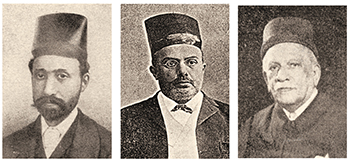
(L-R): Drs K. N. Bahadurji, Nasarwanji Choksy and Jehangir Cursetji
She lauded the work of Dr Nasarwanji Choksy who she called the "pioneer of controlled clinical trials” and whose name was "synonymous with the treatment of infectious diseases.” Choksy also lobbied for the parity of Indian medical degrees with British ones, as did Dr Cawasji Dadachanji who was president of the Bombay Medical Union as well as a member of the Bombay Municipal Corporation Sub Committee on Public Health. The consistent lobbying for parity with British doctors found some results in the 1900s when certain posts in public hospitals were reserved for Indians.
The importance of hygiene in prevention of cholera was expounded by Dr Cawasji Naoroji who "advocated sanitary measures, avoidance of unwholesome drinks, fasting and purgatives, and an equitable state of mind.”
Dr Jehangir Cursetji, a public minded physician spoke up against poor civic facilities, lack of hygiene, and poor sewage and garbage disposal in the city. He was the first to propose medical inspection for school children.
Lively debates took place at the Grant Medical College Society, among the students of the College, and these continued in Gujarati in the Gyan Prasarak Samiti. Forums such as these were extremely beneficial for disseminating knowledge to the public on health issues.
Ramanna paid tribute to the first batch of female doctors from the Grant Medical College. Of the nine female graduates, five were Parsis. She quoted a graduate who said "not only were they required to be efficient doctors but also compete with male doctors.” Motibai Kapadia, one of the early graduates of the College, was appointed to the staff of Victoria Jubilee Hospital in Ahmedabad.
Infant mortality was an issue of high interest to early women doctors Jerbanoo Mistri and Dosibai Dadabhoy. They made several recommendations to prevent this. Acknowledging that not all Indian women would go to a hospital for something as elementary as childbirth, an innovative suggestion from them was that they should work with dais (midwives) to educate them on the hygiene and basics of preventative obstetric medicine. Both these doctors advocated the importance of family planning to improve the health of women.
Sorabjee, in his closing remarks on February 12, appreciated the details provided by Ramanna on the pioneers in the field of medicine. He commended the availability of exhaustive documentation that enabled this research into the medical history of Bombay.
Speaking on "Medical and Health Issues in the Parsi owned Press, 1860-1920” on February 13, Ramanna said that "it is clear that the Press was vigilant for any neglect or transgressions by the authorities in providing sanitary facilities and in coping with disease.” Her lecture was based on the review of extracts from local newspapers that were published in the Report on Native Newspapers compiled by the Oriental Translator for the Bombay Government.
Citing the Rast Goftar in 1861, Ramanna said that the paper eloquently defended the Grant Medical College against charges of decline by E. I. Howard, the then Director of Public Instruction. The newspaper complained that "the stipend of rupees seven to rupees twelve paid to the students had been discontinued” and "there were frequent changes of staff.” "There was scarcely a rich family that did not depend on its graduates for their medical needs,” wrote Rast Goftar. "Even bigoted natives” were availing of the services of the graduates. The paper commended the stance taken on ‘no private practice for doctors of the Grant Medical College’ and lamented that departure from this rule could be a potential cause for the downslide.
Quoting the Kaiser E Hind, Ramanna said that it was vocal about the "coconut and potato headed men who became professors at J. J. Hospital.”
The reforms in the area of sanitation introduced by the colonial administration between 1865 and 1873 were largely due to the public debate generated by the Parsi Press. The papers were keen to have the benefits of these reforms passed on to all sections of society. While the Rast Goftar approved of the reforms, it argued that since they were paid for by the Indian public, the benefits should be available to all Indians. The Jam-e-Jamshed and the Bombay Chabook too said that it was the duty of the Corporation to "attend to the needs of all.”
The Parsi Press, said Ramanna was critical of corruption in the administration and mentioned that there were vested interests in the ‘justices’ who sat on the committees.
The concern over public health continued during the inauguration of the water supply from Tansa to the island city, explained Ramanna. While the Jam-e-Jamshed complained of "weak pipes” and the Rast Goftar of "muddy water,” the Bombay Chabook put forth the proposition that "since the water tax was paid by all, it was the responsibility of the administration to ensure that all had access to clean drinking water.”
The Parsi Press lobbied for the appointment of Indians to positions of authority. Quoting from the Mumbai Samachar, she said that they protested against the appointment of European doctors in high positions, when "native graduates of the Grant Medical College could do the job at much lower salaries.”
The Parsi Press in the period under review continued to question the recurring epidemics in Bombay and why no remedy was forthcoming. The Press was supportive of vaccination as a prophylactic measure and bemoaned the fact that adequate calves were not made available from certain communities for the production of the vaccine. The papers of the time advocated the use of persuasion rather than forceable vaccination. Advocating prophylactic serums, the Jam-e-Jamshed suggested that "government officials should get inoculated in public” and the Rast Goftar recommended "meetings of journalists to demonstrate how the vaccine was prepared.”
Sanitation continued to interest the Press in the early 20th century and the Kaiser-e-Hind was clear in stating there was "very little common sense in the members of the City Improvement Trust and the Bombay Municipal Corporation” when dealing with issues of public health. Jam-e-Jamshed supported the retention of temporary health camps along the sea front which were criticized by the affluent of the city as eyesores.
The Press by and large hailed the setting up of the Anti-Tuberculosis League and publicized anti-spitting measures. The Press was vocal about discrimination against Indian nurses too.
The series of lectures was under the aegis of Muncherji Cama, president of the KRCOI and the vote of thanks was given by Dr Nawaz Mody, joint honorary secretary.
◆ ◆ ◆
From the archive