
Observation
A father’s foresight
A tribute to Shiavax Nargolwala on his birth centenary (1915-2015)
Whilst he was serving as an Indian Civil Service (ICS) officer in Delhi three trustees of the Delhi Parsi Anjuman (DPA) approached my father, Shiavax Dinshaw Nargolwala, at his residence, requesting him to become the president of the DPA. His first question to them was "Is the decision unanimous?” They promised to consult their colleagues and revert. At a subsequent meeting there was a unanimous request that he become the president which he unhesitatingly accepted. The group assured him full cooperation and a free hand in the management of the affairs of the Anjuman. Knowing my father he would not have had it any other way.
Thus began a long and glorious innings of over 25 years as president during which time he left behind a stamp of strong and purposeful leadership. Though his style was sometimes blunt, he was not lacking in flexibility when the occasion demanded. Under his stewardship the Anjuman grew tremendously and even today although nearly 30 years have passed since his demise in a car accident on August 6, 1986, the legacy he left behind is strongly visible.
Through his tireless efforts he got the Katrak family to donate the seed corpus to build the Dar-e-Meher in Delhi. He planned the structure and was on site nearly every day to ensure its timely completion and consecration for religious services to the community. He ensured the fire temple was under the management of the board of trustees and not the panthaky as prevalent in other areas.
The noteworthy stands he took on three religious issues showed his foresight: allowing non-Parsi spouses as members of the DPA; permitting non-Parsis to attend the death ceremony of a Parsi; accepting children of interfaith marriages and recognizing their navjote ceremony so long as any one parent was a Parsi. These were pathbreaking initiatives undertaken by him by forging consensus and this has ensured the cosmopolitan nature of the DPA for posterity.
A founder member of the Federation of the Parsi Zoroastrian Anjumans of India, he helped build the organization and during his time it reached its zenith. Unfortunately it is in a sorry state of affairs today and a poor shadow of the vision its founders had.
A religious man, wedded to a clean, honest and dedicated life, he could not suffer those with blind faith unwilling to think for themselves, his favorite phrase to describe idol worship being "Laakra na dev né khaasra ni pooja (worship of false gods deserves rebuke).”
Thus began a long and glorious innings of over 25 years as president during which time he left behind a stamp of strong and purposeful leadership. Though his style was sometimes blunt, he was not lacking in flexibility when the occasion demanded. Under his stewardship the Anjuman grew tremendously and even today although nearly 30 years have passed since his demise in a car accident on August 6, 1986, the legacy he left behind is strongly visible.
Through his tireless efforts he got the Katrak family to donate the seed corpus to build the Dar-e-Meher in Delhi. He planned the structure and was on site nearly every day to ensure its timely completion and consecration for religious services to the community. He ensured the fire temple was under the management of the board of trustees and not the panthaky as prevalent in other areas.
The noteworthy stands he took on three religious issues showed his foresight: allowing non-Parsi spouses as members of the DPA; permitting non-Parsis to attend the death ceremony of a Parsi; accepting children of interfaith marriages and recognizing their navjote ceremony so long as any one parent was a Parsi. These were pathbreaking initiatives undertaken by him by forging consensus and this has ensured the cosmopolitan nature of the DPA for posterity.
A founder member of the Federation of the Parsi Zoroastrian Anjumans of India, he helped build the organization and during his time it reached its zenith. Unfortunately it is in a sorry state of affairs today and a poor shadow of the vision its founders had.
A religious man, wedded to a clean, honest and dedicated life, he could not suffer those with blind faith unwilling to think for themselves, his favorite phrase to describe idol worship being "Laakra na dev né khaasra ni pooja (worship of false gods deserves rebuke).”
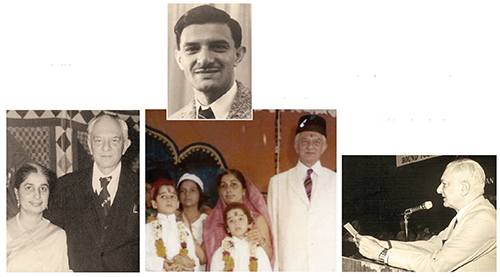
Inset: Shiavax Nargolwala as a young ICS officer;
Far l: Nergish and Shiavax; Adil and Mehrab at navjote with parents and others;
Nargolwala addressing a Federation meet in Delhi
During his 34 years in the ICS he had his ups and downs with ministers and senior colleagues but never did he deviate from keeping the welfare of the country in mind. After passing the ICS examination in 1938 he joined the London School of Oriental and African Studies in his probationary year. On arrival in Bombay in 1939 he reported for duty at the secretariat and was posted to Bharuch as a supernumerary assistant collector.
In 1942 during the Quit India movement when he was posted at Thana, father was asked to proceed to Bassein Fort. A young British police officer accompanied by two or three other policemen went with him. They crossed the creek in a Customs’ launch and arrived early in the morning at the dak bungalow. This small band had to confront a gathering of thousands and using persuasive measures dispersed them. He told them that once the war was over Independence would come very soon and our main task should be to repel the Japanese invaders who had committed terrible atrocities on the Eastern front.
In 1943 he took over as the under secretary finance in Bombay working under the then finance secretary. When appointed to the newly constituted finance and commerce pool cadre, he joined Bombay Customs. In 1945 he was transferred to Calcutta and then further ordered to the Income Tax department till 1956. He then moved to Delhi and enjoyed stints in various ministries, prominent being the ministries of defense, posts and telegraph, and external affairs. He retired on his 58th birthday in 1973.
Having spent his childhood years at Deolali on a farm he was most happy to move to one lovingly built by him and our mother Nergish in Rajokri on the outskirts of Delhi after retirement. Born in Bombay on June 5, 1915 he had spent the first eight years of his life in Nagpur where his father was serving as a tehsildar in the old Central Provinces. He was the eldest of six brothers and on his mother’s demise when his youngest brother was only a day old, the siblings were shifted to Deolali near Nasik for their school education under the care of their grandparents. The Deolali School was the first public school in India where the teaching was excellent with varied extracurricular activities.
Finishing his matriculation in 1930 he joined Sydenham College and then availed of Tata charities to proceed to England where he articled with a British firm of chartered accountants during the day and attended the London School of Economics degree courses at night.
After his ICS career he devoted himself to his chartered accountancy practice which flourished. His financial acumen, integrity and knowledge of tax laws helped many a business house. Passionate about reading, most times at home he would be sitting on his favorite sofa with a book. Western classical music was one of his biggest loves. He himself was an accomplished violin player, a member of the Delhi Music Society and would not miss a single concert in Delhi. His collection of music covered most composers and pieces. He enjoyed his drinks and smoking his pipe and had a large collection of Dr Plumb and meerschaum pipes.
Our family used to look forward to the annual drives to forest reserves. At the time of our navjote he hired a bus and took all visiting relatives to the Sariska Forest wildlife park where all were lucky to sight a tigress and her cubs.
He was disciplined and punctual, always early for an appointment or invitation. We remember once landing up for dinner at 7 p.m. as per the invitation and finding the hosts unprepared.
He travelled the world both while in service and in retirement. In the days when there were no computers or internet he would make copies of his itinerary and have it posted to all he was to meet to ensure they knew of his travel plans. He gave us, his sons, all the love and affection a father can give. We can say with conviction that his values have been the foundation for both of us and we are proud to be his children.
◆ ◆ ◆
From the archive