
Drama
‘Mad’ about acting
Theater with a social message is the mantra for upcoming actor Farhad Colabavala
"Theater as a medium can be a sounding board and a mirror which may help the audience discover their lost selves, their true personalities,” believes 27-year-old Delhi based actor Farhad Colabavala, who founded the theater production house Mad Bawa in March 2015. The stage is a very powerful medium to show bitter social realities, or even a sugarcoated pill to send out strong messages, continues this finance, economics and management graduate turned actor.
Revealing the story behind the naming of his production company in a telephonic interview with Parsiana on October 20, 2015, the young man reminisces that at a very early age he would ape everyone and bring a smile to all around him. "My friends and colleagues would jokingly call me ‘King Bawa’ and as the years went by the name stuck,” he says. An admirer of the "whacko sense of humor of the Parsis,” he decided he must have the word ‘Bawa’ in the name of his venture. "Mad Bawa sounded even better, but I decided to give it a twist by saying ‘mad’ stands for ‘make a difference,’ because I seriously believe that if by doing theater you can make other people laugh and forget about their worries, it is fantastic, you’ve brought about a change.” Acting mad is probably the most difficult thing to do, he says.
Revealing the story behind the naming of his production company in a telephonic interview with Parsiana on October 20, 2015, the young man reminisces that at a very early age he would ape everyone and bring a smile to all around him. "My friends and colleagues would jokingly call me ‘King Bawa’ and as the years went by the name stuck,” he says. An admirer of the "whacko sense of humor of the Parsis,” he decided he must have the word ‘Bawa’ in the name of his venture. "Mad Bawa sounded even better, but I decided to give it a twist by saying ‘mad’ stands for ‘make a difference,’ because I seriously believe that if by doing theater you can make other people laugh and forget about their worries, it is fantastic, you’ve brought about a change.” Acting mad is probably the most difficult thing to do, he says.

Farhad Colabavala
Currently, Colabavala is busy with multiple showings in Delhi and Hyderabad of Eight Kings, a historical drama set in the times of Sheikh Nizamuddin Aulia, the 13th century sufi (Muslim mystic) saint, in which he plays 10 roles in all – eight sultans who formed the Delhi Sultanate before the advent of Mohammed bin Tughlak, Ibn Battuta, the Moroccan traveler and a wandering pir (mystic). The ‘transition’ from one sultan of the Turkic Slave, Khilji and partially Tughlak dynasties to the other was achieved with the help of turbans and visuals of heritage structures, explains the actor. The play is about the fickleness of fate and the transient nature of political power. Ultimately, the play shows how only love has triumphed over the centuries. He continues, "The interesting thing is that after watching the play, one sees a lot of similarities even today between those in power, their lives and their downfall and the conflict with civil society.” Produced jointly by Mad Bawa and Kashti Productions, the 60-minute solo show is written and directed by Vikramjeet Sinha who has a master’s degree in social anthropology from the Delhi School of Economics. Having done mostly comedy roles in Delhi’s Hinglish theater, the actor in Colabavala "jumped at it the moment I read the script.”
His 10-minute play 2922: The Ballad of Vedant Saafi about the journey of an athlete fallen from grace due to alleged drug abuse, and his desire for revenge won an award for the Best Play, Audience Choice at The Short and Sweet Theatre Festival, New Delhi in 2012, reveals the actor.
In an email response to Parsiana’s follow up questions, the theater personality reveals that to be a good actor you need to explore all areas of human emotions "so that you can live the role and portray things.” A graduate of St Andrews University and Warwick Business School in the UK, as his resume proudly states, Colabavala asserts that today management gurus are all stressing that tasteful humor is a key to success at work. "They say a sense of humor is part of the art of leadership of getting along with people and getting things done,” avers this admirer of the work of Rowan ("Mr Bean”) Atkinson, the English humorist "for his sense of timing” and Kevin Spacey, the American actor and director for his "versatile acting skills.”
Affirming that he would not like to be identified with any particular ‘kind’ of theater, Colabavala lets on that some of his plays "have been slightly on the naughty side of life,” and states that as he moves along he would be open to different genres of theater. "In any profession I think it is critical you respect the intelligence of the audience or your customer and give them something which they can understand and relate to.” He takes the example of the provocatively named Kasturba Panda ki Pantie, based on Underpants by American playwright Steve Martin, in which he enacted all five roles including the title role of a middle class housewife. The gentleman explains that the play takes a deeper look at emotional and sexual repression among women and how one in particular deals with it. Pointing out that Pardeh Ke Peeche Kya Hai (What is behind the curtain) and Dinner for Pricks were plays in which he was only an actor and did not have a say in naming any of these. "My guess is that these provocative names do appeal to today’s youngsters and writers and directors feel these names may add to the pull factor of the play,” he remarks.
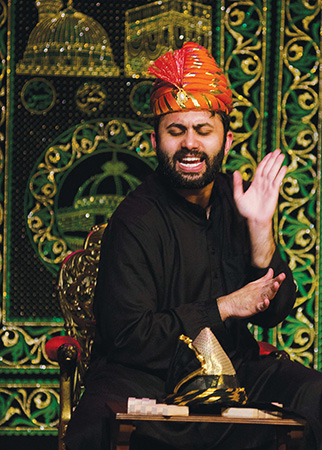
Farhad Colabavala as Khusro Khan of the Khilji dynasty in Eight Kings

Colabavala in Diya
Denying that he is continuing the great Parsi tradition of Urdu and Hindustani theater, Colabavala states very matter of factly that most of his plays are in Hinglish rather than Hindi or English. Eight Kings has a mix of Urdu, Hindi and English and "it took me some time to work on the accent and remember 22 pages of text which I narrate for an hour without a break.” Many people from the audience have come up to him and asked if he could share the name of the memory pill he took to remember and recite such intensive text, he tells us. Future plans include the adaptation of Rohinton Mistry’s collection of short stories, Tales from Firozsha Baag, reveals this Parsi.
While at Vasant Valley School in Delhi, Colabavala cut his teeth in theater in class nine after he won a gold medal three years in a row in Oral Interpretation, at an inter-school competition organized by the American Embassy School. He recalls that in one of the years, he presented a seven-minute tableaux from Pakistani novelist Bapsi Sidhwa’s Ice Candy Man. Parents Khushroo and Kumud were clear that the young Farhad needed what he terms a "basic education” before following his dream on stage. While at university in the UK he acted in History Boys, the award winning play by Alan Bennett about a group of students preparing for their entrance exams to Oxford and Cambridge. "A great experience, working with a cross cultural group of crew and cast members,” he recalls.
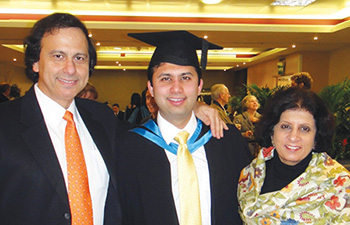
With parents Khushroo and Kumud
Also while at college he enjoyed conceptualizing and scripting a show called Diya which he claims was a fashion show with a twist, hosted by the Asian Society of St Andrews. He played the lead role in the sketch, bringing out the funny elements of Indian society. "After the play my dean who had just joined us from Harvard came up to me and said that St Andrews’ gain was Bollywood’s loss,” laughs the showman.
Colabavala who terms his parents "the wind under my wings,” is proud to be Zoroastrian. Navjoted at nine, he fondly remembers that his paternal grandmother Putli taught him the basic prayers, along with telling him stories about Zarathushtra. "I have been lucky to have the best of both worlds,” he says, referring to his maternal Punjabi heritage. We celebrate all festivals, he laughs.
In between doing stand-up comedy shows and getting involved in product launches, this Zoroastrian finds time to volunteer with underprivileged children at a school in Delhi, and helps by directing plays for their annual day, and on a regular basis by teaching aspects of stagecraft.
Theater teaches you about life, concludes Colabavala, "and is just an extension of life.”
◆ ◆ ◆
From the archive