
More than a ‘natak’
Parsi theater was once a pioneering force that heralded many innovations
"The social history of the modern South Asian theater and cinema is intimately bound with that of the Parsi community and its theater,” declares Nicholson. From its origins in 1853 as a tool for reform for the citizens of Bombay, Parsi theater grew in 40 short years into the subcontinent’s primary form of visual entertainment that catered to the growing needs of a new Indian middle and industrial working class, notes the scholar. "Actually the term ‘Parsi theater’ is quite deceptive. There was nothing Parsi about it except that it originated from the Parsis.”

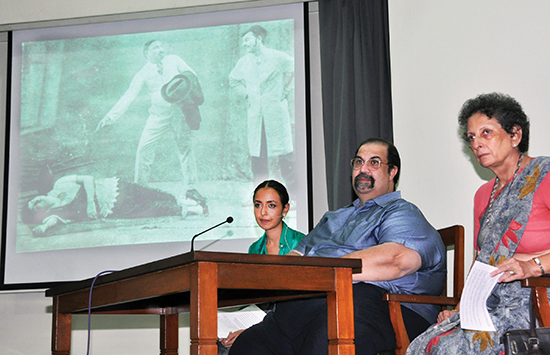
In the first 16 years, 20 drama companies were created by Parsis. "A lot of times groups would go bankrupt. Some Parsis committed suicide. A lot of companies shut down. They sprang up as quickly as they shut down,” she revealed. They performed plays in various languages: Urdu, Hindustani, Gujarati and English. Themes ranged from the Shahnameh and Persian legends to Indian classics like Harishchandra (1883) and Chandravali (1881). Many dramas were adapted from Shakespeare’s works like Dil Farosh, literally "The Merchant of Hearts” was based on The Merchant of Venice, and Gulnar Firoze on Romeo and Juliet.
The Delhi based Parzor Foundation’s website notes that "The first Parsi theater company called Parsi Natak Mandali was owned and directed by Gustadji Dalal and supported by Dadabhai Naoroji, K. R. Cama, Dr Bhau Daji, Ardeshir Moos and others. It was followed by theatrical companies managed by Parsis, which included The Zoroastrian Theatrical Club, The Student Amateur Club, The Victoria Natak Mandali, Natak Uttejak Company, Empress Victoria Theatrical Company and The Alfred Natak Mandali.
Parsis derived their initial inspiration for theater from the English touring companies that performed in Calcutta and Bombay. The troupes included women. "It’s okay when a gori (fair) madam performed. It’s not okay when a Parsi woman performed on stage. In fact there were gori women like the popular, beautiful English actress Mary Fenton performing on the Parsi theater stage at a later date.”
Initially, the theater personnel were all Parsis and women’s roles would be acted by handsome men. The Times of India, October 21, circa 1861 remarked regarding the performance of the play The Seven Clerks: or the Three Thieves and the Denouncer by the Parsi Amateur Dramatic Club that "it is surprising that such an enlightened community as the Parsis has not yet overcome its strong prejudice to women impersonating female characters upon the stage. Surely there is plenty of latent dramatic talent amongst Parsi ladies... As it was, the part of Victorine had to be taken by Mr N. S. Sooj and he did it very well and in the best of possible taste.” Parsis from all strata entered theater, even young boys who dropped out of school. This of course was the commercial theater. But the taboo that existed for Parsi women and women of other communities did not apply to Muslim women and hence they were permitted on stage. "The Muslim community did not object. It was not such a taboo for nautch (dance) girls were there.”
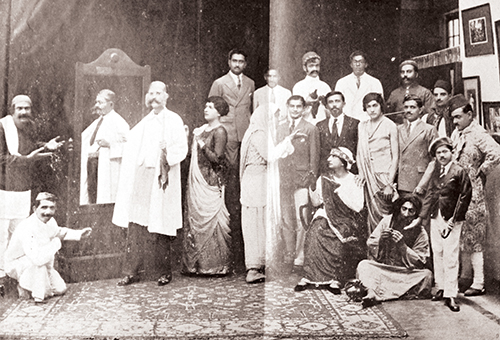
The Calcutta Amateur Dramatics Club in the play Arsi No Ulthap, (1933)
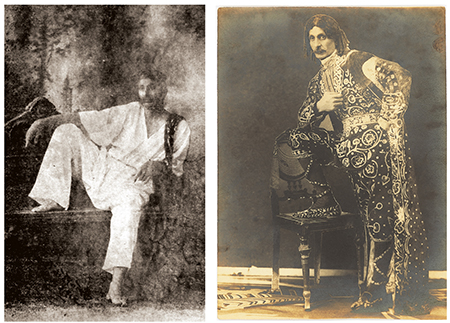
One of the Muslim women was Lalata Begum, who was brought on to the stage by Dadi Patel of the Victoria Theatrical Company in around 1870, writes the late Dr Mani P. Kamerkar in her article "Nascency of nataks” (Parsiana, August 21, 2009). She was "an expert dancer, who performed so well that she won the approval of the audience and attracted full houses. Having once got the acceptance of the public, other Parsi groups introduced women on the stage also.”
The stage brought together talent from different faiths for some plays with Sanskrit themes were written by Muslims like Murad Ali Murad and directed by Parsis like Sohrabji Ogra, notes Parzor. When the Parsi theater started touring, it resulted in Hindus and Muslims being included as actors, playwrights, stage and theater staff. "You could tour with Urdu (which was more widespread), not Gujarati,” observed Nicholson.
A wealthy postgraduate, Dadabhai Sorabji Patel, one of the Parsi pioneers in theater, started to take theater groups on tour. Patel who could have earned between Rs 500 to Rs 700, a princely sum in those days had he continued in the family business, chose to join the theater. He died at a young age while touring, states the scholar.
Beginning 1880s, Parsi troupes toured excessively, to cantonments and abroad. By 1890 there was "one mainstream Urdu theater that spread across South and South East Asia,” says Nicholson. Aside from Hindustani and Urdu there were "multiple branches of Parsi theater. Wherever it went, it spread. So when it went to Malaysia you had your Parsi Bangsawar developing. When it went to Indonesia you had Comédie Stamboul. Even South Indian Tamil and Telugu theater was heavily influenced by Parsi theater… I’m not sure how far south they went.”
Initially the audience comprised either single men or families, says the scholar. "From the 1860s Memons, Khojas, Bohras began to attend theater. There was a shift from Iranian natak (such as tales from the Shahnameh, celebration of the Pahalvan and Irani Parsi identity).” Bourgeois theater gave way "to the popular, commercial theater aimed at the masses.” The Parsis wanted to "capitalize on this bigger market.” In order to cater to this burgeoning clientele, "a transition from Gujarati to Urdu was required… Prior to Independence, Urdu and Persian had practically the same phraseology. At that time Hindi did not exist in the sense we know it today.”
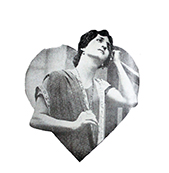
Character Roshan in the play Jaltu Jigar
Further, the emphasis changed from plot to spectacle. For example showing Aladdin flying on a carpet was more important than showing what he felt or thought. This appealed to the audiences. Parsi theater used special effects and mechanical scenery to become the carrier of modernity, avers Nicholson.
In an introduction on Google Books to Somanatha Gupta’s treatise Parsi theatre: Its Origins and Development translated into English by Kathryn Hansen, professor, Department of Asian Studies at University of Texas at Austin, a blurb notes: "From its inception… Parsi theater rapidly developed into a mobile, company-based entertainment that reached across colonial and princely India and extended overseas into Southeast Asia. Like its counterparts in modern Bengali and Marathi, it employed the prevailing local languages (Gujarati, Urdu and Hindi), used the European-style proscenium (area separating the stage from the auditorium) with richly painted backdrop curtains and trick stage effects, and depended on spectacle and melodrama to create audience appeal. Simultaneously, it ushered in the conventions and techniques of realism, marking the transition from stylized open-air presentations to a new urban drama. Although largely displaced by motion pictures after the advent of sound in the 1930s, Parsi theater remains a vital component of the subcontinent’s cultural heritage, significant for its long-term impact on diverse regional theatrical styles and the popular cinema.”
"Literally early Indian cinema became what Parsi theater was between 1890 and 1930,” observes Hansen. "The song-and-dance routines which almost define Bollywood were already there in Parsi theater.” Parsi women made an entrance in films in the 1930s, but when there was an ‘outcry’ from the orthodox Parsi community, the women preferred to adopt Hindu names, says Nicholson.
Reading Gujarati
Nicholson’s interest in the subject started when she read Hansen’s translation of Gupta’s book while studying theater at Copenhagen. The book cited no primary sources so Nicholson decided to hunt for them. She contacted Delhi based Dr Shernaz Cama of Parzor in 2010 who had transcripts of several plays. Much of the material was in Gujarati which Nicholson was unable to read. She however photographed the material. After her marriage to playwright Giovanni Papotto in 2011, while waiting for her visa to come through, she asked her mother Dr Anjali Nicholson to read the texts to her. They sat every night and while the mother read out the matter, "I watched it on the screen. That’s how I learnt to read Gujarati.”
Parzor is currently looking for both tangible and intangible material concerning Parsi theater and contributions could be sent to Vanshika Singh (singh_vanshika@yahoo.co.in), states Rashna who also is serving as chief advisor of a project entitled "Preserving Parsi Theatre” that comes within the purview of a program launched by the Sangeet Natak Akademi on "Safeguarding the Intangible Cultural Heritage and Diverse Cultural Traditions of India.”
The J. N. Petit Library, according to Rashna, has "excellent resources on the culture and history of South Asia.” The KRCOI also extended her much assistance. "A lot of the disputes we have today were being deliberated with as much intensity over hundred years ago. People were talking of inter-marriage, the juddin question, the Parsi Marriage and Divorce Act,” she found.
Rashna hails from a family of medical practitioners. Her late grandfather Dara was an ophthalmologist as are her parents Anjali and Darius and her sister, Maneck. She met Giovanni while both of them were working for the Freedom Theater in the West Bank. He is now busy with the Don Juan archives in Palestine.
Although the community may now take pride in the talent of its forebears, in the late 19th century there was much criticism in the Parsi Press such as Rast Goftar, Jam-e-Jamshed, Chabuk, Samachar Darpan, Apakhatyar regarding commercial Parsi theater. Unable to stop the movement, the gentrified Parsi theater developed sometime in the 1890s as a reaction to the mainstream commercial Parsi theater. This honorable alternative was ‘of the Parsis, by the Parsis and for the Parsis.’ Here, Parsi women did not have to sit next to non-Parsis.
"The two theaters, mainstream and bourgeois coexisted until the 1930s,” says Nicholson. Whilst the commercial theater was unable to survive especially with the proliferation of Hindi cinema, vestiges of the gentrified version remain in the Parsi theater of today.