
Books
Radical, rational research
The Argument for Acceptance in Zoroastrianism by Dr Kersey H. Antia. Published in 2015 by Twilit Grotto, Kasson, MN 55944, USA. Pp: xxx + 174. Price: Not mentioned.
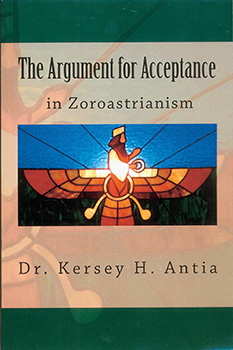 Semantics juggling cannot suppress the actualities behind Dr Kersey H. Antia’s overdue book The Argument for Acceptance in Zoroastrianism. Is it "acceptance” that is being debated here, or "conversion” in its broadest sense? If the former, it is comprehensively argued — since far-sighted diasporan Parsis, mainly North Americans, have reconciled themselves to new socioreligious circumstances and attitude changes among reluctant prelates and earlier objectors.
As a matrix for future conversions — a missionary activity clearly mandated by our religious tenets and commentarial literature — this valuable book is an enduring landmark case for Gathic and Haptanhaitic precepts. Zarathushtra’s idealized view is of a revitalized world "designed to bring about a just, unified, progressive society universally” (as a thoughtful Parsiana correspondent has affirmed in a related context). The much invoked frashokarati from Ys.30.9 encapsulates this design.
Indeed, our early religious texts long absorbed within priestly recitals of the Yasna and the (priest-composed) Vandidad have shown, for the former, the missionary successes of far journeyed athravans (fire-priests?) in celebrating their return (Ys.42.6, where these are enshrined).
The Vandidad’s much discussed first fargard, although little appreciated in its wider implications, lists the 16 lands where Zoroastrian missions had travelled, and where earlier prevailing Ahrimanic beliefs and practices became superseded.

Dr Kersey Antia: refreshing narrative
From the first Sasanian period we have the rock-inscribed evidence of the zealous prelate Kirdir who travelled west with the Great King Shahpur I’s armies to coerce erring priests into "improvement” (!), and on his return to forcibly convert Jews, Christians and Buddhists to Mazdayasni. His methods were draconian; his actual successes few and of short duration. Indeed, some mid-Sasanian monarchs occasionally resorted to force and even persecutions to achieve religious conformity. The perceived arch heretics Mani and Mazdak were summarily executed at the urgings of their respective priestly advisers.
No such drastic measures were employed by the author of this highly informative paperback. Far from forgotten, it was the ordained Zoroastrian priest Antia who, against his religiously illiterate opposition and concerted backlash, formally initiated the American, Joseph Peterson, into the Mazdaic religion. Some 30 years on, the fuss surrounding his righteous deed has largely dissipated, taking its partisans with it, most having withdrawn into a sullen silence.
Peterson himself has since proven his credentials as a fully practising Zarathushtrian believer: surpassing all expectations, diligently abiding by the religion’s precepts, and scintillating with his romanized transcriptions of all its major texts on his website. A remarkable vindication of deep learning and loyal commitment to his chosen faith — one which no Parsi, for all pious protestations and grandiose declarations, has hitherto replicated.
Antia’s painstaking compilation of Parsi perspectives on acceptance of outsiders appears here in its second, expanded edition. The operative term is "acceptance” through a traditional Parsi initiation ceremony — the navjote. Generally speaking, any navjote’s validity as an authentic religious ritual has been challenged time and again by this reviewer on the ground that neither officiant nor initiate is sufficiently equipped to comprehend the profundity of this important rite of passage. The ceremony itself has long been Hinduized in its externals: a truism which sits uncomfortably among some North American Parsis.
Acceptance, therefore, is not within the Indian Irano-Parsi milieu — one wholly obsessed with flats, food and funerals — but by communities of free-willed believers and well-versed practitioners of Zoroastrian precepts throughout the world. Their humanitarian scope is given the authoritative sanction of the Gathas, Yasna Haptanhaiti and Fravardin Yasht. It is an inviolable spiritual acceptance, particular to each individual; one not within a narrow, closed-minded Irano-Parsi ethnicity.
Antia’s cautiously paced argumentation — he doesn’t "argue;” he rationalizes! — deserves careful attention from traditional nar-ashos, "heroic (upholders of) truth-possessors,” as indeed from aspiring neo-Zoroastrians. He provides a rich harvest.
His book comes across as a refreshing corrective to the visceral outbursts of his detractors some of whom, under guise of scholarship exemplified by virulent attacks from the obscurantist Zoroastrian Studies (ZS) organization and disaffected Pahlavisants from the Mary Boyce school of dualists have, with their flim-flam arguments, wilfully distorted the very Gathas which their peculiar religiosities simply cannot tolerate. They have courted a well-deserved derision, and they have obtained it in plentiful measure. This is why exception was taken to their shady activities and tactics.
Boyce herself had prudently recorded her findings with cautiously hedged approving remarks (Antia has included most), impressing upon this reviewer that she did not in any way wish to interfere in community affairs or to offend its sensibilities. Its antagonists, devious to a degree, were unable to sustain their insidious program of wholesale deceit without recourse to bombast, distortion, dissimulation and low grade insults. Not that these any longer matter!
What bothers this reviewer, however, is why the worthy Antia has elected to bulk out his argumentation with a pointless, lengthy refutation of this predictably hostile ZS in the book’s wasted Part III. Perhaps he bears lasting scars; they are not visible to any thinking Zoroastrian.
Being long settled in the western hemisphere, Antia could have advantageously inserted instead the well-documented medieval European response to Zarathushtra as it developed from the East, coming in subtle ways and along obscure routes to influence and change the earlier, hesitant Renaissance perspectives for the better! Its rich philosophical content was itself a catalyst for benevolent change effecting a major leap towards the European enlightenment, nudging Abrahamic systems into enduringly universal values, even as it permeated humanist thought.
He has nevertheless given sufficient indications of the geographical spread of Zoroastrian concepts. His excursions into the "Jezberny in a country called Hungary in Europe” (from a naive Jam-e Jamshed article), the Alan movements from the tribal North Caucasus to clan-based Gaul along the north Black Sea land route, all make for reliable, exhilarating reading. Remaining momentarily with Hungary, Antia’s mention of the Magyar-Yazdi connexion appears to have overlooked Ignaz Goldziher’s little known but highly relevant article showing Zoroastrian terminological cognates with Hungarian. There is now also some light emerging from Croatia/Hrvatska of early Iranian contacts: should we be investigating "lost” Iranian tribes? Will they be "converted” or "accepted?” Regressive Parsiism is doomed to extinction there!
When probing into their Zoroastrianness it becomes increasingly obvious that one is dealing with divergent forms of the religion which Parsiism, with hollow pretensions to orthodoxy and authenticity through unprovable age-oldism and its spurious traditions, has failed to substantiate in its manic drive for exclusivity! Hence the assiduously assembled bulk of evidence by Antia solidly counters the massive wall of ZS prevarication, distortion and deceit — at every probative level.
Very noticeable is the ZS penchant for denouncing everything unsuited to their murky outlook and vituperative regard for Antia as "forgeries.” Despite their futile (and childish!) denials and denunciations, Zoroastrianism everywhere has accommodated itself quite seamlessly to the majority populations and religions comfortably and uncontroversially. That is largely due to Antia’s tenacious and patient advocacy of the untarnishable tenets of true Zoroastrianism.
Zarathushtra had advanced himself and all true adherents of his Mazdaic revelation as ahum.bish — "Healers of Life/Existence” — through the Ahura-inculcated mãthras or inspired utterances which make appeal to intellectual resources. It has ever been the religion of life which bespeaks a practical psychology. One cannot help wondering if there is some remote connexion, across time and space, with Antia — Zoroastrian priest and consultant psychiatrist.
An expected reference to the priest-compiled Denkard — our "Mazdaean Encyclopaedia,” specifically to its crucial chapter 172 from Book III, seems to have been missed. For those not in the know, it strongly emphasizes acceptance into the Weh-den — the good religion "adorned with total wisdom” of all humankind. For, it goes on to declare, "When all mankind who are in the material world come over to the profession of the good religion, the assault (of evil) shall be destroyed and all of creation shall attain to an untainted purity and to perfect bliss: this is the revelation of the good religion!” Compiled from scattered sources, the four named scholar-priests (III.420) who authored the Denkard have forthrightly urged universal acceptance. Bearing in mind that this compilation was finalized in the 9th/10th century CE — well after the Arab occupation of Iranshahr (from 642 CE) — the Denkard remains an outstanding monument to the resilience and steadfastness of Mazdayasnian believers who had never lost sight of the true tenets and precepts of their Zarathushtrian faith. Antia could advantageously have added this to his substantial pro-conversion/acceptance dossier.
Instead, one is confronted with the boldly fonted nasty little offering from the odious Deen Parast with its squalid unZoroastrian perspectives and underhand editorial tactics in supposed justification of its misogynistic views of outmarried Parsis. Antia instead inserts the Janus-faced tactics of its contributing editor, himself an avid practitioner of double standards. Why this contrary inclusion in an otherwise well presented set of rebuttals? It surely cannot be through some misconceived strategy in his basically sound argumentation!
Was this book, one therefore wonders, written solely for the information of the North American Irano-Parsi diaspora? If so, it is needlessly restrictive in its intended readership. Having with difficulty detached themselves from the prevalent dogmatism and narrowness within close-minded circles in their homeland, the newly settled Parsis have reshaped their values through reason and rationality away from the tyranny of an intransigent and self-serving clerical cabal.
Antia has taken a major step towards this revaluation: "Argument” provides several guidelines through his discerningly updated, sharply focussed reading presented in the footnotes and bibliography. (The index is patchy as is the general proof-reading.) Its advertising as an "expanded edition” diminishes its real worth and scope as an entirely new work embracing results of the latest scholarship with which Antia has valiantly and, dare it be said, gallantly! tackled in his presentation.
◆ ◆ ◆
From the archive