
Some serious silliness
A theater group is working towards making Parsi theater contemporary
Others in the team include Danesh Khambatta, who also directs and acts in home productions, Darayus Subedar, the backstage man cum finance person, Sajeel Parakh, who spearheads the theater workshops and Sharmila Kazerouni who runs the production and administrative functions.
Speaking to Parsiana at Patel’s home, which also serves as the registered office of the limited liability partnership, on their love of the theater, Patel states that he and Khambatta have known each other since they were schoolmates at St Mary’s. They all went to different colleges and got together only due to their common love of theater. Subedar and Patel are trained lawyers and Khambatta has completed his Masters in journalism. Irani is a commerce graduate and Parakh has a diploma in event management. Kazerouni is an ophthalmologist.
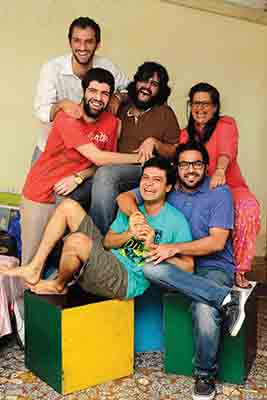
Patel, the unstated head honcho, bemoans the fact that theater in India, and Bombay in particular, is seen as a stepping stone to Bollywood. He is quietly dismissive of those whom he calls ‘camera actors,’ as stage actors need to acknowledge that there is an audience in front of them which catches every move. No luxury of retakes here, he stresses. Funding of cultural events and specifically theater has taken a back seat in Bombay these days, states Patel. Subedar, the money-man nods in agreement.
Of their work with school children, the thespians say that they find teaching speech and drama fulfilling. And it also brings in the jam for the bread and the butter, as Irani puts it. The more non-elitist the school, the more receptive are the students, they say in one voice. "I would rather teach school kids in South India than South Bombay,” quips Irani, having recently returned from a long stint of teaching drama to children at Jose Thomas Performing Arts Center in Cochin. SPP had a two-year contract with this Kerala based center, to manage all its theater activities.
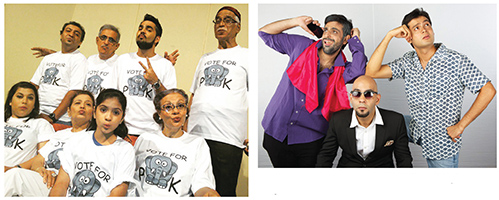
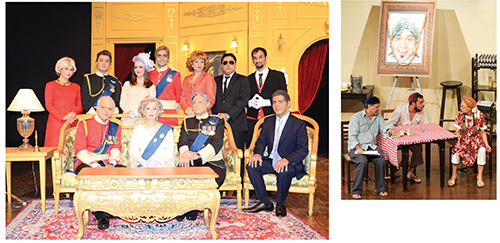
(Right) The cast of The Buckingham Secret and (left) a scene from SodaBottleOpenerWala
The band of boys is appreciative of the support they have received from the National Centre for the Performing Arts (NCPA). Several of their offerings have been co-produced with this multi-venue, multi-purpose cultural center of Bombay. "You will find us on most work days at the NCPA, at one of the theaters or the other,” states Patel, who is the only married one in the quartet.
This team, which has collaborated with famous Bombay stage actors Boman Irani and Sabira Merchant, are highly appreciative of the support they have received from these senior thespians. Merchant has a pivotal role as the Queen in The Buckingham Secret, which has completed 13 shows. "She is an absolute professional,” Patel avers. "No airs and graces,” continues Irani. The play has an irreverent take on the supposedly Parsi origins of the British royal family, where Queen Elizabeth is actually Freny and Camilla, the Duchess of Cornwall, is re-christened Kamla Bai.
Boman Irani, the acclaimed cinema actor returned to theater after 10 years of abstinence for their Rusty Screws, a play about a hotheaded nuclear family, smiles the soft-spoken Khambatta. He states that being an alumnus of St Mary’s helped to get Boman to act in their show as he too was a Marian. "He even contributed to the script,” adds Patel. Shernaz Patel is another stage performer whom the group holds in high esteem, though they have not shared a stage with her.
Show business
After some egging on by the rest of the group, Irani agrees to share the story behind the idea of The Buckingham Secret. "I’ve always been a royalist,” he says, "and in school I would tell my naive schoolmates that when the Zoroastrians fled from Iran, one boat left for England and one for India, and sooner or later the British royals would come claim me as their own.” He says all this with a poker face, as if he were talking of the price of onions in the local market.
Speaking about the quality of the audiences for English theater in Bombay, Irani, ever the actor, states that "people in our country don’t want to see theatah, m’deah.” No one wants to hear about the agonies of Antigone, he quips. Audiences want ‘ha ha ha’ type of plays, not high brow theater and SPP is there to fulfill that need, he states. One play that he dreams of producing is Ayn Rand’s Night of January 16, but fears that if the members of the audience who play the jury in this unique drama leave the stage to arrive at a verdict as required by the script, they would start playing Candy Crush on their phones. "There are no audiences for our own Hindi production Kalaam,” Patel moans. It was too serious a play for our theatergoing public, he says of this story of fractured consciences and helpless situations.
When asked where they see themselves in 2020, Irani jumps in with: "Till last year we didn’t know where we would be this year. We now know there could be a career for us in theater,” he says jokingly. A lot of new people are entering the theater world so it is very important to be agile, he continues. Khambatta, the reserved one, only raises his eyebrows and communicates without speaking that they are in this business for the long haul. Sensing Khambatta’s thoughts, Patel nods affirmatively. Such is the bond between the boys. Subedar grins gently.
Whose parents have been the most supportive, we ask. Khambatta puts up his hand shyly, confirming the support of his parents Rohinton, a liasoning consultant, and Armaity who is an audio-therapist. "It’s not that our parents have been dismissive of our efforts, just apprehensive,” pitches in Irani, adding that they will always be apprehensive "until someone walks up to us in a mall and asks for our autographs in front of them.”
At the NCPA complex, which all four unanimously call their second home, Irani and Khambatta are rehearsing for a forthcoming play, Tirangi Tehmul (Tricolored Tehmul), an Adi Marzban Endowment Fund production written by the late Dorab Mehta, to be staged in time for the Parsi New Year in August this year. This is not an in-house production.
Between photo shoots, Irani talked to Parsiana about future plans for SPP. On the cards is a sequel to The Buckingham Secret called Off White House which will deliver the message "that you don’t have to be white to be a president.” A yet untitled English production opens in September 2015, a comedy which, though it features two homosexual couples, does not use homosexuality for getting the laughs. "I believe in breaking stereotypes. These couples could well be any couple anywhere, battling day-to-day existence,” states Irani.
They troop to Bangalore and Goa in September and October with Class Act 2 — Laughter Therapy, their humorous take on anger management, with characters from diverse communities. In the pipeline is a staging in Muscat of Class Act which completed 100 shows in India in April this year. Also on the cards is a grand musical to be staged in 2016, based on the life of a famous international personality. "It’s never been done before,” Irani shares.
Stressing on the importance of being agile to be able to change course according to the opportunity, Irani states that they did not know till two weeks ago that they would be doing a new play in September. At a lunch meeting with the theater director of NCPA, the dynamic team grabbed whatever dates were available and agreed to flesh out a nascent idea into the yet untitled production.
The religious affiliations of the quartet range from mild (Subedar who says he does practice "in a way” and wears the sudreh and kusti) to indifferent (Khambatta who has faith in a god, does not believe in rituals and does not wear a sudreh and kusti). Patel says rituals are a waste of time and one should be allowed to do what one wants. Irani, a devout believer of Avatar Meher Baba, says his religion is humanitarianism.
The show must go on, is the message all four lads give out. "No one in our age group is doing our kind of theater. That makes us pioneers, doesn’t it?” asks Patel.