
Drama/Cinema/Theatre
“A game of Chinese whispers”
Oorvazi Irani wants her movie to shake people out of their lethargy
"A crystallization of the message of our Prophet,” is how Bombay based Oorvazi Irani describes The Path of Zarathustra, a 79-minute film she has directed, produced and acted in. "It is like a jewel box and the viewer has to open it to see the gem within,” she continues, speaking to Parsiana on July 30, 2015 at a South Bombay coffee shop. "A graduate of the school of hard knocks,” as she calls herself, Irani has completed a film appreciation course designed for teachers from the Film and Television Institute of India (FTII), and has two films under her belt — a six-minute short film on her maternal grandmother called Mamaiji and a nine minute film titled The K File, a quasi-realistic take on the dilemma of Ajmal Kasab, the terrorist who held Bombay to ransom on November 26, 2008.
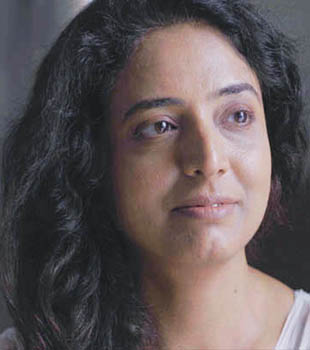
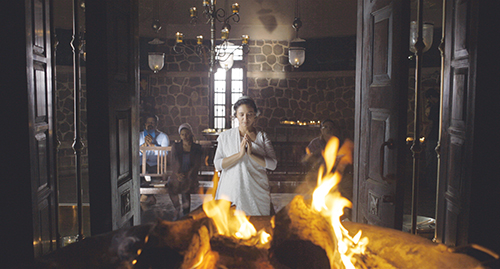
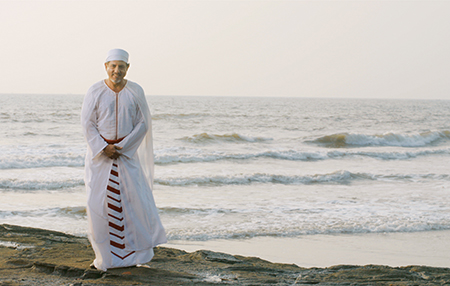
Oorvazi Irani; A scene from the film
Irani dabbled in fashion photography in the past, "but soon got tired of it, as they only wanted you to copy this and copy that.” She found her métier in teaching acting and other aspects of filmmaking. She has been teaching film techniques at Shri Vile Parle Kelavni Mandal’s International Baccalaureate School since 2010 and states that she introduced the Michael Chekov acting technique, an exercise to get to the core of a character, favored by Johnny Depp and Anthony Hopkins, to India. A freelance educationalist, as she describes herself, she has taught film appreciation at various institutes in Bombay. As director in SBI Impressario Private Limited (SBII), a media company started by her father Sorab in 1975, she has been involved in "various aspects of research, production and direction of their projects,” states her website. SBII has produced and co-produced films for Delhi Doordarshan and UK’s Channel Four, and counts among its significant offerings the 1990 national award winning Parsi-Gujarati feature film Percy and a six-part travelog Ramayana for Channel Four, where Irani cut her teeth as assistant director and head of research.
The germ of The Path of Zarathustra was sown, says Irani when she attended a public meeting organized by the National Minorities Commission in 2006 where she heard eminent Zoroastrian speakers like Lt Gen Adi Sethna and Prof Armaity Desai speak on the Parsi identity. "Who is a Parsi, what is a Parsi, these questions kept on simmering in me,” she says. Itching to make a film on the subject, she was cautioned by friends and even some of her close family members. "‘Who will watch it? How will you even sell the idea? Who will finance it?’ asked my aunts,” she shares. Not having answers did not faze this 38-year-old. "What can I give the world? I contemplated. How can I meaningfully contribute to my community? I asked myself,” she says.
She started giving concrete shape to her ideas in 2012. Sorab had completed setting up the IMAX cinema in Bombay and had time on his hands. "We wanted to make a great film,” she reveals. It was also the year of producing Mamaiji, her fond look at the life of Moti (Morvarid) Roowala, which she made in a very off beat, lyrical style.
The Path of Zarathustra, she says, "is not a feature film in the commercial sense, but there are elements of fiction.” In a feature film, the message of the Prophet would be lost. She denies that it is a documentary either, as it has a very personal narrative style. "Being in this in-between realm did not limit me,” she laughs. So what is the film all about? "It’s all about raising questions. My film is not for those who want answers in black and white,” she responds. Everyone asks who am I or why am I here, she continues, "but it is too simplistic to give answers, as there is no one answer.” Maybe she wanted to shake things up, she muses. "There is a little too much stagnation in our community,” she states.
The publicity material for the film, which releases in early September in Bombay, Delhi, Bangalore and Poona states that it falls in the genre of magic realism, and uses the tag line "There is no belief without believers.” Explaining the intriguing line, Irani states, "I am doing my bit about our dwindling numbers.” If there are no Parsis, there can be no Zoroastrianism, as "let’s face it, the Parsis are an important component of the Zoroastrian ethos,” she opines.
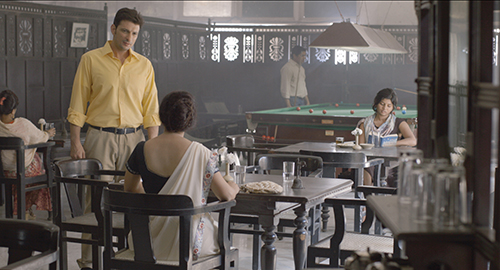
Irani with Rushad Rana in a scene from the movie
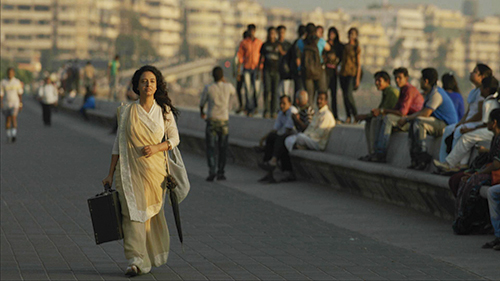
The protogonist (Irani) in Bombay
Mazdak, a character in movie
In her quest for the meaning of life, truth and faith, the protagonist played by Irani comes across various characters from Zoroastrian history like Mazdak and Mani, played by stage and film veterans Darius Shroff and Firdausi Jussawalla among others. "Rushad Rana plays my romantic interest,” says Irani of her character in the movie. The mystery of the book and message that the dying grandfather (played by Tom Alter) leaves the protagonist, referred to in the film’s synopsis, is revealed in the end. The movie concludes on a humanistic note, is all Irani allows herself to say.
Farrukh Dhondy, the UK based writer and TV producer was roped in to write the screenplay, having known Sorab for two decades. He truly believes that films are a director’s medium, Irani says of him. "But you will see an interplay of his radical, intellectual thinking and my quiet contemplation in the film,” she reveals. The music has a lot of Indian classical overtones, and this may surprise audiences, as they would expect largely Western classical in a movie made by a Zoroastrian, she remarks. Did she consult any religious experts during the making of the film? No, is the immediate answer from Irani, an alumnus of Christ Church School and Jai Hind College, repeating that it is all about finding answers on your own.
Three years to make a 79-minute film? It was the planning, the scripting and the need for perfection that is embodied in these three years, says Irani. Shooting took all of one month, she explains.
Irani says that she has not compromised at all with any aspect of the film. "I stopped shooting when there was no money,” she says, her lips pursed. She is all praise for her funders, which include, besides SBII and her sister Nooshin, her "collective of Parsi philanthropists.” She is thankful to her funders, she avers, for not interfering with any aspect of the film. Irani includes her mother Meherangiz (whose father was a Parsi and mother Irani) in her support system, and also Nooshin who is an airport manager for Indigo Airlines.
In his enthusiastic recommendation of the film in an email received by Parsiana, Dinshaw Tamboly, managing trustee World Zoroastrian Organisation Trust Funds, India states that Irani "dared to think for herself and (was not) blinded by dogmas of our race being superior to others.”
Claiming that she is not religious but spiritual, Irani says that she chooses to follow the concepts of good thoughts, good words and good deeds. Not an everyday wearer of the sudreh and kusti, she feels one should not be judgmental about interfaith unions. Religion, she states, "is like the game of Chinese whispers. The message gets altered when it gets passed down over the centuries.”
An admirer of veteran Indian film maker Satyajit Ray for the realism in his detail and for his interplay of facts with lyricism, and an ardent follower of new age Iranian cinema, particularly the work of director Mohsen Makhmalbaf, Irani says she does not want to be locked down with any genre. "The sky is the limit,” she says, and rues the fact she may not be able to show her movie in Iran. She does intend to release it in New York and London in 2016.
Irani states that Sorab and she showed the film to Dr Almut Hintze, the Zartoshty Brothers Professor of Zoroastrianism at the School of Oriental and African Studies, London University. A testimonial from Hintze reveals that she found the film "contemplative and lyrical.” Hintze ends with: "The film … addresses questions on the meaning of life that everybody should consider for himself or herself.”
Reiterates Irani, "Just surrender to what the movie is all about.”
◆ ◆ ◆
From the archive