
History
A messiah and a missionary
The similarities and differences between Rabindranath Tagore and Mahatma Gandhi were outlined by Lord Bhikhu Parekh
"Of the two major people who influenced India, Gandhi still ‘sells.’ Tagore is forgotten,” lamented Lord Bhikhu Parekh delivering the inaugural Amy and Sheryar Ookerjee Memorial Lecture "Gandhi and Tagore: conflicting visions of multicultural India” at Wilson College on August 27, 2015. When young people were asked who Rabindranath Tagore was, those who were acquainted with the man said he wrote the national anthem. But few knew anything more, noted the academician and reputed political theorist. Many could not identify the image of the poet who won the Nobel Prize for literature in 1913.
Tagore "set an example as he stood up” to the Mahatma, said the Baron of Kingston upon Hull. Their concepts of what would hold India together varied. "Some talk of unity in diversity; others talk of cultural synthesis. Neither works.” Unity had to encompass diversity or differences, while a synthesis implied groups would give up their unique characteristics.
Gandhi, a Gujarati and Tagore, a Bengali, "were both deeply religious individuals,” noted Parekh. Gandhi believed God was omnipotent and governed by laws. You had to "realize God and become one with every living being.” He wanted to "wipe away every tear from every eye.” He viewed engagement in politics as a means to "remove injustices” and claimed "truth is the fundamental aim of life.”
Tagore "set an example as he stood up” to the Mahatma, said the Baron of Kingston upon Hull. Their concepts of what would hold India together varied. "Some talk of unity in diversity; others talk of cultural synthesis. Neither works.” Unity had to encompass diversity or differences, while a synthesis implied groups would give up their unique characteristics.
Gandhi, a Gujarati and Tagore, a Bengali, "were both deeply religious individuals,” noted Parekh. Gandhi believed God was omnipotent and governed by laws. You had to "realize God and become one with every living being.” He wanted to "wipe away every tear from every eye.” He viewed engagement in politics as a means to "remove injustices” and claimed "truth is the fundamental aim of life.”
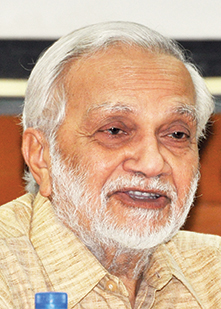
Lord Bhikhu Parekh
Tagore saw himself as a missionary and conceived God as "a creative artist, struggling with recalcitrant matter to create a better universe. He admired the beauty of the universe. He viewed beauty and truth as twins. He heard in the landscape the voice of God. One life was not enough” for a person to admire all the beauty in the world, stated the academician. Tagore traveled to 29 countries in 10 years. Gandhi, in contrast, stayed in India, venturing to England only for the Round Table conference. He saw himself as a messiah: "‘I am the one who can save India.’ His arrogance led to guilt,” said Parekh.
Both agreed that Indian civilization is social, not political and were apprehensive of state interference. As regards nationalism, Tagore believed "the nation is nothing but the people.” He avoided the language of nationalism and polarization. Both said "power is derived from the people.” Civilization is a cluster of tendencies, Parekh observed.
Tagore said India was ours not because the British returned it to us "but due to our service.” He believed India should be open to other cultures. Gandhi saw a core of Indianness while Tagore believed the absorption of different cultures created the Indian identity. Parekh noted the national anthem "strung together all the provinces, the rivers and hills.” Though only one verse of the song is sung, the anthem comprises 11 stanzas, Parekh observed.
The two giants also differed on the symbolism of the charkha; Gandhi spun for half an hour every day creating yarn which would be gifted to the impoverished. He saw this effort "as a way of showing he cared. Donating money does not indicate commitment.” He was not keen on industrialization. Tagore was more so.
Gandhi gave a call to boycott foreign made cloth. When a bonfire of such material was lit, Gandhi termed it "a most moving spectacle.” He believed they were "burning not cloth, but shame.” Tagore questioned: "Why burn? Give it to the poor.”
Tagore saw the Taj Mahal as a "wonderful” monument, "a teardrop on the cheek of eternity.” Gandhi would have preferred to cover it, terming the structure a "self-indulgent” expression of Shah Jahan’s love. He believed "the money could have been put to better use.”

(From left): Pervin Mahoney, Dr V. J. Sirwaiya, Shehernaz Nalwalla
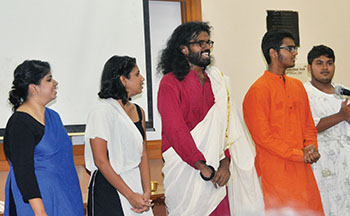
College students performing skit
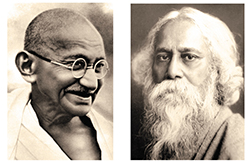
India’s two greats: Mahatma Gandhi (left) and Rabindranath Tagore
Gandhi liked the Ramayana; Tagore valued the Mahabharata which he believed "captures the soul of the people.” Gandhi was more inclined to the Hindu culture; he often quoted from the Upanishads. Tagore’s clothes were deliberately an amalgamation of Hindu and Muslim attire.
Gandhi valued discipline; Tagore valued literature, art, aesthetics. When asked what he missed most, Gandhi replied literature. He used to watch plays and read Sir Walter Scott. Tagore believed politics should be avoided; politics resulted in inflated rhetoric and untruths.
"Both are Indian in their own different ways. Both appreciated where the other was coming from… Nehru is indebted to both.”
After Parekh’s talk, the students of the College performed a short, humorous skit penned by Sheryar some years back. The drama is set in the home of Socrates and featured the Greek philosopher and his nagging wife, amongst others. "I think it must have been written when Sheryar was young,” stated his step daughter Pervin Mahoney. "He was inspired by Socrates choosing death rather than abandoning his beliefs, I guess.”
Shehernaz Nalwalla, vice president of Wilson College termed the Ookerjees a "lovely couple who meant so much to us.” The college principal Dr V. J. Sirwaiya stated that both had been students and professors at the College. Amy was a popular student in the institution and later became a professor of English. "She was a good listener,” he noted. Sheryar taught philosophy for 37 years and "left his mark” as head of the department.
The current head of the philosophy department Harsha Badkar, recalled Sheryar remarking that though Wilson College was founded by missionaries, "they (non-Christians) were never forced to say anything they did not want to. They could challenge Christianity.”
Parekh termed Sheryar "a good professor, a talented teacher and a man of many parts.” He hoped the College would institutionalize the memorial lectures so that unlike other well intentioned initiatives, this one wouldn’t "start and then stop.”
◆ ◆ ◆
From the archive