
History
Gandhi and the pa-rishis - I
Though Dadabhai Naoroji was his constant adviser and inspiration, many Parsis made a profound impression on the Mahatma
Poring over Mahatma Gandhi’s collected works in 98 volumes numbering nearly 50,000 pages, Dinyar Patel, a PhD student at the Department of History, Harvard University came across umpteen references to the Parsi community. The outcome of his study resulted in two academic papers on the relationship between Gandhi and the Parsis.
His first paper titled "Like the Countless Leaves of One Tree” refers to Gandhi’s efforts to engage the community in the independence movement despite the Bombay riot of 1921 when Parsis supporting the future British monarch were targeted by the nationalists. His second paper "Gandhi and the Parsis” refers to Mahatma’s efforts to involve the community, especially the ladies from well-known industrialist families, in khadi production. The salient features of his study were presented by Patel in a talk at the K. R. Cama Oriental Institute on May 28, 2009. Beginning with this issue Parsiana is carrying edited excerpts from his papers.
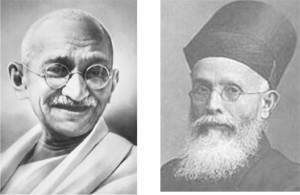
Mahatma Gandhi (left) and Dadabhai Naoroji, the Grand Old Man of India
In September 1888, Mohandas Gandhi, then a young aspiring barrister, set sail for England with three letters of introduction in his possession, "the most precious,” as he recalled later, "being for the GOM (Grand Old Man) of India, Dadabhai Naoroji.” The letter had been given by a Maharashtrian family friend who professed to not even know Naoroji. "What does it matter?” the family friend told young Mohandas. "Everyone knows him and adores him as India’s great son and champion . . . The fact is, you need no introduction to him. Your being an Indian is sufficient introduction.” Naoroji, who had spent many of his years in London engaging in political work and functioning as an unofficial adviser to Indian students in the British capital, instantly attracted Gandhi’s attention. "Whenever an address by him was announced, I would attend it, listen to him from a corner of the hall and go away after having feasted my eyes and ears,” he noted in his Autobiography. Yet the timid student from Porbandar held onto the letter for weeks, feeling that he "had no right to trouble such a great man for an interview.”
Finally, Gandhi mustered the courage to personally meet the GOM, hoping to receive advice on the technicalities of Indian law and assuage personal doubts on his ability to apply his Inner Temple training to the Indian legal environment. Instead, Gandhi found someone who would become his "constant adviser and inspiration... I came to revere him from the very moment I waited upon him with a letter of introduction,” Gandhi eulogized the GOM. Rather than receiving specific answers to any of his questions, Gandhi emerged from the meeting deeply inspired by Naoroji’s selfless commitment toward upholding Indian rights and fighting for the country’s political liberties. "The thought uppermost in his mind all the time was how India could rise and attain her freedom,” Gandhi wrote in Navajivan on the 100th birth anniversary of the GOM. "I myself and many others like me have learnt the lessons of regularity, single-minded patriotism, simplicity, austerity and ceaseless work from this venerable man.”
In the years after their first meeting, Gandhi maintained constant contact with Naoroji, seeking his advice and assistance in South African matters. Yet it was Naoroji’s continued leadership in Indian nationalist politics which most inspired the future Mahatma. Gandhi was particularly drawn toward the GOM’s conception of India as a collection of communities united by the common bonds of nationhood, bonds far stronger and more sacred than the opposing forces of particular communal identities. Nevertheless, in his affiliation with one of the smallest minorities on the subcontinent, with its distinct culture, religious practices and traditions, Naoroji saw no obstacle in his ability to speak on behalf of all Indians. "He made no distinction between Hindus, Muslims, Parsis, Christians and others. He regarded them all as the children of Mother India and hence all received equal service from him,” Gandhi stated. "Dadabhai is loved from the Hindukush to Cape Comorin and from Karachi to Calcutta as no other living man in India is loved,” he wrote on Naoroji’s 79th birthday. "He has given a lifetime to the service of the country of his birth, and though a Parsi, Hindus, Mahomedans, Christians and all revere him just as strongly as the followers of Zoroaster.”
Consequently, Gandhi described the GOM as both a "fakir (ascetic)” and a "rishi (sage);” upon his death he pronounced him a "Mahatma (evolved soul).” Long after his demise, Naoroji continued to inspire Gandhi: returning from the Round Table Conference in December 1931, Gandhi confided to Rustom Masani, the future biographer of the GOM, his belief that Naoroji "would follow the same policy that I have been pursuing for the last few years.” Gandhi acknowledged Naoroji to be one of the most significant influences on his life and political activities.
For having "produced a Dadabhai,” Gandhi declared, the tiny Parsi community "had rendered the greatest service to this country.” Yet Dadabhai was hardly the first — and definitely not the last — Parsi to make a profound impression on the Mahatma. In Kathiawar, London, South Africa, and across the breadth of India, Gandhi encountered countless Parsis who became mentors, supporters, fellow workers and friends. The Mahatma’s close relations with the Parsis is hardly surprising: in the late 19th and early 20th centuries, Parsi influence on Indian society, politics and business was at its zenith. Jamsetji Tata and his sons, Ratanji and Dorabji, commanded over India’s first great industrial house; in 1916, Gandhi urged a Karachi audience to emulate the Tatas in order to "try to develop our (Indian) business.”
Pherozeshah Mehta, the "Lion of Bombay,” championed the cause of increased Indian involvement in governmental affairs from the chambers of the Bombay Municipal Corporation. Along with Naoroji and Dinshaw Wacha, Mehta helped guide the Indian National Congress during its earliest stages. When Sir Pherozeshah was knighted in 1905, Gandhi regarded the conferral as "no less a compliment to the Congress than to the honorable gentleman himself.” The Mahatma fiercely disagreed with Madame Bhikhaiji Cama’s rhetoric of violent and armed rebellion; nevertheless, he praised her "patriotic fervor” and published some of her writings in his journal, Indian Opinion, just days before Cama famously unfurled the first Indian tricolor in Stuttgart.
Aside from these individuals, Gandhi’s Parsi acquaintances included student friends from London; financial benefactors and satyagrahis (soldiers of non-violence)in South Africa; and philanthropists, Congress allies, government officials and civil servants, and the pillars of Bombay society once he returned to India in 1915. "My memories about them (Parsis) are so happy and my association with them has been so close that I feel under a debt to them,” the Mahatma proclaimed in Navsari, Naoroji’s place of birth, in 1921. While the GOM remained a rishi, Gandhi was happy to declare the average Parsi "pa-rishi,” one-fourth a sage.
Indeed, Gandhi was eager to harness Parsi support and recruit community members for his political work in India, particularly non-cooperation, formally sanctioned by the Congress at its Calcutta and Nagpur sessions in 1920. By 1920, Naoroji and Mehta were no more; nevertheless, Parsi political and economic influence remained strong. Gandhi was quick to recognize the wealthy community as a potential source for funding the Congress and its activities. "No one can equal the Parsis in generosity,” the Mahatma stated, referring to the community’s reputation for charity and philanthropy. "No community has donated as much for philanthropic purposes as the Parsis have done . . . If such a community puts its ability to good use, it is bound to benefit the world.”
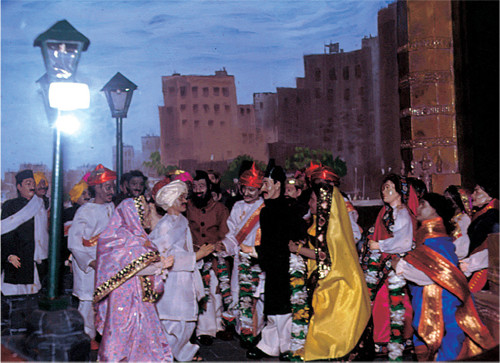
Tableau at Mani Bhavan depicting crowd receiving Gandhiji in Bombay on his return from South Africa in 1915 Photo: Varghese W. Fernandez
In addition to its charitable activities, Gandhi praised Parsis for their traits of honesty, thrift and industry. Once committed to the Congress program, the community could very well serve as a model to the rest of the country. "I expect much by way of enlightenment and soul-force from this community of 80,000,” Gandhi told Parsis after suggesting their adoption of swadeshi (local self-sufficiency), prohibition and reduced meat-eating. "Being small, it can introduce useful reforms in a short time. I should like the Parsis to introduce such reforms and so be perfect modern sages of India.” An educated, socially progressive, and close-knit community, Parsis appeared as ideal candidates for promoting — and even leading — the cause of swaraj (home rule). The Bombay Times thus summarized Gandhi’s remarks to the Parsi Central Association in June 1921: (Pherozeshah) Mehta was called the Lion of Bombay and he (Gandhi) hoped that the Parsis would work in such a manner that they would be called the Lions of India. They were a generous people; they had brains and they had money; they had great merchants and they were capable of much self-sacrifice for the sake of their country. If they could work for India by making the necessary sacrifice, they could easily make themselves the leaders of India. He for one expected great things from the Parsis.
Yet even as Gandhi made such pronouncements he had become well aware that the Parsis possessed very mixed opinions toward the non-cooperation movement. The Mahatma, it is true, attracted numerous willing Parsi satyagrahis in India during his lifetime; however, beyond such individuals and liberal nationalists such as Naoroji and Mehta, many Parsis displayed hostility, deep ambivalence or outright indifference towards the nationalist movement. These attitudes were a consequence of many of those traits and qualities of Parsis which Gandhi so admired. Eager to embrace western education and social reform, Parsis also became highly Anglophile, displaying increased identification with western culture and westerners. As a result, many Parsis strongly disagreed with Naoroji’s dictum that they were Indians first and foremost: rather, Parsis began distancing themselves from the rest of Indian society as they crafted a unique community identity that stressed a fundamental "difference” from Hindu or Muslim co-nationals. India-wide affairs and politics had little appeal for such individuals who sensed little connection with the rest of the nation beyond Bombay and a cluster of settlements in Gujarat.
Having developed from an obscure community of farmers into one of the most dynamic and prosperous subject peoples of the British Empire, Parsis also placed great faith and trust in "enlightened” British rule. Gandhi’s call to non-cooperate with the British Indian government, therefore, was unthinkable to many Parsis who prided themselves on their loyalty and cast the British connection as essential to India’s — and their community’s — welfare. Naoroji’s push for steady constitutional reform concerned Parsis who resented modifications to a favorable status quo; Gandhi’s political methods, in contrast, provoked outrage. The Bombay Chronicle recorded one such outburst during a community meeting with Gandhi:
"The Parsi community were always loyal to their rulers, whether they were Hindus or English. They were not prepared to ask the English to go out of this country bag and baggage, and they did not want to get out of the Empire, over which King George ruled. Any movement which did not exclude these things would have their fullest support. They were fully with Mr Gandhi if he was willing to go forward constitutionally, but not otherwise. They were willing to sacrifice and do everything for their King and their country.”
Non-cooperation and Gandhian politics concerned even the more moderate elements of Parsi society which expressed no ideological objections. Gandhi’s championship of swadeshi, emphasis on the welfare of village India, and his often-hostile rhetoric against industry, capital, and western ways had little appeal for urban, commercially-minded community members. Fundamentally, many Parsis feared that non-cooperation would undermine the very pillars upon which the community’s success and way of life rested. With large numbers of Parsis employed in the civil service, commerce and industry that depended on government support, the legal profession and the financial sector, the community risked severe economic dislocation from anti-British agitation or a prolonged boycott of the government. A correspondent for The Times of India thus questioned Gandhi on the very practicability of Parsi involvement in non-cooperation:
"Are the Parsis to ask their children to leave Government and aided schools when no provision is made for national schools adapted to meet the special requirements of the Parsis? Are the Parsi lawyers to boycott law courts and starve their families? Are the Parsis to give up their lucrative vocations and devote themselves to spinning yarn for three annas a day? The three annas per day will not suffice to pay their daily bill for soda water, let alone whisky and soda. Or, should the Parsis give up their present dress, which is more European than Asiatic, and go back to the days of their ancestors, who used to put on pyjamas with legs wide enough to carry a dozen fowl? Is it possible, thus, to set back the hands of time? Will Mr Gandhi be so good as to give a convincing reply to these queries?”
In spite of vocal opposition to his political ideology and methods, Gandhi refused to disengage with the community, instead reminding them of his previous connections with them and holding out hope of the Parsis’ eventual support for non-cooperation. In speeches and writings, the Mahatma encouraged Parsis to cast off their indifference to Indian affairs, recognize their Indian identity, and devote their energies toward nationalist activities. Gandhi also addressed the Parsis’ deep apprehensions about swaraj, downplaying their fears that Hindu or Hindu-Muslim domi-nation in independent India would spell ruin for the community, its interests, and the privileges it acquired under British rule.
In appealing for Parsi support, the Mahatma faced his greatest test in November 1921 during the Prince of Wales Riots in Bombay. On November 17, Hindu and Muslim mobs attacked Parsis, Anglo-Indians and Europeans returning from welcoming ceremonies for the Prince of Wales, an event that the Congress sought to boycott. Over the next three days, sporadic attacks descended into full-scale communal violence with Hindus and Muslims pitted against Parsis and Anglo-Indians, the latter two groups singled out for their apparent hesitancy to join the non-cooperation movement. Gandhi responded swiftly by condemning violence against Parsis, organizing intercommunity cooperation to end the riots, and outlining his views on the specific and unique rights of minorities.
In appealing to the Parsis both before and after the riots Gandhi demonstrated much more than special concern for a tiny yet powerful colonial elite. Rather, this engagement reflected the Mahatma’s strong commitment to involving all Indians — regardless of communal affiliation — within the Congress and in building a truly national movement for swaraj. To be continued
◆ ◆ ◆
From the archive