
History
Gandhi and the pa-rishis - III
Seeing the communal riots that followed the reception accorded to the Prince of Wales, the Mahatma chose to defer his civil disobedience movement
Poring over Mahatma Gandhi’s collected works in 98 volumes numbering nearly 50,000 pages, Dinyar Patel, a PhD student at the Department of History, Harvard University came across umpteen references to the Parsi community. The outcome of his study resulted in two academic papers on the relationship between Gandhi and the Parsis.
His first paper titled "Like the Countless Leaves of One Tree” refers to Gandhi’s efforts to engage the community in the independence movement despite the Bombay riot of 1921 when Parsis supporting the future British monarch were targeted by the nationalists. His second paper "Gandhi and the Parsis” refers to Mahatma’s efforts to involve the community, especially the ladies from well-known industrialist families, in khadi production. The salient features of his study were presented by Patel in a talk at the K. R. Cama Oriental Institute on May 28, 2009. Beginning with the July 21 issue Parsiana has been carrying edited excerpts from his papers.
In January 1915, Mahatma Gandhi and his wife Kasturba landed at Bombay’s Apollo Bunder. Members of the Parsi elite took an active part in welcoming home this hero of South Africa. Sir Pherozeshah Mehta, who Gandhi credited with teaching him his "first practical lesson in ahimsa (non-violence),” presided over a reception at the Petit family’s sprawling mansion on Cumbala Hill. Within a matter of months, however, Mehta lay dead and Gandhi was left wondering whether, "(a)t a time when the people of India expect to win important political rights, no one is left, we may say, who could speak to the Government on our behalf.” Addressing a condolence meeting in Ahmedabad, Gandhi eulogized Mehta: "He was more of an Indian than a Parsi and believed that the unity of India could be achieved only by turning the entire population into a single community.”
Mehta had been a controversial figure amongst fellow Zoroastrians: many Parsis criticized him for putting Indian interests before those of his co-religionists. Such criticism did not emanate solely from the orthodox Parsis. As late as 1932, Maneckji Kavasji Patel, a Parsi member of the Congress who had supported both Gandhi and Bal Gangadhar Tilak, denounced "those Parsis who declared from the house top that they were Indians first and Parsis afterwards.” In spite of commercial interests stretching from the United Kingdom to China and their dominance in professions across the Indian subcontinent, Parsis remained fiercely communal and insular from the rest of Indian society. Most Parsis expressed either indifference or opposition to nationalist politics. Such attitudes were the result of the Parsis’ particular community identity and a desire to preserve the unique position they occupied in British India.
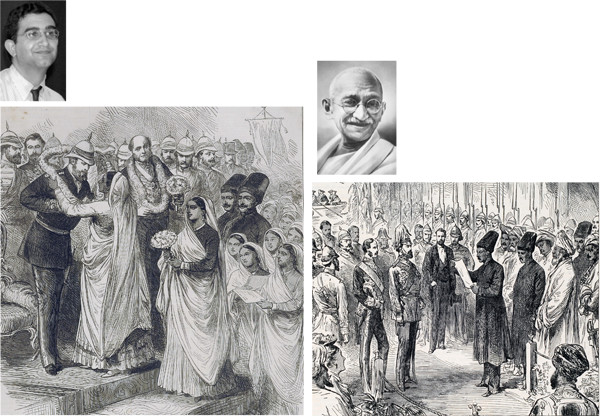
Top left : Historian Dinyar Patel; Gandhi (top right). Below (left): Parsis garlanding the Prince of Wales and (right) reading out a welcome address Photos courtesy Dilnavaz Mehta of Rare Finds
Parsi identity posed a fundamental challenge to engagement with even the most liberal strains of nationalism. Early to embrace both British social norms and Western education, Parsis Anglicized during the 19th century; a consequence of this Anglicization was a growing sense of aloofness and detachment from their fellow Indians. Instead, many Parsis began celebrating their distant Iranian roots and claimed a fundamental difference from — and, indeed, superiority to — Hindus and Muslims. In a strange twist of fate, Gandhi himself had witnessed the consequences of increased Parsi identification with Europeans while in South Africa: when Transvaal railway authorities arrested a Parsi traveler for refusing to give his thumbprint, the Parsi pointed out that, under Transvaal law, members of his community were treated on par with whites and were not subject to this measure, which was reserved for "Asiatics.”
Parsis understood their position of privilege in India to be a direct product of British administration and influence. For centuries, Parsis had remained an obscure minority in coastal Gujarat but, as Dosabhai Framji Karaka stated, "no sooner did the Parsis come into contact with the English, and receive the privileges that belong to a British subject, than their enterprise and energy... awakened with renewed vitality and force. Under the fostering protection of an enlightened Government, the civilization of the Parsees commenced.” Those who cast the Raj as inherently oppressive and inimical to Indian interests found little favor within the community. Madame Bhikhaiji Cama, for example, horrified most of her co-religionists and passed away at Bombay’s B. D. Petit Parsee General Hospital "unhonoured and unmourned.”
Parsis were conscious of their precarious position in Indian society. Numbering no more than 100,000 individuals, Parsis sensed imminent danger in the religiously-defined mass politics of Tilak; they worried about the swadeshi (local self-sufficiency) nationalism in Bengal that created an environment of instability and stressed disengagement with the government and available constitutional methods; and, although many disagreed with Dadabhai Naoroji and Mehta, they balked at the radicals in Congress who threatened to displace the liberal nationalists and their message of political moderation. Radical, mass politics were not simply a challenge to Parsi political influence; they could be devastating for a numerically insignificant community whose commercial success largely depended on maintenance of the current order.
It is therefore not difficult to understand the community’s growing opposition to Gandhi once the Mahatma began calling for mass satyagraha (non-violent protest) and non-cooperation in deliberate opposition to the British Indian government. Parsis were amongst the most prominent moderate Indian political leaders to express their concern. Sir Dinshaw Wacha joined moderates such as Sir Surendranath Banerjea and V. S. Srinivasa Sastri in issuing a memorandum against the use of satyagraha as a means of protesting the Rowlatt Bills. Gandhi’s disappointment was palpable. "There was a time when the word of Sir Dinshaw Wacha was respected all over the Bombay Presidency,” he wrote in a Navajivan article entitled "Why is Non-Co-Operation Being Delayed?” Gandhi’s friendship with the industrialist and philanthropist Jehangir Petit, who had staunchly supported satyagraha in South Africa by serving on two fundraising committees and bringing up the "South Africa question” within the Imperial Citizenship Association, also came under strain over the issue of non-cooperation. In 1920, two more Parsi politicians signaled their disagreement with Gandhi by publishing another manifesto against non-cooperation. Homi Mody, then a member of the Bombay Municipal Corporation, Phiroze Sethna, a member of the Imperial Legislative Council, and other moderates including Sir Narayan Chandavarkar, C. V. Mehta, Kanji Dwarkadas, and Jamnadas Dwarkadas condemned non-cooperation as a divisive and potentially catastrophic method that would "retard the progress of the country on sound, stable lines of constitutional development.”
Gandhi, adept at using the Press in his favor, had made efforts to address Parsi concerns: in order to rectify "so much misunderstanding,” in 1919 he published a lengthy explanation of satyagraha in the Parsi New Year (Pateti) edition of the Gujarati evening paper Sanj Vartaman. However, the Mahatma found little sympathy within the Parsi Press, then an influential component of both the Gujarati and English language media in western India. The Jam-e-Jamshed expressed its concern with Gandhi’s emphasis on mass politics. "We have great respect for Mr Gandhi’s abilities,” the paper editorialized shortly after the Congress’ adjournment, "but it must be borne in mind that in any movement the followers are always more enthusiastic and less wise than their chief and that they bring trouble upon themselves and the country by their excess of enthusiasm.” In a later edition, the Jam-e-Jamshed thundered against Gandhi’s conception of swaraj (home rule) itself: "You intend getting rid of the British Government by means of non-cooperation. We Parsis, along with other Indians, are of the opinion that we cannot do without the British for some years to come.”
The "sacred memories” which Gandhi claimed to have with the Parsis encouraged the Mahatma to vigorously address the community’s indifference to the nationalist movement. He challenged Parsis to shed their conservatism, look beyond their own interests, and evaluate whether British rule had, in fact, been beneficial for the majority of the Indian population. In a special letter addressed "To The Parsis” published in March 1921 in Navajivan, Gandhi wrote:
"You are a very cautious community. You are compact, and you rightly insist on abundant proof of the stability and the morality of any movement before you would take to it. But there is now danger of your becoming over-cautious, and your success in trade may make you oblivious of the wants and aspirations of the multitude of your countrymen.”
Gandhi tempered this warning by expressing his faith in the Parsis, writing that he knew it to be simply "a question of time when you will throw in your lot as a community with the reformers who are hungering to free India from the curse of an Imperialism which is bleeding her to death.”
While appealing to Parsis to consider the interests of the entire Indian population, Gandhi also made strident efforts to address the problem of Parsi identity: "Parsis should feel as much for the country as the others do.” During his April 1921 visit to Navsari, where he paid his respects at Naoroji’s family house, the Mahatma furthermore reminded Parsis that they "have a special bond with India. India gave them shelter at a critical time. To be sure, she has lost nothing thereby. By accepting them, the Hindus and India as a whole have only gained.” Addressing another Parsi meeting in Bombay two months later, the Mahatma ingeniously claimed that it was Zoroastrianism that had taught him "to non-co-operate with Satan; it had taught (Gandhi) to keep apart from Satan, from all evil” — thereby framing his struggle against the British Indian government in religious terms specifically designed to appeal to the Parsis.
During public meetings, Parsis expressed their fears to Gandhi: that Hindu-Muslim unity "between the 23 crores of Hindus and seven crores of Muslims” inevitably meant that "between them the 80,000 Parsis would suffer.” Gandhi believed it was "impossible for the country to make a move forward without taking all the different communities with it and India could not afford to leave a single community behind.” Furthermore, the Mahatma regarded safeguarding minority rights as a national priority. "It was the duty of the communities who were in a majority to safeguard the interests of the minorities and look after them, and that was the first principle of swaraj which they had to keep in view,” the Bombay Chronicle reported Gandhi telling a Bombay meeting.
The Parsi Political Association held a public gathering in Bombay to celebrate the birth anniversary of Tilak, hardly a popular figure amongst the Parsis during his lifetime. In June, the Parsi industrialist Ardeshir B. Godrej — who had proudly advertised Queen Mary’s use of his safes during her 1911 visit to India — contributed the largest donation, to date, for the Tilak Swaraj Fund, a gesture which prompted the Government of India to retaliate by canceling further orders for Godrej safes. News of the government order prompted Gandhi to remark, "How should the people deal with such a malicious government, if not by resorting to non-co-operation with it?”
The Prince of Wales, the future Emperor of India, announced his impending visit to the country; the Viceroy, Lord Reading, consequently organized an elaborate welcoming ceremony for the royal guest in Bombay. Gandhi and the Congress sensed the perfect opportunity in which to air political demands and organize a mass protest sure to attract attention both across India and the Empire. The Bombay Provincial Congress Committee resolved to organize a hartal (strike) on the day of the Prince’s arrival and "to bring about by all possible means a complete boycott of the visit of His Royal Highness the Prince of Wales.”
Gandhi had little need to mention the far more serious grievances motivating popular support for the hartal. In a series of overflowing meetings held the day before the Renown steamed into Bombay Harbour, speakers such as Sarojini Naidu and Jamnadas Mehta exhorted Indians to remember the Rowlatt Acts, the Khilafat wrong, the Amritsar Massacre, and martial law in the Punjab. A group of Parsis held their own gathering where participants spoke of the "religious feelings and honour of their Moslem brethren;” Khurshed F. Nariman, an admirer of Tilak and an emerging figure within the Congress, prompted thunderous applause when he called for the introduction of the charkha (spinning wheel) into all Indian homes and universal adoption of hand-woven swadeshi cloth; Perin Captain told her fellow Parsis not to be "fools and cowards” by attending the Prince’s welcoming reception. Burjor F. Bharucha prepared a speech to be delivered at Gandhi’s bonfire of foreign cloth. While khadi (hand woven cloth) supporters drummed support for the bonfire and collected silk saris flung out of house windows by sympathetic families, the Bombay Chronicle declared it "India’s Painful Duty to Boycott the Prince’s Visit.”
Early in the morning of November 17, soldiers and policemen descended on the southern tip of Bombay, lining the streets from Apollo Bunder to the Maidan that were to be used for the Prince’s procession. As the morning wore on, trams ferried crowds of well-wishers from northern neighborhoods to Apollo Bunder. At 8 a.m., hartal supporters forcibly stopped one of these trams on Ripon Road and demanded that its passengers, mainly Parsis, Europeans, and Anglo-Indians, disembark — by 9:30 a.m. crowds had halted several more southbound trams. A thicket of police insulated the welcoming ceremony from events developing elsewhere in Bombay. Meanwhile, a large audience of Indians, with a significant Parsi, Anglo-Indian and Jewish component, greeted the Prince of Wales as he stepped ashore. In spite of fierce protests launched by Congress sympathizers in previous weeks, Sir Jamsetjee Jeejeebhoy of the Bombay Parsi Punchayet proceeded to deliver a welcome address to the Prince on behalf of the Parsi community, one of the few communal addresses delivered on that day. Parsi schoolgirls helped stage a garba (Gujarati folk dance) performance for the royal visitor.
Once the ceremonies concluded, crowds boarded trams or the handful of motor and horse-drawn vehicles openly defying the hartal. Beyond the reach of soldiers and police, these passengers found a city seething with discontent. Men wearing Gandhi caps jeered and threw stones at vehicles passing by Marine Lines and Charni Road. Throngs of protestors attacked tramcars, assaulting female Parsi passengers and tearing their saris. European and Anglo-Indian women on trams suffered similar fates — nevertheless, Parsis were the prime target for non-cooperators’ outrage at the violation of the hartal and boycott. Rioters — a mix of Khilafat volunteers and individuals in khadi — moved into the Parsi district of Grant Road and into Anglo-Indian neighborhoods around the "Khada Parsi” statue in Byculla, attacking those wearing non-khadi Parsi and European attire. By nightfall, one European had been murdered and soldiers began redeploying into affected areas.
Riots took on a decisively communal color on November 18 and 19, pitting Hindus and Muslims against Parsis and Anglo-Indians. A swelling body of rioters mounted an attack on at least two Zoroastrian fire temples, the Dadysett Agiary and the Wadia Atas Bahram, one of the most sacred Parsi centers of worship. Parsis responded with vengeance, identifying the rioters as Gandhians. By November 20, a mob of 500 Parsis, armed with bamboo sticks reportedly supplied by a "well-known Parsi millionaire,” gathered on Princess Street to defend the Atas Bahram, establishing an "actual reign of terror” as they harassed Hindu and Muslim passers-by. Bands of Parsi and Anglo-Indian youth cried "Down with the Gandhi caps” as they targeted individuals in khadi while other Parsis brandished firearms as they patrolled neighborhoods in motor vehicles. Congress loyalist Bharucha, "on whom was concentrated the hatred of the educated Parsi hooligans,” was severely assaulted.
During the riots, Parsi involvement in the liquor business provided aggrieved mobs with one more example of the community’s supposed intransigence on non-cooperation — peaceful picketing gave way to destruction and desecration of property. In Khetwadi, where many Parsis lived and worked, The Times of India reported the destruction of all liquor shops, vandalized with "charred remains of casks burnt in front of them,” and evacuated residential buildings facing "a road strewn with broken glass.” On Grant Road, several Parsi families were trapped in a building while a surging crowd, provoked by the liquor shop on the ground floor, threatened to set fire to the structure. Nearby on Foras Road, a group of Parsis with lathis (sticks) protected another residential building with a ground floor country liquor shop. However, the Parsi store owner, Cowasji Battliwalla, diffused a worsening situation by bringing all of his casks onto the street and emptying their contents in front of an applauding crowd.
In his leaflet, part of a massive campaign to restore order through posters, public addresses, roving motor vehicles ferrying Congress volunteers to affected areas, Gandhi particularly condemned the violence toward Parsis: "This news of the rough handling of Parsi sisters pierced me like a dart. I felt that my sisters or daughters had been hurt by a violent mob! Yes, some Parsis had joined the welcome. They had a right to hold their own view free of molestation. There can be no coercion in swaraj. The Moplah fanatic who forcibly converts a Hindu believes that he is acquiring religious merit. A non-co-operator or his associate who uses coercion has no apology whatsoever for his criminality.”
Gandhi’s reaction to the violence was marked by a strong defense of minorities, even overlooking their own role in perpetuating the disturbance.
"I must refuse to eat or drink anything but water till the Hindus and Mussulmans of Bombay have made peace with the Parsis, the Christians and the Jews, and till the non-co-operators have made peace with the co-operators... And the Parsis? I have meant every word I have said about them. Hindus and Mussulmans will be unworthy of freedom if they do not defend them and their honour with their lives. They have only recently proved their liberality and friendship. The Mussulmans are especially beholden to them, for the Parsis have, compared to their numbers, given more than they themselves to the Khilafat funds. Unless Hindus and Mussulmans have expressed full and free repentance, I cannot face again the appealing eyes of Parsi men and women that I saw on the 17th instant as I passed through them.”
Only on November 26, days after order had been restored in Bombay, did the Mahatma acknowledge that Parsis and Christians "used greater violence than was necessary” while demanding that the two communities "feel their share of the guilt” for the riots.
In the aftermath of the first incidents of violence, Gandhi announced a major change in his program of non-cooperation. "I have personally come to the conclusion that mass civil disobedience cannot be started for the present,” he stated in his publicly-distributed leaflet. "I confess my inability to conduct a campaign of civil disobedience to a successful issue unless a completely non-violent spirit is generated among the people.” He further declared, "Hindu-Muslim unity is not worth a day’s purchase if it does not prefer the interests of smaller communities to its own. Christians and Jews in India are not foreigners, nor are Parsis. We must go out of our way to be friendly to them and to serve and help them, above all to protect them from harm from ourselves.”
If Parsiana readers have any personal reminisces or family stories involving Mahatma Gandhi or any of his associates, acquaintances, or volunteers, about various important Parsi Gandhians and nationalists such as Dr M. D. D. Gilder, Burjorji Bharucha, Sorabji Adajania, the Captain sisters, Jamshed Mehta or Mithubehn Petit they can contact the author at dinyar.patel@gmail .com or +001 (650) 796-2486. His mailing address is: Department of History, Robinson Hall, 2nd floor, Harvard University, Cambridge, MA 02138, USA.
To be continued
◆ ◆ ◆
From the archive