
Books
Colonial connection
A Kenyan Journey by Pheroze Nowrojee. Published in 2014 by Transafrica Press, PO Box 48239-00100, Nairobi, Kenya; email: transafricapress.com. Pp. 178. Price: Not mentioned.
For all the contributions that Asian migrants from the Indian subcontinent have made to East Africa in the past century and a half, it is a sad reality that their history has not been documented as well as it might have been. There have been sporadic attempts to fill this lacuna, including, most recently, events and publications to commemorate the arrival in Britain, 43 years ago, of thousands of mainly Gujarati families who were expelled by Uganda’s megalomaniac military dictator, Idi Amin, under circumstances that were truly heartrending. Efforts are also underway to create archives based on oral histories provided by those still alive to tell the tale, not only of that mass exodus, but also of the circumstances surrounding the migration of wave upon wave of Indian laborers to British East Africa in the 19th century. Any research into the subject is bound to yield a fascinating story of complex relationships involving Britain, India and Africa, as well as rich accounts of how the migration touched particular families.
The book under review offers captivating insights into the destiny of one such family, the Nowrojees, whose fortunes were linked to the history of the colonial railways in Kenya (somewhat misleadingly called the ‘Uganda Railway’). It is, hearteningly, a success story, despite the family’s share of trials and tribulations which are described in poignant detail in the book. Unlike many of their diasporan compatriots, the Nowrojees did not have to uproot themselves with the departure of the British from Africa; the narrator of the book, a fourth generation Nowrojee, stands tall as one of Kenya’s leading lawyers and human rights activists.
The story begins with his great-grand-uncle, Motabhoy Darabshaw, setting foot in the port city of Mombasa in 1896 to start work as a railway engine driver. Alas, there were no engines to be driven when he arrived, as the rail itself had not yet been laid. The work progressed gradually, however, with Motabhoy bearing up patiently until the railhead reached Nairobi three years later. Soon, however, tragedy struck the country in the form of the bubonic plague which saw ‘Natives and Indians’ being confined within the city limits of Nairobi. Motabhoy suffered a grievous personal loss: his infant son, Jall, died aged 52 days. However, the period also saw him bring his extended family over to Kenya: his niece Dinoo and her husband Pheroze (the narrator’s grandparents) reached Nairobi in 1900. Pheroze was soon employed, also in the Uganda Railway, first as a fireman and, three years later, as a driver. He appeared to lead a life of contentment and pride, having even had the honor of being selected as the driver of the royal train that was to carry the Duke of Connaught from Mombasa to Nairobi in 1906.
The book under review offers captivating insights into the destiny of one such family, the Nowrojees, whose fortunes were linked to the history of the colonial railways in Kenya (somewhat misleadingly called the ‘Uganda Railway’). It is, hearteningly, a success story, despite the family’s share of trials and tribulations which are described in poignant detail in the book. Unlike many of their diasporan compatriots, the Nowrojees did not have to uproot themselves with the departure of the British from Africa; the narrator of the book, a fourth generation Nowrojee, stands tall as one of Kenya’s leading lawyers and human rights activists.
The story begins with his great-grand-uncle, Motabhoy Darabshaw, setting foot in the port city of Mombasa in 1896 to start work as a railway engine driver. Alas, there were no engines to be driven when he arrived, as the rail itself had not yet been laid. The work progressed gradually, however, with Motabhoy bearing up patiently until the railhead reached Nairobi three years later. Soon, however, tragedy struck the country in the form of the bubonic plague which saw ‘Natives and Indians’ being confined within the city limits of Nairobi. Motabhoy suffered a grievous personal loss: his infant son, Jall, died aged 52 days. However, the period also saw him bring his extended family over to Kenya: his niece Dinoo and her husband Pheroze (the narrator’s grandparents) reached Nairobi in 1900. Pheroze was soon employed, also in the Uganda Railway, first as a fireman and, three years later, as a driver. He appeared to lead a life of contentment and pride, having even had the honor of being selected as the driver of the royal train that was to carry the Duke of Connaught from Mombasa to Nairobi in 1906.
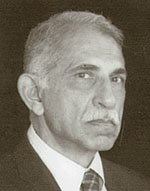
Author Pheroze Nowrojee
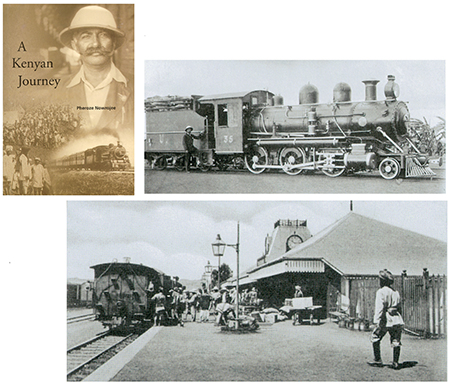
(Clockwise from above) book cover; driver Pheroze Nowrojee with
Uganda Railway train, Mombasa; Nairobi Railway Station
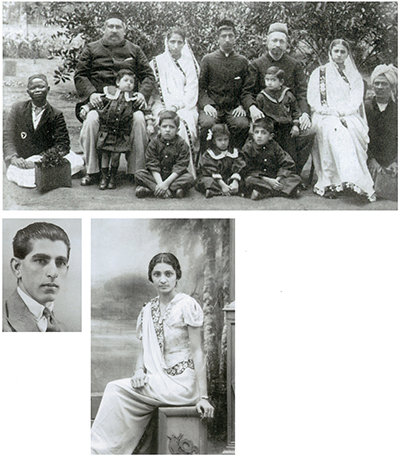
(Top): Darabshaw Motabhoy (seated, ext l) with family and friends;
(above): Eruch Nowrojee and wife Tehmi (right)
The construction of the railway itself had by no means been a smooth affair. Of the 31,983 ‘coolies’ who had been imported from India for the task, 2,493 died while on the job. "It was,” notes the author, "the death of four workers for each mile of rail, and there were 582 miles laid. It meant over 30 co-workers were dying each month during the seven years it took to build the line and consolidate it.” Hardly a pretty picture.
Pheroze’s life moved at an even keel, including during the First World War, in which he was mentioned in despatches for keeping the railway running despite frequent German bombings on the line. However, on the night of April 16, 1916 an incident occurred which shattered the tranquillity of his life: his train was involved in a collision with another train and he suffered serious injuries, including a nervous breakdown. His plea to be put on a stationary job was turned down by his employers, and even his claims concerning entitlement to sick leave on full pay were disputed. A complex bureaucratic tussle ensued which drove him to such desperation that he soon threw in the towel and tendered his resignation. But that did not see an end to his worries either; far from it. A substantial chunk of his post-resignation entitlements was also denied on the grounds that he had, contrary to the rules, failed to take the first available steamer back to India after his resignation and chosen instead to enter into correspondence about the perceived injustices inflicted upon him – a course of conduct which was seen as insolence by the powers-that-be.
Tired and broken, Pheroze and Dinoo left Kenya for India on November 16, 1916. Before his departure, Pheroze applied for and received a Certificate of Domicile from the Kenyan government – a piece of paper which, the author notes, "gave him neither right nor employment nor profit” but which "gave him … a right to love what he was about to lose.”
On returning to India, Pheroze found employment as an engine driver with the Great Indian Peninsular Railway. But he was restless and moved first to Kolhapur, then to Gorakhpur and eventually to Karachi, taking up various jobs including as a travelling salesman for the Lipton tea company. The iniquity of his expulsion from Kenya, however, rankled with him. "It was becoming painfully obvious,” says the author, "not just that he was a railwayman, but that he was an East African as well. He had to go back. But he could not … He felt diminished, day after day, the years passing. His spirit fading.”
And then something extraordinary happened. Dinoo got their son, Eruch (who had been recalled from boarding school after his parents were unable to pay the school fees), to write an impassioned letter to the King Emperor, no less, seeking justice for Pheroze. The letter, reproduced in full in the book, makes fascinating reading for a number of reasons. And, against all the odds, it produced the desired result. In late May 1919 Pheroze received a letter from his erstwhile employer offering him re-engagement as an engine driver in the Uganda Railway. Overwhelmed by this unexpected turn of events, he headed back to Kenya posthaste along with Dinoo after sending young Eruch back to his boarding school in Panchgani, secure in the knowledge that he could now afford to pay the school fees. Pheroze’s joy can only be imagined.
He soon resumed his duties and his work was duly recognized. Whenever a "reliable driver” was needed, especially to steer the Governor’s Specials, the railway administration would send for him. Soon the War Medals started coming in. In 1928 Pheroze’s name featured in a list of six experienced drivers chosen to remedy delays on the Mombasa-Nairobi mail trains. Despite all these honors, there was no escaping the fact that age was beginning to take its toll on his performance, so much so that on one occasion he was formally reprimanded for not preventing the derailment of one of the wagons of a train he was piloting. The writing was, alas, truly and clearly on the wall: in April 1933 he was formally invalided from service after a medical board found him unfit to carry on.
A particularly sad aspect of Pheroze’s story is that, by the time he visited the country of his birth for the last time in 1933-34, "India was long remote to him, and the country no longer meant anything to him.” He died, fittingly, in a railway carriage, his beloved Dinoo by his side, while travelling from Nairobi to Mombasa in 1936. His body was brought back to Nairobi and interred among the graves of the city’s Parsee Burial Ground.
The author, his namesake, never got to know him, having been born three years later, but writes with palpable pride and affection about his illustrious grandfather. "What then,” he asks, "was his life about, to us who are looking back a century later? Certainly a thread was his tie to this land. Today we would call it being Kenyan.” There is pride, too, in the author’s references to his own father, Eruch, the writer of that remarkable petition to the King Emperor which ensured that the family’s connection with Kenya was restored in the face of great odds. Eruch went on to become a successful lawyer, occupying at one time the position of president of the Law Society of Kenya.
This slim volume goes well beyond a family history. It raises questions of identity, the legacy of colonialism, shared sympathy between subject peoples, inter-generational binding, the enigma of arrival, the anguish of departure and so on — with these themes being touched upon, but not necessarily explored at any great length. Given the author’s own not uneventful life in post-independence Kenya, many readers will hope that his next offering will be an autobiography.
◆ ◆ ◆
From the archive