
Life-Style
Hockey, health and helpline
Former sportsperson Arnavaz Damania is now actively involved in neighborhood outreach programs
"I have a smile on my face and a prayer on my lips that they show their mettle,” says Arnavaz Damania reacting to news that the Indian women’s hockey team will return to the Olympics after a gap of 36 years, having qualified for the 2016 Rio Games. The sprightly 77-year- old says she has always had faith that our Indian players are good and can be a team to reckon with. "Last I had taken our team to Moscow (in 1980, as manager to the Olympic team) where we could have been winners,” she writes in an email to Parsiana. The Poona resident who half-jokingly calls herself "more a Maharashtrian than a Parsi” has played several roles in the world of women’s hockey in India – from member of the Bombay and Maharashtra teams in the 1950s and 60s, to judge at the 2000 Sydney Olympics. Interspersed in these years were her stints as president of the Women’s Hockey Association of Maharashtra for 26 years ending in 2001, vice president of both the Maharashtra Olympic Association and the Indian Olympic Association, and judge at the Barcelona Olympics in 1992.
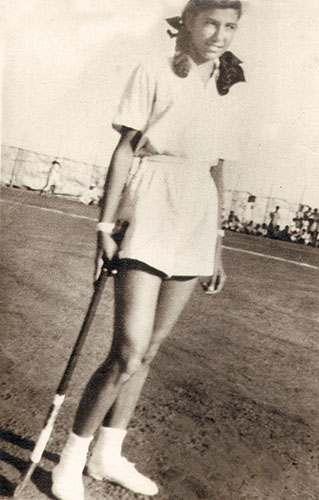
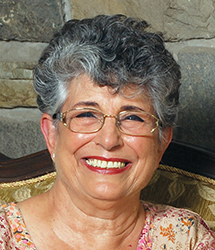
Arnavaz Damania today and as a hockey player
Speaking to Parsiana in the immaculate garden of her home, surrounded by albums of photographs and press clippings of her hockey days, Damania is bitter about the general bias of sports officials against women’s hockey in the country. "We could have been among the best in the world,” recalls the judge at the Argentina Intercontinental Cup 1985, but for unnecessary meddling by government sports officials. Women’s hockey was never sincerely encouraged in this country, she says, affirming that the women’s teams for many years did not even have a coach separate from the men’s team. "Things are looking up now,” she smiles, "though it hurt, in the years I was active.” There were no manuals, no policy guidelines on the roles and responsibilities of coaches and tournament directors. "I would note down how other countries conducted their affairs when I went overseas, and bring it back to the babus (sports officials) here,” who would promptly file it all away. Also, there was a bias against women umpires and tournament directors within India. There was resentment too: "Who is she to travel overseas, the sports officials would mutter behind my back,” she says, about the days when foreign travel was perceived as a perquisite. "I made my career and found my roles on my own,” she affirms.
Instrumental in providing the first poly-grass (synthetic) turf ground in Maharashtra for hockey players in the Pimpri Chinchwad area of Poona, she recalls the graciousness of Margaret Alva, the then union minister of state for sports and youth affairs. "I think it was my dhansak that swung the ministers including Sharad Pawar, then chief minister, in my favor,” she smiles, narrating how she won the three-year "battle” to set up this sport facility.
Damania did not restrict her love of sports to hockey. A keen canoeist, she has served as senior vice president of the Indian Canoeing and Kayaking Federation.
Of all her achievements, and all the roles she has played, the one as assistant tournament director at the Delhi Asian Games, where India won the hockey gold in 1982 is closest to her heart. It was a proud moment for the country, she states simply. "In addition to my official role, I even had to give grooming lessons to the girls,” which she did, along with beauty treatments at her then newly established beauty parlor, Gazelle.
Gazelle Health Spa and Academy, which now has three outlets in Poona was a venture she started "because my husband wanted us to have something to fall back on when he retired,” she laughs. Dara, who superannuated as managing director of ThyssenKrupp Industries India, continues to work as representative of the German engineering company in India, in addition to being associated with some welfare organizations.
Arnavaz and Dara celebrated their golden wedding anniversary three years ago. Daughter Danish is a senior computer programer with Texas Instruments in Toronto, while Anahita, a law graduate is a beauty and hair therapist. Feruzan, following in her mother’s footsteps, was part of the hockey team in the Beijing Asian Games in 1990 and is now administrator at Gazelle. Arnavaz was the deputy chef-de-mission at the time in Beijing.
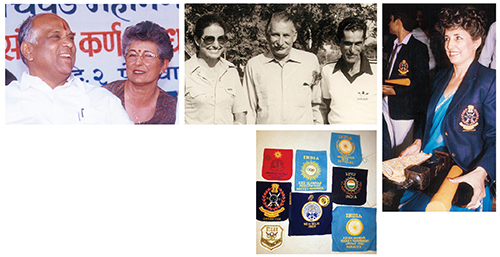
Arnavaz Damania with (clockwise from above left) Sharad Pawar;
Field Marshal Sam Manekshaw and Minoo Golakhaari; with Shiv Chhatrapati Award;
a selection of badges she sported over the years
A personal tragedy in her family – the loss of a loved one to suicide – gave Damania the strength to start a crisis intervention center in 2005 with the help of international bodies working in the area of suicide prevention. The NGO (nongovernmental organization) she started, Connecting, today takes calls from and listens to up to 300 callers a month, from people who are in danger of taking their lives. In addition, volunteers provide emotional support to survivors of suicide at the burns ward of Sassoon Hospital in her home city and make house calls to help survivors and their family members cope with their crises. This highly networked lady has built relationships with over seven police stations across Poona, wherein Connecting helpline is one of the first numbers called by the police to help survivors or family members in their grief. "One home leads to an entry in the wider neighborhood,” she says, talking of how a suicide in one home sparks off a ‘me-too’ in neighborhoods. Care leads to preventive action, states Damania, of the proactive work the 100+ volunteers carry out in the area of community outreaches. Connecting also conducts seminars in schools and helps teachers identify children who may need special attention and who could be harboring thoughts of suicide. "I did not let his life go to waste,” she states, recalling the bleak days after the personal tragedy.
The winner of the Shiv Chhatrapati Award for recognition as a frontrunner in organizing and promoting women’s hockey in Maharashtra, "in the same year that Polly Umrigar won his award for cricket (1982-1983),” Damania bemoans the fact that there are no top class hockey players today amongst Zoroastrians.
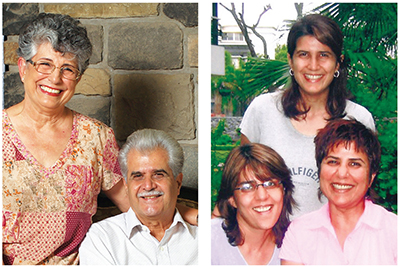
The Damania family (from left): Arnavaz, Dara, Anahita, Feruzan (standing) and Danish
Recalling her growing up years, Damania states that her parents Dilbar and Adarbad Irani were extremely supportive of their daughters’ sporting activities. Sister Gool was also a hockey player, and Ruby, the eldest, was a strong academician. The girls were strictly brought up, she reminisces. "No sleeveless clothes,” she laughs, but states that she owes her cosmopolitan outlook on life to her father who "never said ‘Aapré Parsi, éloko Hindu’ (We are Parsis, they Hindus).” All this parochialism is a new fangled thing, states the lady who takes credit for being the first girl from Poona to fly internationally as cabin crew for Air India for two years, till marriage came her way in 1962. "I was fascinated with the Air India job. Different routes had different experiences and I could have written a book on all the episodes,” she laughs. Even in that phase, she found time to play on the Air India hockey team.
Damania who has been involved in fund-raising for the Sardar Patel Agiary (which she charmingly calls Gaam ni Agiary — Village Agiary — as opposed to the agiaries in Poona Camp), recalls holding fun fairs and sports events to help raise funds for that place of worship. Amidst the various positions she has held, chairperson of fund-raising for the Sardar Dastur Girls School, her alma mater is one she is happiest about. "My school, so I have to do it,” she says, her eyes twinkling.
Waving at the lawns of her home, Damania points out that this was where she started inculcating a sporting mindset in the Zoroastrian youths of Poona in the late 1980s. "We started with summer camps from May 1 to May 31 each year. Soon the 25 kids we started with grew to 300,” over the 10 years she organized this summer event. She recalls organizing outdoor picnics, boating expeditions and basketball and volleyball events for the thrilled children. "All at a charge of Rs 15 per month, mind you,” she reveals.
"What is the point of saying you believe in Humata Hukhata Hvrashta, if you don’t put it into practice?” she asks. Confirming that she is against discrimination towards Zoroastrian women married outside the fold, Damania says "she loves all her non-Parsi sons- in-law equally.”
Shaking her head sadly, this veteran states, "Sports is not a priority for Zoroastrians; I cannot think why.” I am willing to do my bit to help,” she tells Parsiana, as she leaves for her fitness routine, "Though I have promised my family I will never go back to being active in hockey administration.”
◆ ◆ ◆
From the archive