
Religion
Nurtured in Navsari
Five High Priests and nearly 3,000 Zoroastrians join in the 250th anniversary celebrations of the Navsari Atash Behram
Faith and festivity were palpable in Navsari for Parsi founded institutions and homesteads had heeded the call to decorate their premises with flowers, lights and chalk to celebrate the 250th "glorious” anniversary of the Navsari Atash Behram. Not only Zoroastrians, even members of sister communities were seen enjoying the spectacle of lights against the night sky, trying to capture a vantage view on their mobiles.
 At daybreak on October 3, 2015, the multi-hued lights that lent a magical enchantment to the Atash Behram the prior night merged with the sun’s rays. A lively band played a medley of tunes for nearly half an hour to welcome the first set of pilgrims who arrived by 6 a.m. to participate in the religious ceremonies. Sandalwood sellers around the periphery of the Atash Behram were doing brisk business for the scheduled celebrations were to commence with a faalani (contributory) maachi at 7 a.m. followed by a khushali nu jashan at 8 a.m.
At daybreak on October 3, 2015, the multi-hued lights that lent a magical enchantment to the Atash Behram the prior night merged with the sun’s rays. A lively band played a medley of tunes for nearly half an hour to welcome the first set of pilgrims who arrived by 6 a.m. to participate in the religious ceremonies. Sandalwood sellers around the periphery of the Atash Behram were doing brisk business for the scheduled celebrations were to commence with a faalani (contributory) maachi at 7 a.m. followed by a khushali nu jashan at 8 a.m.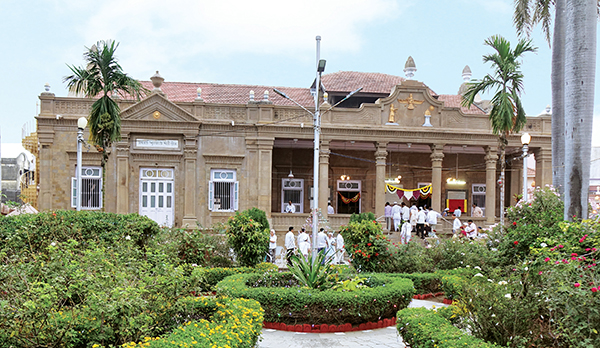
Navsari Atash Behram (Photo: Soli Buhariwala);
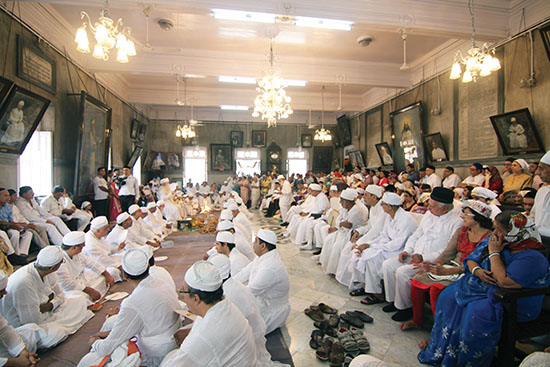
Jashan at Navsari Atash Behram
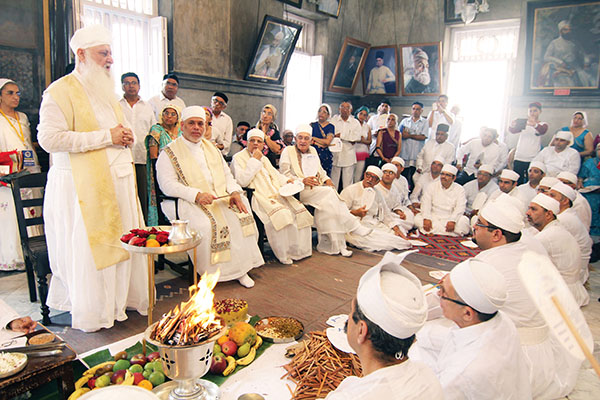
Dastur (Dr) Firoze Kotwal addressing the assembly
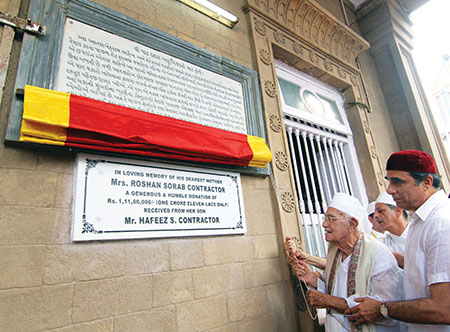
Hafeez Contractor, Ervad Khurshed H. Desai, Dastur Kaikhushru N. Dastur Meherjirana unveiling the plaque
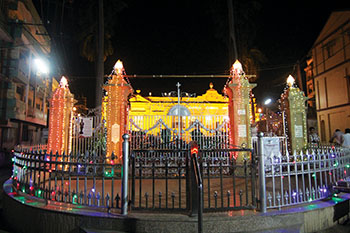
Illuminated Atash Behram
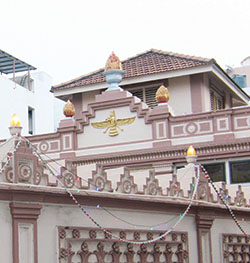
Upper segment of Modi Dar-e-Meher
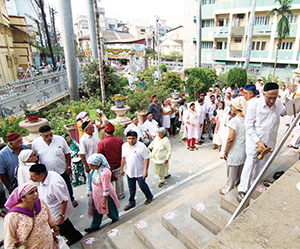
Devotees in the compound
The volunteers of the Navsari Atash Behram and Vadi Daremeher Trust Fund (NAVDTF) had ensured that the floral and chalk decorations were in place, a table at the entrance was equipped to handle cheque and cash donations for which instant receipts were issued, devotees were guided to leave behind their footwear in one corner of the verandah, warned to mind their step at the other end before entering the hall where chairs and benches had been laid out for the jashan.
After offering their sandalwood inside the kebla, the devout started crowding around the grilled windows and entrance to the sacred fire nearly 15 minutes before the maachi but with each fresh wave of arrivals, they were invariably dislodged from their original place. Once the boiwala Ervad Cyrus Panthaky made his way into the sanctum sanctorum, offered the sandalwood on behalf of the assembly and struck the boi deva bells nine times, the devotees made a scramble to secure seats in the hall outside.
In anticipation of the subsequent rush, the seasoned pilgrims had already reserved their seats for the jashan but there were many who stood for the entire hour from 8 to 9 a.m. whilst Dastur (Dr) Firoze Kotwal led the over 50 priests who participated in the jashan. The other high priests in attendance were Dastur Kaikhushru N. Dastur Meherjirana of Navsari, Dastur (Dr) Kaikhusroo JamaspAsa of Bombay and Dastur Khurshed Dastoor of Udvada. Appreciating that JamaspAsa had come to Navsari just to participate in the morning jashan despite his ill health, Kotwal as trustee of the NAVDTF requested fellow trustee and honorary secretary Ervad Khurshed H. Desai to felicitate him with a shawl and memento in the Atash Behram.
Seated on a bench in the front row with the congregation were many senior priests who would have been unable to squat on the ground with the other priests but they were all felicitated on behalf of the NAVDTF and the Bhagarsath Committee. Subsequently another benefactor went around presenting a cash gift to every priest in attendance. Any Zoroastrian priest was welcome to participate in the jashan, said Desai. Dastur (Dr) Peshotan Mirza being on a pilgrimage to Iran he had conveyed in his message to the Navsari community that "on the morning of this auspicious occasion I shall be performing a jashan ceremony at Mt Demavand and our prayers and thoughts will be with and for you.”
The largesse of Bombay based architect Hafeez Contractor was celebrated with a plaque unveiled by Meherjirana at the entrance of the Atash Behram that read: "In loving memory of his dearest mother Roshan Sorab Contractor, a generous and humble donation of Rs 1,11,00,000 received from her son Hafeez Contractor.” Subsequently the philanthropic architect donated a further sum of one crore rupees for the uplift and training of mobeds in Navsari that was announced at the evening function.
Whilst the congregation was partaking of the consecrated chasni, priests from the Desai family were already preparing for the second jashan. As explained Desai, every year on the anniversary of the sacred fire, mah Ardibehesht, roz Srosh, two jashans are performed: the first on behalf of the Navsari anjuman and the second on behalf of the Desai family that has been associated with this Atash Behram since its inception in 1765.
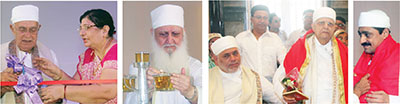
(From left) Meherjirana, Dhun Kasad, Kotwal, Dasturs Khurshed Dastoor,
(Dr) Kaikhusroo JamaspAsa, Cyrus Dastur
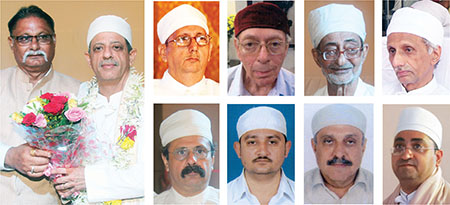
(Left) Yazdi Kasad and Ervad Khurshed H. Desai; (2nd row) Ervads Rooyintan Peer,
Noshir Kotwal, Homi Kotwal, Sorab Vajifdar; (3rd row): Ervads Cyrus Panthaky,
Kaizad Kotwal, Homi Antia, Khurshed F. Desai
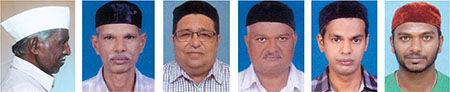
(Alongside) Chanabhai Patel, Dinsha Jivasha, Aspi Bilimoria, Firdosh Avari,
Harvespa Jivasha and Kayzad Pithawala
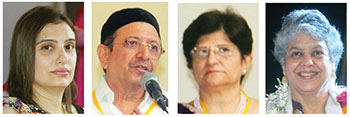
(From left) Monaz Kasad, Kersi Deboo, Hutoxi Jamadar, Bachi Tamboly
Dharam ni tékdi
It was under the leadership of Khurshedji Desai or Khurshedji Bapa as he was respectfully known, that the second oldest atash behram in India was established in Navsari, mentioned historical and religious write-ups by different priests in the bilingual English-Gujarati brochure released on the 250th anniversary. Prior to that, for nearly 300 years until 1741 Navsari had enjoyed the presence of the sacred Iranshah fire ever since Changasha, a behdin, took the initiative of bringing it from Vansda. The sojourn of the Iranshah having started from Sanjan, as per the arrangement among the priests, tending the sacred fire fell within the purview of the Sanjana priests whilst ceremonies for marriage, navjote and death were undertaken by the Bhagaria priests of Navsari. With the passage of time, as the ranks of the priests increased, their income reduced leading to ecclesiastical disputes. The schism among the athornans prompted the Sanjanas to leave Navsari with the sacred Iranshah fire which was first carried to Valsad and thence to Udvada.
Experiencing a religious vacuum, the community requisitioned Khurshedji Bapa who had the necessary influence with the government to establish another Atash Behram. Khurshedji Bapa’s father Tehmulji Rustomji had been conferred the Desaigiri of Navsari province. Preparations were made in right earnest to prepare the old Atash Behram as a home for another sacred fire. Besides Khurshedji Bapa who contributed Rs 300, Surat stalwarts like Noshirwanji Bomanji, Sohrabji Minocherji, Dadabhoy Manekji and Minocherji Khurshedji shared the costs of Rs 1,339 and 10 annas. Using the alat from the Iranshah and assembling 16 different fires an atash padshah was consecrated for enthronement on the same site where the Iranshah had earlier been placed. The first boi ceremony before the atash behram fire was performed by Dastur Sohrabji Rustomji Meherjirana, the seventh descendant. When pirates raided Navsari in 1776, Dastur Sohrabji personally took the sacred fire to Surat where it was kept hidden in the house of Dadabhai Manekji Seth. On three different occasions the fire was sent to Surat for safekeeping.
More than a century later the old structure began to deteriorate and need was felt for a larger atash behram for which purpose neighboring properties were purchased and ultimately the foundation stone for the new Atash Behram was laid on December 25, 1922. Whilst the present Atash Behram edifice with its Modi Hall and Khurshedji Desai Hall was under construction, the sacred fire had been shifted about 200 m away to the Vadi Daremeher, the abode for training of priests founded around 600 years prior to the Atash Behram.
It was under the leadership of Khurshedji Desai or Khurshedji Bapa as he was respectfully known, that the second oldest atash behram in India was established in Navsari, mentioned historical and religious write-ups by different priests in the bilingual English-Gujarati brochure released on the 250th anniversary. Prior to that, for nearly 300 years until 1741 Navsari had enjoyed the presence of the sacred Iranshah fire ever since Changasha, a behdin, took the initiative of bringing it from Vansda. The sojourn of the Iranshah having started from Sanjan, as per the arrangement among the priests, tending the sacred fire fell within the purview of the Sanjana priests whilst ceremonies for marriage, navjote and death were undertaken by the Bhagaria priests of Navsari. With the passage of time, as the ranks of the priests increased, their income reduced leading to ecclesiastical disputes. The schism among the athornans prompted the Sanjanas to leave Navsari with the sacred Iranshah fire which was first carried to Valsad and thence to Udvada.
Experiencing a religious vacuum, the community requisitioned Khurshedji Bapa who had the necessary influence with the government to establish another Atash Behram. Khurshedji Bapa’s father Tehmulji Rustomji had been conferred the Desaigiri of Navsari province. Preparations were made in right earnest to prepare the old Atash Behram as a home for another sacred fire. Besides Khurshedji Bapa who contributed Rs 300, Surat stalwarts like Noshirwanji Bomanji, Sohrabji Minocherji, Dadabhoy Manekji and Minocherji Khurshedji shared the costs of Rs 1,339 and 10 annas. Using the alat from the Iranshah and assembling 16 different fires an atash padshah was consecrated for enthronement on the same site where the Iranshah had earlier been placed. The first boi ceremony before the atash behram fire was performed by Dastur Sohrabji Rustomji Meherjirana, the seventh descendant. When pirates raided Navsari in 1776, Dastur Sohrabji personally took the sacred fire to Surat where it was kept hidden in the house of Dadabhai Manekji Seth. On three different occasions the fire was sent to Surat for safekeeping.
More than a century later the old structure began to deteriorate and need was felt for a larger atash behram for which purpose neighboring properties were purchased and ultimately the foundation stone for the new Atash Behram was laid on December 25, 1922. Whilst the present Atash Behram edifice with its Modi Hall and Khurshedji Desai Hall was under construction, the sacred fire had been shifted about 200 m away to the Vadi Daremeher, the abode for training of priests founded around 600 years prior to the Atash Behram.
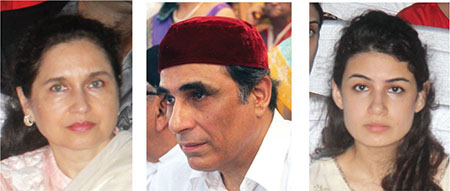
From left: Perl, Hafeez and Zoish Contractor
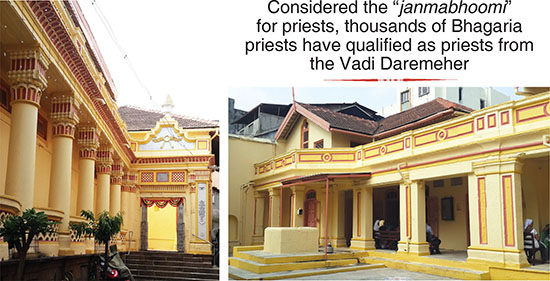
Considered the "janmabhoomi (motherland)” for priests, thousands of Bhagaria priests have qualified as navars and maratabs from the Vadi Daremeher which prides itself on its strict religious training. The initiative for this institution was laid after Zarthosht Mobed, his sons Kamdin and Mobed, and a group of Parsis arrived in Navsari from Sanjan in 1142 CE, and feeling the need for a religious shrine to perform rituals, built the Vadi Daremeher. The term Bhagaria or Bhagarsath derives from the equitable system of work and income distribution among the priests such that no injustice is done to any priestly family. In fact, nearly 145 priestly families of that time were divided among five clans or ‘pol’ named after individuals like Kaka Pahlon ni pol, Kaka Dhanpal ni pol, Asha Faredun ni pol, Mahiyar Faredun ni pol and Chanda Faredun ni pol. With an uninterrupted lineage, they were able to ensure that there was never any alteration in the ancient pav mahal ceremonies and have maintained meticulous historical records.
That one of the Bhagaria mobeds, Meherji Vaacha, visited the court of Emperor Akbar in 1579 after which he was honored as the first Dastur Meherjirana is a matter of prestige for the Navsari community. On the wall facing the entrance to the sanctum sanctorum in the Atash Behram is a silhouette which many devotees feel bears an uncanny resemblance to the familiar standing posture of the first Dastur Meherjirana. Among the other Dasturs to emerge from the Bhagaria priests are JamaspAsa, Darab Pahlan, Faramroz Kutar, Khurshed Dabu and Firoze Kotwal.
Eminent Indians like Dadabhai Naoroji, Jamsetji Tata, Jamsetjee Jejeebhoy "have been a gift from Navsari to our nation,” noted an article in the souvenir by Dinshaw Tamboly, chairman of WZO Trust Funds, whilst affirming, "we Navsakras, whilst preserving our Zoroastrian ethics, culture and heritage, remained loyal to India… Zoroastrians of Navsari have achieved what they have only because they have kept the faith.”
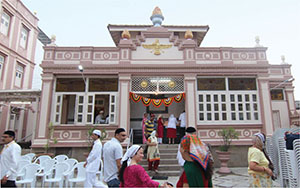
Modi Dar-e-Meher in the Atash Behram compound
Felicitations forever
It was not only the Navsari Parsis numbering under 2,000 who participated in the festivities on October 3 but almost 1,000 outstation visitors who had come by road and rail to join in the historic celebrations. In fact when traveling by train to Navsari, 70% of the passengers in our coach were Parsis making the ticket collector enquire whether community members were heading for the opening of a new temple. Lest he mistake us for some Johnny-come-lately, he was promptly issued a clarification that we were proceeding for the 250th anniversary of our fire temple!
There was a time when the population of Navsari was 30,000 of whom 10,000 were Parsis. Today Parsis number less than 2,000, constituting barely two percent of the city’s population, the audience was informed at the evening function on October 3 at the Bai Dosibai Kotwal Parsi Orphanage Party Ground, inaugurated the same day by Meherjirana. The original owner of the property was Byramji Nusserwanji Seervai who in 1908 gifted it to Bai Dosibai Kotwal. The orphanage with six students was opened on June 1, 1923 to provide better education to orphans and poor Zoroastrians. After the municipality acquired 29,000 sq ft of its property, it was decided to use a part of its remaining non-agricultural land as a party plot, to be rented out to the community at a reasonable rate and to non-Parsis at the market rate.
At least 10 % of Navsari’s Parsi population was felicitated during the over four-hour evening program anchored by Kersi Deboo and Hutoxi Jamadar with a never-ending round of flowers and/or shawls and mementoes in the form of medallions bearing an imprint of the Atash Behram. Those felicitated included the four High Priests, Meherjirana, Kotwal, Dastoor and Cyrus Dastur of Surat whose Modi Atash Behram also celebrated its 192nd anniversary that day. Next on the list were president Meherjirana and trustees of the NAVDTF Ervad Noshir Kotwal, Dastur Kotwal, Ervad (Dr) Rooyintan Peer, Ervad Khurshed H. Desai and honorary secretaries Ervads Homi Kotwal and Sorab Vajifdar. The current committee members Ervads Aspi Mulla, Rusi Antia, Homi Antia, Mahiyar Vajifdar, Rohinton Kanga, Cyrus Kanga, Khurshed F. Desai, Sharukh Desai, Cyrus Panthaky, Porus Desai, Fredy Palia, Mehernosh Madon and Hormuz Sirvai, some of whom serve as boiwalas at the Atash Behram, were next called on stage. The staff at the Atash Behram whose contribution was acknowledged were Dinsha Jivasha, Aspi Bilimoria, Firdosh Avari, Harvespa Jivasha, Kayzad Pithawala and the gardener Chanabhai Patel.
It was not only the Navsari Parsis numbering under 2,000 who participated in the festivities on October 3 but almost 1,000 outstation visitors who had come by road and rail to join in the historic celebrations. In fact when traveling by train to Navsari, 70% of the passengers in our coach were Parsis making the ticket collector enquire whether community members were heading for the opening of a new temple. Lest he mistake us for some Johnny-come-lately, he was promptly issued a clarification that we were proceeding for the 250th anniversary of our fire temple!
There was a time when the population of Navsari was 30,000 of whom 10,000 were Parsis. Today Parsis number less than 2,000, constituting barely two percent of the city’s population, the audience was informed at the evening function on October 3 at the Bai Dosibai Kotwal Parsi Orphanage Party Ground, inaugurated the same day by Meherjirana. The original owner of the property was Byramji Nusserwanji Seervai who in 1908 gifted it to Bai Dosibai Kotwal. The orphanage with six students was opened on June 1, 1923 to provide better education to orphans and poor Zoroastrians. After the municipality acquired 29,000 sq ft of its property, it was decided to use a part of its remaining non-agricultural land as a party plot, to be rented out to the community at a reasonable rate and to non-Parsis at the market rate.
At least 10 % of Navsari’s Parsi population was felicitated during the over four-hour evening program anchored by Kersi Deboo and Hutoxi Jamadar with a never-ending round of flowers and/or shawls and mementoes in the form of medallions bearing an imprint of the Atash Behram. Those felicitated included the four High Priests, Meherjirana, Kotwal, Dastoor and Cyrus Dastur of Surat whose Modi Atash Behram also celebrated its 192nd anniversary that day. Next on the list were president Meherjirana and trustees of the NAVDTF Ervad Noshir Kotwal, Dastur Kotwal, Ervad (Dr) Rooyintan Peer, Ervad Khurshed H. Desai and honorary secretaries Ervads Homi Kotwal and Sorab Vajifdar. The current committee members Ervads Aspi Mulla, Rusi Antia, Homi Antia, Mahiyar Vajifdar, Rohinton Kanga, Cyrus Kanga, Khurshed F. Desai, Sharukh Desai, Cyrus Panthaky, Porus Desai, Fredy Palia, Mehernosh Madon and Hormuz Sirvai, some of whom serve as boiwalas at the Atash Behram, were next called on stage. The staff at the Atash Behram whose contribution was acknowledged were Dinsha Jivasha, Aspi Bilimoria, Firdosh Avari, Harvespa Jivasha, Kayzad Pithawala and the gardener Chanabhai Patel.
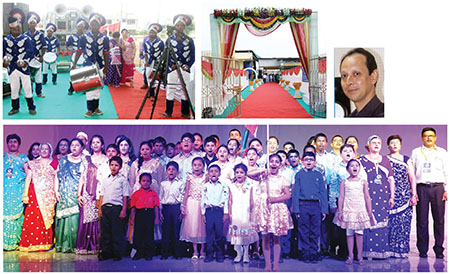
Clockwise from above left: Band playing at Bai Dosibai Kotwal Parsi Orphanage
Party Ground; entrance to the venue; Rumi Baria; event organizers and participants
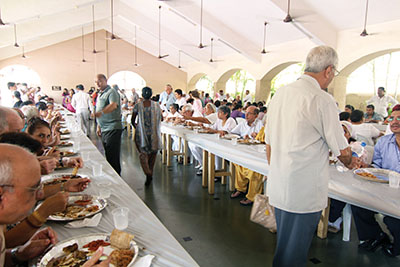
Lunch at Jamshed Baug
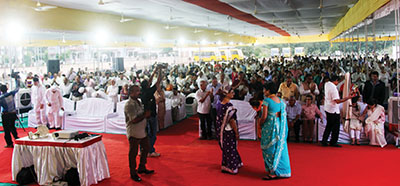
Audience at Bai Dosibai Kotwal Parsi Orphanage Party Ground
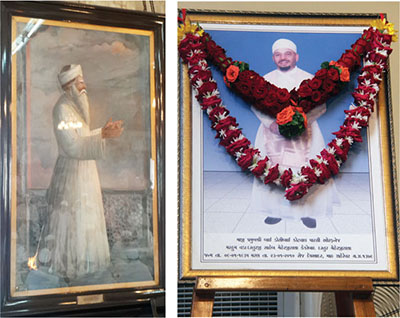
First Dastur Meherji Meherjirana (left) and 16th Dastur Meherji Meherjirana
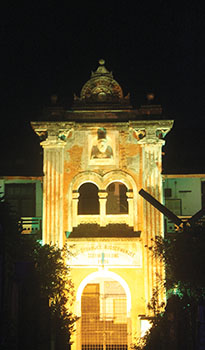
Illumination at the Byramjee Nusserwanjee Seervai Building
The various individuals and teams who have assisted the Atash Behram in different capacities were not forgotten either: auditor Vispi Dastur, architect Percy Pithawalla, Yasmin and Soli Vajifdar for maintaining the accounts, Bomi Mistry and his Yazdan group for cleaning the Atash Behram, Jepee and Jolly Mehta of, JP Electricals, Yazdi Khan for electrification, Behzad Kolah for termite treatment, Filly Medhora and Percy Daruwalla for maintaining the antique clocks. Four others who were also thanked for their "special service rendered to the community” were Tehmul Variava, Rusi Guzder, Aspi Ghadially and Marazban Tampal.
Among the donors and benefactors who were thanked were representatives of the Navajbai Ratan Tata Trust for the two crore rupees donation made in 2011, Hafeez Contractor, Pirojsha Godrej Foundation Trust, Shapoorji Jokhi family, Farrokh Kavarana, Hormaz Avari, Dorab Bajina, Maki Majra, Arin and Percy Master. The trustees of the Bombay Parsi Punchayet, Dinshaw Mehta and Khojeste Mistree and former trustee Burjor Antia were felicitated as also of the Surat Parsi Panchayat Jamshed Dotivala and Yazdi Karanjia, of the WZO Trust Fund, Bachi and Dinshaw Tamboly…
In his brief address, the 17th Meherjirana reminded the gathering to view one’s life as God’s gift that should be dedicated to the cause of religion so that difficulties in life can be surmounted with God’s blessings. A framed photo of the 16th Dastur Meherji Meherjirana who had served as the high priest for 49 years and six months, and impressed the Navsari community with his wisdom and charity, graced the stage during most of the evening.
"Navsari dharam ni tékri chhè (is the Vatican of the Parsis),” pointed out Khurshed Dastoor hoping that the 22 pav mahal ceremonies that were performed in earlier times at the Vadi Daremeher will once again be revived under the stewardship of the present committee. Regretting that religion today is relegated to the background, Cyrus Dastur urged the community to "try and understand religion” that is replete with the message of righteousness and purity. "Our forefathers have given it to us as a legacy and it is our duty to strengthen it.”
Referring to his association with the Atash Behram and the Vadi Daremeher for the last 55 years, Kotwal recalled that during his college holidays he would offer at least one boi at the atash behram. Privileged to lead the jashan at the 250th anniversary, he mentioned that he was given the same honor at the 225th anniversary too. The Vadi Daremeher’s importance can be gauged from the fact that its sacred religious implements would be sent to fire temples throughout India. "If you take one step to work for the religion, Parvardegar will take 1,200 steps towards you,” he advised the assembly.
Dismissing the current trend of political leaders who announce that religion is a personal matter, Peer insisted, "Religion is the central force round which we are revolving… Luckily there are no external forces trying to destroy our faith. Ravan is in our community.” Alluding to those members of the community who dislike using the term ‘Parsi,’ Peer asserted, "In India, Parsi and Zarathoshti is the same. No one has the right to separate them.” At the individual level, by wearing the sudreh kusti, we have to pledge to adhere to the faith and protect it, he added. Everyone in the community has a Navsari connection, stated Peer, quoting Kavi Ardeshir Khabardar’s couplet, "Jya jya vasé Parsi, tya tya vasé Navsari (wherever resides a Parsi, with him dwells Navsari).”
When the audience was hopeful that the entertainment program would commence after nearly three hours of felicitations and speeches, came yet another round of floral presentations, this time on behalf of the Kotwal Orphanage trustee and honorary secretary Yazdi Kasad. Whilst some in the audience started leaving the grounds to proceed to Jamshed Baug, the venue for the evening dinner, the majority stayed back to view the film directed by Rumi Baria with the assistance of Jagruti Baria, Devang Mehta, Piyush Bhatt, Mehernose Gheewala and others. The scripting of the film was by Rohinton Karanjia. Interspersed during the narrative of the film highlighting the lineage of the 17 Meherjiranas, the roots of the religion and its spread in Iran, the arrival on the shores of India and prosperity in its adopted land were live performances by 32 youngsters choreographed by Khushnama Solai, Parvana Vandriwala, Zinobia Ambapardiwala, Yashita Tamboly, Pauruchisti Kadodwala and Simin Bharda. The choreographers were part of the event management team led by Khurshed H. Desai. Besides his wife Jeroo, Cyrus Vandriwala, Aspi Ambapardiwala and Navzer Desai served as the backbone of the event and the publication of the souvenir. The others on the Event Committee included Percy Ambapardiwala, Zubin Besania, Zubin Amroliwala and Bakhtawer Minocherhomji.
A line-up of buses eventually transported the audience to Jamshed Baug to partake of the free dinner hosted by Avari and catered by Khushru Kasad. Until 11 p.m. it was only the four rows of vegetarian diners in different sittings who had managed to complete their dinner. For the non-vegetarians, the wait was much longer if one had the patience. The community members who had joined in the celebrations finally departed with a complimentary brochure and coins bearing the Atash Behram frontage that were on sale to preserve lasting memories.
◆ ◆ ◆
From the archive