
“The vision and benevolence...”
The 100 year old The Dorabji Nanabhoy Mehta Sarvajanik Hospital today is one of the leading hospitals in Navsari
Sir Jamsetjee Jejeebhoy, eighth baronet, graced the occasion in keeping with tradition as his ancestor, the fifth baronet, had inaugurated the facility in 1915. The Hospital’s chairman Farrokh Mehta told Parsiana he felt it would be in order if a descendent of the same family graced the centenary event.
.JPG)
.JPG)
.JPG)
.JPG)
Addressing the gathering, Jejeebhoy extolled "the vision and benevolence of Meherwanji Mehta” who founded the Hospital in memory of his deceased brother, Dorab. The institution offered a "hygienic and conducive environment” to facilitate childbirth. "It’s really a proud moment when the community comes together to celebrate such events.”
He remarked that "no one outside of the medical faculty likes to visit a hospital” save the maternity ward. "Unfortunately Parsis don’t get a chance to visit often” on account of the low birth rate!
Noting the ups and downs in the institution’s history, he commented, "It’s not a straight, upward line.” He then cited Ratan Tata’s remarks on electrocardiogram reports where "a straight line means you’re dead.”
Jejeebhoy lamented the "exorbitant, staggering and spiraling costs of healthcare” and stressed the need for "preventive” measures. One should "follow a healthy lifestyle, exercise, receive proper nutrition, avoid junk food, have access to clean water and hygienic surroundings.” He stressed the need for electronic maintenance of patients’ records which should be available at any time. "No patient should be asked to repeat his/her medical history.”
Bemoaning a tendency to offer doctors monetary and other incentives to fill hospital beds and perform unnecessary surgeries, he noted that often bypass surgery is performed "when a stent would be equally effective.” Hysterectomies in many cases could be avoided. Many doctors, when recommended surgery for themselves, seek a second opinion, he claimed. Medicine was "a noble art and not a business... Medicine and ethics are two sides of the same coin…doctors should do pro bono work. (They) need to be caring, compassionate and committed.”
TDNMSH trustee and principal fund-raiser Dinshaw Tamboly said the Hospital had "evolved into its present state due to the efforts of the trustees (in the past and present), the doctors,” and all the stakeholders. He said the establishment was "fortunate to have enjoyed the confidence” of donors who were "too many to name.” Commenting on the "young energetic team who are part of the Hospital’s managing committee,” he observed, "The future of TDNMSH is in sound and competent hands…there are no weak links in the chain.”
The Jiyo Parsi program funded by the Government of India at the initiative of the Parzor Foundation had entered into a collaborative agreement with the TDNMSH to aid and/or facilitate economically challenged Parsi and Irani Zoroastrian couples to take benefit of the fertility treatment, noted Tamboly in a press release dated March 23, 2015.
The World Zoroastrian Organisation Trust will issue the application forms and check on the bona fides of the couples and their economic status. TDNMSH "will arrange for a doctor specializing in providing fertility treatment” at the Hospital "or at the clinics of doctors approved by them.” A cashless facility is being offered with the hope "that couples of South Gujarat who are unable to make payments… will come forward and take advantage” of the scheme.
Trustee Dara Deboo listed the various medical facilities started by Parsis in Navsari, India and abroad (see "Medical institutions established by Parsis” on page 35), while his brother Kersi narrated the history of TDNMSH (see "The Origins” on facing page). Awards and recognition were given to doctors, staff members, donors and special invitees. A 208-page souvenir, flush with advertisements, provided details of TDNMSH, listing the institution’s 119 employees and around 2,000 donors. TDNMSH gave Rs 33,37,398 in "relief to poor patients” in the financial year ending 2014, admitted 6,923 patients and treated 26,176 outpatients in the period.
.JPG)
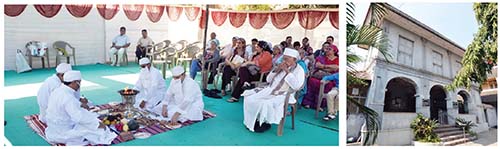
Above: Jashan on Hospital grounds; Dowager Lady Avabai J. J. Agiary; well-wishers at maachi
.JPG)
.JPG)
Dr Harshad Desai’s write-up narrated the contribution of committee member Nanabhai (Nanukaka) Patel in developing the Hospital and raising donations in the past. "The extension building was built (through) Nanukaka and Pravin Mehta’s efforts... The major donors of the Hospital are Jayrambhai Patel, chairman of Leva Patidar Wadi (he organizes camps every year for poor patients and free dialysis patients), Babubhai Shah of Bombay, Chhotubhai Patel of USA, diamond tycoon Mehta, Pravin Patel, Navsari, Prabhubhai Mistry, USA, P. S. Industries, Navsari and many more.
"It was the idea of homeopath Dr Lallubhai Patel to have an ICU (intensive care unit) in Navsari and with a large donation of about two lakhs rupees from Rambhai Patel of Munsad, the first ICU in Navsari with six beds was started in 1982.”
Other firsts at the institute were: echo cardiogram service, two dialysis machines, trauma ICU, respiratory ward with two beds, ICU, cardiac ambulance, modern laboratory, three ventilators, a two-bed mortuary, and a large multipurpose OPD (outpatient department).
The other major current donors include Sam Sooi and family, Dr Madhurika Naik, and the Bai Navajbai Tata Trust, according to Rohinton Contractor, honorary joint secretary and managing committee member.
TDNMSH trustee and honorary secretary Dinyar Mehta wrote about the "Mehta khandan’s (family’s)” contribution to the Hospital while Farrokh referred to TDNMSH "as a gift from my family to Navsari and society at large.”
In the early 20th century Navsari’s population was about 25,000, with Parsis numbering around 7,500. Another 2,000 Parsis resided in the Navsari province.
Following the lead taken by Sir Jamsetjee Jejeebhoy in the field of education, in the 19th century Navsari already had Sir Cowasjee Jehangir Madressa School, Seth Rustom Jeejeebhoy School, D. K. Tata Boys’ School and Navajbai Tata Girls School.
In the field of health care there was the hospital run by the Gaekwad Government and Sir Jamsetjee Dispensary at Kaliawadi at the end of the 19th century. The first modern hospital in Navsari was the Ratanji Faramji Daboo Parsi General Hospital, started in 1913.
Among the Parsi residents of Navsari was the leading Mehta family whose ancestors had served as revenue collectors during the Mogul, Maratha and British periods. The heirs of this family were leaders in the area of education. Some of them had earned fame as doctors and teachers.
Members of the Mehta family resided on five streets in the Malesar locality. Some members of this family toured Bombay, Calcutta and abroad especially China, where they earned wealth as traders. Among the affluent in Navsari, the Mehta family donated towards the construction of school buildings and digging of wells for drinking water in Navsari and neighboring villages. Meherwanji Nanabhai Mehta traded at Calcutta.
On the passing away of Dorabji Nanabhai Mehta on June 6, 1911 his family announced a donation of Rs 7,000 on the day of the uthamna. Other relatives and friends contributed Rs 876, which added up to Rs 7,876. At today’s rates that would amount to five crores as the price of gold then was five rupees per tola (10 g).
On the advice of leading Parsis of Navsari it was decided to use this amount for a modern maternity hospital in Navsari. At that time midwives would help women deliver babies at home. There was a high incidence of maternal and infant mortality.
When the suggestion to start a maternity hospital came up, the conservative society opposed it. But Dorabji’s brother Meherwanji Mehta started the maternity hospital with only four beds on a trial basis in his own Mehta Cottage. In the first month there were six deliveries with more ladies coming forward to avail of the benefit. As the demand increased, Meherwanji gave a part of his vast bungalow, Mehta Lodge, for the maternity hospital.
Since the Parsi lying-in-hospital started by Meherwanji received a good response, it was decided to raise a splendid maternity hospital with modern facilities. A trust was formed in 1912 and Meherwanji, the founder trustee, donated his land in Lunsikui area admeasuring 4,950 sq yds, approximately 45,000 sq ft. Besides Meherwanji, the four other trustees were Dorabji Faramji Tamboly, Dr Edulji Rustomji Dadachanji, Dr Pirojshah Mancherji Mehta and Hormusji Cowasji Gotla.
A managing committee was formed for administering the Hospital which included the trustees, chief medical officer and other committed persons:
Dr Palanji Hormusji Dadachanji, Dr Dhunjisha Hormusji Mehta, Dr Jehangir Behramji Dordi, Dr Behramji Dadabhai Rana, Ratanji Edulji Kanga, Bomanji and Hormusji Desai. Six Parsi doctors of Navsari became members of the managing committee of this institution and rendered selfless service.
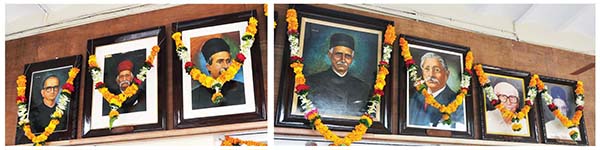
Portrait gallery of Hospital’s stalwarts in the past
Dr Pirojsha Mancherji Mehta, nephew of Meherwanji, was appointed the first chief medical officer of the D. N. Mehta Parsi Lying-in Hospital. Dr Pirojsha passed his medical exam in 1901 and ran two private dispensaries as a general practitioner in Navsari. When it was decided to set up the maternity hospital in Navsari he took great interest and served as chief medical officer for many years thereafter.
On March 3, 1913 the ground breaking ceremony was done by Navsari’s former Suba Rao Bahadur Khaserao Balwant Jadav and construction started. The modern 32-bed maternity hospital for Parsi ladies was inaugurated on January 17, 1915 at the hands of Sir Jamsetjee Jejeebhoy. There were facilities for modem surgeries and services of trained doctors were available.
Donations were accepted only from Parsis and Rs 62,000 were spent in all. Only Parsi ladies’ deliveries were done. Additionally, provisions were made for improving the health of weak women. There were also facilities for training and accommodation of nurses at the institution. A separate fund was created for ladies and those who could not afford the cost to which several Parsis donated. The expenses were met from the interest on this amount.
At one time, all 32 beds were fully occupied and provisions were made for additional beds when more deliveries took place. As per the custom in those days, women who delivered stayed in the maternity hospital for 40 days. All conveniences, including food, were provided to them at nominal rates or free.
As time passed, the Parsi population of Navsari declined. The Parsis migrated from Navsari to Bombay and other places. Other private hospitals started in Navsari and under these circumstances the use of the maternity hospital declined with deliveries reduced to about 100 in an entire year. When it was difficult to get full time doctors and the number of beneficiaries started declining, in 1963 the trustees resolved to convert the maternity hospital into a general hospital and opened it for all citizens, in addition to Parsis. Thus, a small hospital came into existence from a maternity home.
Kersi Deboo
.JPG)
established by Parsis
In Navsari
Charitable dispensary by Rustomji Jamshedji Jeejeebhoy; 1860
Victoria Dispensary from a donation of Rs 75,000 set aside by Sir Jamsetji Jejeebhoy; 1862
Ratanji Faramji Daboo Parsi General Hospital; 1913
Dorabji Nanabhai Mehta Parsi Lying in Hospital; 1915 (converted into a general hospital in 1968 and now renamed Dorabji Nanabhai Mehta Sarvajanik Hospital)
Khurshedji Desai Gondalwala Dispensary; 1961
Nanabhai Bejonji Choksi Parsi Ambulance
Garda Dispensary
In Bombay
Sir J. J. Group of Hospitals; 1845
Jerbai Masina Hospital; 1902
Parsi Ambulance Division; 1904
The B. D. Petit Parsee General Hospital; 1912
Bombay Native Dispensary
Navroji Wadia Maternity Hospital; 1926
Jerbai Wadia Hospital for Children; 1929
Cama and Albless Hospital
Tata Memorial Hospital
Lady Ratan Tata Medical Research Center
Cawasji Jehangir Ophthalmology Hospital
Motlibai Wadia Hospital
Godrej Hospital
Godrej Wing of Breach Candy Hospital
Sakarbai Petit Veterinary Hospital and Veterinary College
In Surat
Cawasji Jehangir Civil Hospital; 1863
Surat Parsi General Hospital; 1920
Gulbai Mehta Parsi Lying in Hospital; 1920
In Poona
Jehangir Hospital; 1946
N. M. Wadia Institute of Cardiology; 1946
Grant Medical Foundation, Ruby Hall Clinic; 1959
Forbes Marshal Hospital
Byramji Jeejeebhoy Medical College and Hospital
In other parts of India
Manekji Damanwala Dispensary, Udvada
Mengusi Hospital, Billimora
Dr Shroff Eye Hospital, New Delhi
Byramji Jeejeebhai Medical College and Hospital, Ahmedabad. (Mohandas Karamchand Gandhi was admitted as a student in this College in 1888. He attended the College for 15 days and gave up medicine because he was not comfortable holding a surgical knife.)
Ratanji Chausarewala Eye Hospital, Valsad
Dhanbhura Veterinary Dispensary, Valsad
Petit Dispensary, Khergam
Byramji Jeejeebhoy Hospital, Matheran
Gulbai Mehta Parsi General Hospital, Karachi; 1919
Ratanji General Hospital, Hong Kong
Aaban Charitable Health Care Services, Sri Lanka