
Events & Personalities
Feted and feisty at 70
"Your Parsi genes keep you fit and healthy,” claimed The Times of India (TOI) editor-in-chief Jaideep Bose complimenting veteran journalist and columnist Bachi Karkaria (née Kanga) on her 70th birthday at a function organized by fellow journalists at the Mumbai Marathi Patrakar Sangh hall premises at Azad Maidan on September 30, 2015. "If I had 10% of her joy of life I would consider myself lucky,” he added. "Bachi made civic reporting important.”
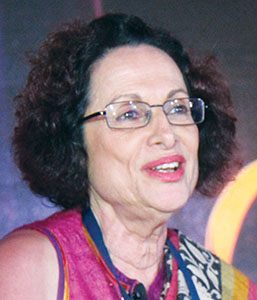
Bachi Karkaria: "legendary status"
"At some stage we must take Bachi seriously,” joked veteran journalist and former Member of Parliament Bharat Raut referring to her renowned use of puns. "We may not understand everything she writes but there is deep thought,” he added. Though they had never worked together there was "an affinity” as they both covered the city. They wrote on issues concerning the aam (ordinary) reader, "issues that relate to you, relate to me.”
Noted Times Now belligerent television host Arnab Goswami who on his prime time 9 p.m. slot harangues some of his guests, drowns out others and invariably dominates the discussion, recalled Karkaria beseeching him when appearing on his weekday popular show, "Today you must let me speak!”
Describing Karkaria as "a nice, warm, smiling person,” he added, "You wear your legendary status very lightly.” Whenever she appeared on his show "she took on anybody without worrying about the consequences.” He narrated an incident where one guest, fearful that his utterances on the program may have offended some people, refused to leave the studio premises until he was provided security. Karkaria never asked for protection of any sort, he observed. He spoke of her body of work on HIV (human immunodeficiency virus).
Former Afternoon Despatch and Courier editor and TOI journalist Carol Andrade, who is currently the dean of the St Paul’s Institute of Communication Education stated she had roped in Karkaria to "teach how to report on a city that we love.” Also termed "gutter journalism,” by some.
Journalist Shashi Baliga, one of the main organizers of the event along with Raut, said it was "to celebrate the career of an extraordinary journalist” and noted the function had no "sponsor,” and that the dinner that followed at the Press Club next door was contributory.
Addressing her friends and colleagues in the hall, Karkaria remarked she "found everyone saying nice things about me without my having to die!” She recalled a crucial lesson she had learned from her fabled editor, Khushwant Singh at the erstwhile The Illustrated Weekly of India: "Take your writing seriously, not yourself.” From her printer, publisher, editor father Navel Kanga she had learned, "make your own sunshine” and "be flexible. If you don’t bend you’ll break.”
She recalled growing up carrying proofs for the Gujarati weekly Navroz started by her grandfather, Eduljee Kanga, and went to bed listening to the "thamp, thamp” of the printing presses. Her grandfather roped in semi-skilled Biharis to do the hand typesetting with individual, Gujarati, metal types. "He had to first teach them typesetting and then Gujarati!” she recalled. Karkaria was "closer to her father,” but "over the years my mother (Jaloo) became the real editor, not my father.” Jaloo was also a better businessperson earning handsomely from the job work done at the press.
Karkaria remembered that on the day she joined The Statesman, the prestigious daily in Calcutta, Sanjay Gandhi died crashing a plane he was piloting; the second day, former President of India V. V. Giri died and on the third day the newspaper’s editor expired. "If anyone dies on the fourth day I’ll go home,” she resolved. Fortunately for her, no one of consequence did, and she went on to join the TOI group in Bombay, retiring as the paper’s National Metro Editor but continuing to write articles, editorials, an agony aunt column for Mumbai Mirror and freelancing.
◆ ◆ ◆
From the archive