
History
The town and its fire
The history of Udvada and the Iranshah are touched upon in the Iranshah Udvada Utsav souvenir
A souvenir published for the Iranshah Udvada Utsav (IUU) last December contains articles pertaining to the coastal south Gujarat town/village. Among the pieces are two by the high priests of Udvada. Two extracts, which have been edited for clarity, style and brevity are published in this issue. The IUU was held under the aegis of the Foundation for the Development of Udvada and supported by the Gujarat tourism department and the Udvada Samast Anjuman.
The families and the fire
The Iranshah Atash Behram is managed by the Udvada Athornan Anjuman. The Sanjana priests work under the leadership and guidance of two high priests, Dastur Khurshed Dastur Kekobad Dastoor who is the 20th descendant of Dastur Bhikhaji Rustomji and Dastur (Dr) Peshotan Dastur Hormazdyar Mirza (since deceased), who was 21st descendant of Dastur Rustomji Sheriyarji, who brought the sacred fire to Navsari.
Among the five priestly dioceses, the Sanjana priests look after the Iranshah fire temple at Udvada. They comprise nine main families descended from Khurshed Kamdin, NaganRam and ChhaiyanShae (or Shahiar), the men who saved the sacred fire in Sanjan after the attack of 1465 CE by Sultan Mahmud, and then took it to Bahrot, Bansda and Navsari. The nine families are: Bhaijina, Dastur, Katila, Mirza, Patel, Sidhwa, Andhyarujina, Bhadha and Unwala. Each of the above nine families has the right to serve the Iranshah for a month. It is a nine-month cycle, after which the first family once again gets to serve the fire.
The division of the duties for Iranshah among the nine families is a mathematical feat by itself. The nine families are divided into groups of three. Among each family of the group, four of the 12 months are awarded. Now, whatever the number of priests in the family, the 30 days had to be accordingly divided among them. The time to serve the Iranshah due to each priest in the family is known as paanti. Depending on the number of priests in a family, a member would get the number of days to serve. If a family had many members, each member priest could even get less than an hour in the days when there were many priests. The method of division was so fine that the time was calculated in hours and minutes.
The Iranshah Atash Behram is managed by the Udvada Athornan Anjuman. The Sanjana priests work under the leadership and guidance of two high priests, Dastur Khurshed Dastur Kekobad Dastoor who is the 20th descendant of Dastur Bhikhaji Rustomji and Dastur (Dr) Peshotan Dastur Hormazdyar Mirza (since deceased), who was 21st descendant of Dastur Rustomji Sheriyarji, who brought the sacred fire to Navsari.
Among the five priestly dioceses, the Sanjana priests look after the Iranshah fire temple at Udvada. They comprise nine main families descended from Khurshed Kamdin, NaganRam and ChhaiyanShae (or Shahiar), the men who saved the sacred fire in Sanjan after the attack of 1465 CE by Sultan Mahmud, and then took it to Bahrot, Bansda and Navsari. The nine families are: Bhaijina, Dastur, Katila, Mirza, Patel, Sidhwa, Andhyarujina, Bhadha and Unwala. Each of the above nine families has the right to serve the Iranshah for a month. It is a nine-month cycle, after which the first family once again gets to serve the fire.
The division of the duties for Iranshah among the nine families is a mathematical feat by itself. The nine families are divided into groups of three. Among each family of the group, four of the 12 months are awarded. Now, whatever the number of priests in the family, the 30 days had to be accordingly divided among them. The time to serve the Iranshah due to each priest in the family is known as paanti. Depending on the number of priests in a family, a member would get the number of days to serve. If a family had many members, each member priest could even get less than an hour in the days when there were many priests. The method of division was so fine that the time was calculated in hours and minutes.
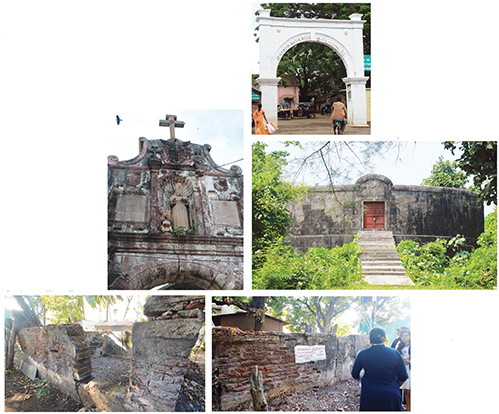
Clockwise from top: Arch near Udvada railway station, dakhma, front and rear of
Portuguese water tank for camels in Udvada, cross and motif atop archway to Portuguese enclave in Daman
Offering maachi to the sacred fire at the turn of each gah during the boi ritual is mandatory for all atash behrams. In the Iranshah a maachi of nine pieces of sandalwood is used because of the tradition that the fire from lightning was used in this Atash Behram was invoked from the ninth heaven by mobed Nairyosang Dhawal.
While offering maachi, different numbers of Atash Nyaish are recited as follows: Havan 11, Rapithwan seven, Uzirin seven, Aiwisrutherem nine, and Ushahen 11 (adding to 45). The approximate number of Atash Nyaishes prayed by mobeds in Iranshah can be calculated 45 x 365 = 16,425 x 1290 years = 2,11,88,250, to date.
The maachi at Iranshah is arranged in a special way. The priest first faces east and places two pieces of sandalwood, about 10 to 12 inches long, with a ladle on the embers in east-west direction, each piece parallel to the other, with a space of three to four inches. Then he places two more pieces of sandalwood with a ladle on the previous two pieces in the north-south direction. Then he again keeps four pieces of sandalwood with a ladle on the previous two pieces in the east-west direction. Lastly he keeps the ninth piece of sandalwood with a ladle on the previous eight pieces in the north-south direction.
After arranging the maachi the priest washes the stone platform on which the sacred fire is kept with clean water while chanting prayers. This act symbolizes washing the feet of the King (fire). Thereafter the priest wipes his hands, puts on cotton gloves, or extends the sleeves of the jamah to cover his bare hands. After that a ritual is performed at atash behrams, which is called chakfarvun or "moving around.”
While uttering particular words from Yasna 68, the priest moves around the afarganyu. He holds a chamach (ladle) with both his hands and keeps some sandalwood pieces in the ladle held in the left hand and touches it to the edge of the sarposh (ash receptacle) of the afarganyu, while praying specific words standing in a particular direction, each time touching the ladle to the edge of the fire urn during the perambulations. After the first Atash Nyaish is recited, two karshas are drawn on the sarposh with the chamach, while praying Yatha Ahu Vairyo and they are then rubbed out after the completion of the third Atash Nyaish. Dastur Khurshed Dastoor
The rulers of Udvada
Udvada was a small village then under the rule of the maharaja of Mandvi Rajya (kingdom) near Surat. It was a summer retreat, a holiday resort for the royal family. A small palace of the king called ‘medi’ in Gujarati also existed in Udvada. Medi is a building with a terrace. Today, after 273 years, though the medi is no longer in existence, the area is still called Medi Vadi, more popularly known in Parsi Gujarati as "meri vadi.” In recent times some Parsis ignorantly tried to link it with Queen Mary of England, but it is not so.
It is said that because herds of camels belonging to the maharajas used to graze there, the village was called Untvada which later changed to Udvada. However literary scholars explain the etymology of the word Udvada as a Sanskrit-Gujarati compound word udanvaas. Udan in Sanskrit means a peninsula. Even at present Udvada is surrounded by water on three sides — west, north and east (the east side being more prominent during high tides and the monsoons). The Gujarati word vaas means a dwelling, a place where people reside.
It is interesting to note that during ceremonial recitations the priests recite the name of the village as Udepur, which means the same as Udanvaas.
The little known early history of Udvada reveals that for centuries before the 16th century the town was under the rule of the maharajas of Dharampur Rajya (kingdom) with Dharampur city as its capital. Presently it is a royal heritage city on the banks of the Swargavahini river at the foothills of the Sahyadri mountain range near the present day cities of Vaghai and Vansda in Gujarat state. Under British rule Udvada fell under Bombay presidency and was given the status of a nine-gun salute by the British. The town acceded to the Union of India in 1948.
In the 16th century the Portuguese captured Vasai (and built Vasai fort in 1531), Daman, towns and villages around Daman including Udvada. Thus Udvada came under Portuguese rule till the early 18th century. There is an old well in Udvada with an inscription in probably the Portuguese language with the year 1714 inscribed on the wall. This well is still in existence and is under the ownership of a priestly family of Udvada.
In the 18th century Udvada came under the rule of the Marathas — the Peshwas. In 1731 ACE, Pilaji Rao Gaekwad conquered Mandvi Raj. Later, Peshwa Chimaji Aappa asked Maharaja Durjansinghji of Mandvi to capture Vasai fort from the Portuguese. Durjansinghji carried out the mission successfully in 1739 and in return the Peshwas gave back his kingdom of Mandvi and gifted him some more villages and towns.
Thus in 1742 when Shree Iranshah was brought and enthroned in Udvada it was under the rule of Maharaja Durjansinghji of Mandvi who was under the Peshwas. Presently, Mandvi city is 61 kms east of Surat and near the Kakrapar Atomic Power Station Township on the banks of the Tapti river in the district of Surat (Bardoli taluka).
To avoid confusion it may be noted that there is a Mandvi city in Kutch near Bhuj which in olden times was a major port under the rule of the maharajas of Kutch. The history of Udvada is not to be confused with this city.
During the 17th century, there was a population of Parsi laypersons (behdins), mainly agriculturists, and also a priestly family residing in Udvada. In 1697 ACE, a dakhma came into existence, consecrated under the leadership of Dastur Darab Hormazdyar of the Rivayat fame. Before 1697 ACE the Parsis of Udvada had to carry their deceased (ravans) to Valsad for dakhmenashini during which they had to endure difficulties particularly during the monsoons. For this reason they complained to the Portuguese government that they were not willing to stay in Udvada. The government offered to construct a dakhma at their expense but the Parsis respectfully declined the offer stating they required only permission to build. Finally, it was decided that Parsis would construct the dakhma out of their own funds and the government would waive their taxes for two years. Those original Parsi behdin families are Kadvana, Kotkotia, Pesina, Bachana, Kumana, etc, who constitute the behdin anjuman of Udvada and along with the athornan anjuman constitute the Samast Anjuman of Udvada.
Dastur (Dr) Peshotan Mirza
◆ ◆ ◆
From the archive