
“We will manage differences”
Despite the mixed signals sent by voters the new trustees have to meet rising expectations
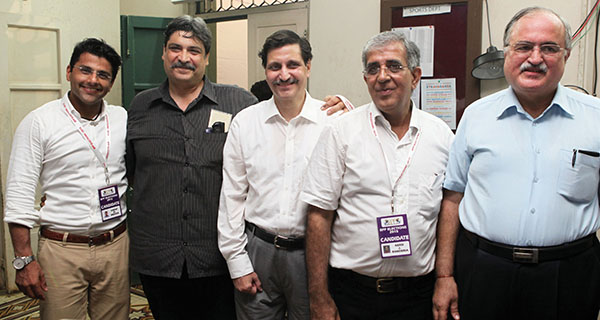
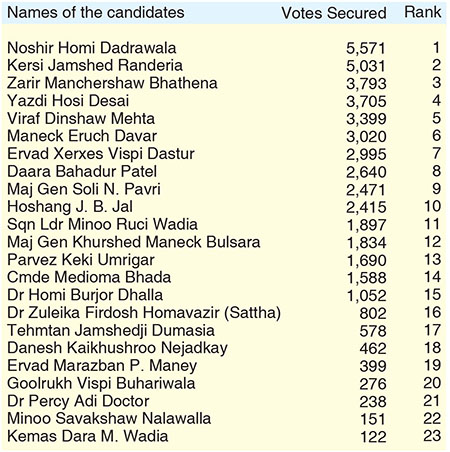
A few minutes later, the results were announced by Dastoor to loud cheers and elated victors. Noshir Dadrawala emerged as the top vote getter followed by industrialist and Parsi Times owner Kersi Randeria, chartered accountant Zarir Bhathena, sitting trustee Yazdi Desai, who now as per the norms of seniority becomes the board’s new chairman and stockbroker and son of the outgoing chairman, Viraf Mehta. All the victories were hard fought and proved a measure of vindication.
But the real heroes of the day were the voters who put up with technical glitches, long queues under a roasting sun without fans, water and at two locations, Bharucha Baug in Andheri and Khareghat Colony on Hughes Road, without accessible toilet facilities. They trundled in unassisted and assisted, on wheelchairs and on foot, mostly older with a sprinkling of youth. Some motored down from Bilimora, Vyara Songadh, Bardoli, Thana, Udvada and elsewhere to vote for their candidates. Many voters were uncertain who to cast their ballot for. One woman inquired if she could carry a slip of paper with the candidates’ names and numbers into the balloting room. She could. Others had to contend with bureaucratic requirements of the correct form being submitted and original government identification cards (this was not required at all centers). Even laminated certificates were finally accepted after being punched.
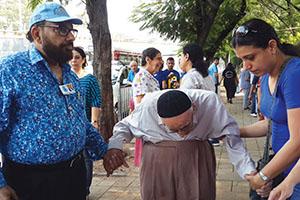
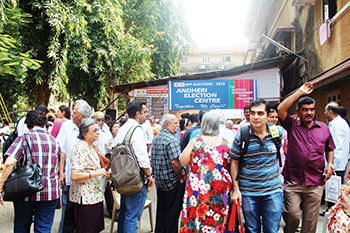
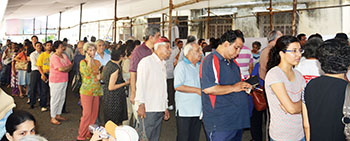
Voting venue Khareghat Colony
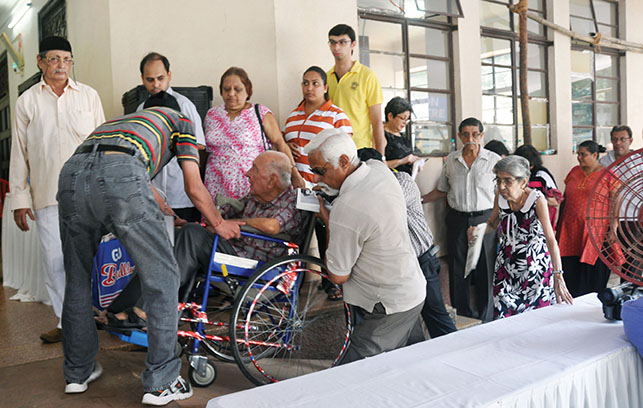
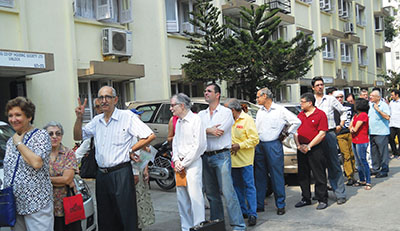
Voters at Rustom Baug (above) and Cusrow Baug
A long, hard fought, strenuous election campaign had seen the top 11 contenders of the 23 attending voter meets every day of the week and filling the Jam-e-Jamshed and Parsi Times with pages and pages of advertisements. The spending limit of three lakhs specified in the voluntary code of conduct was given the go by to the extent that several prominent community members wrote a letter to the Parsi Press singling out two candidates. The letter was subsequently withdrawn after the two alleged offenders clarified the amount was spent by well-wishers! The code unfortunately did not bar others from paying. But allowing for the non-existent functioning of the earlier fractious BPP board, the adoption of any code, however diluted, was miraculous.
Earlier that evening at Khareghat, Mehta had entered the counting room which was off limits to all but the election officials and members of the auditing firm Deloitte Haskins and Sells. The prestigious, multinational auditing firm was appointed to scrutinize the election process spread out over five geographic centers from 10 in the morning till 7 in the evening. Desai had followed Mehta in to keep an eye on him.
In 2008 Dadrawala received the lowest number of votes from the seven elected. He was the only member of the Adult Franchise for Progress high profile team put together by the astute lawyer Berjis Desai and Randeria. Two years later, Dadrawala was hounded out by Mehta, WAPIZ (World Alliance of Parsi Irani Zarthoshtis) and BPP trustees Khojeste Mistree and Desai with the connivance of the other three trustees, Arnavaz Mistry, Jimmy Mistry and Armaity Tirandaz.
When Parsiana voiced apprehensions of the new board working together, Dadrawala WhatsApped a reply, "We will manage differences…I am optimistic…We have to be gracious in victory. After winning I first met Viraf and told him ‘We will find a way to work unitedly.’ To Yazdi I said, ‘Let’s put (the) past behind us.’”
The win was especially sweet to Randeria in light of the 2008 debacle. This time his ‘panel’— a term viewed with distaste by him initially — swept the polls. The "tremendous three” (Randeria, Dadrawala and Bhathena) as they not immodestly referred to themselves were among the top three vote getters, with Dadrawala and Randeria garnering over 50% of the 9,842 votes cast. Till now Randeria preferred to play the role of a behind-the-scenes kingmaker. But adult franchise and a vigilant Press restricted the backroom maneuvering that was more amenable to the earlier Anjuman Committee election scheme where a handful of power brokers could manipulate the electorate.
Randeria outmaneuvered his wily and politically savvy opponent, Dinshaw Mehta by convincing Dadrawala and Bhathena to contest along with him rather than Viraf. At one point Dadrawala announced his candidature along with publisher Maneck Davar, a long time ally and friend but then switched to Randeria’s camp a day or two later. Similarly Bhathena, who is close to Dinshaw publicly stated he did not intend to stand for election but subsequently joined Randeria.
Dinshaw suffered a further setback when Davar decided to contest the election as an independent, shunning an alliance with Viraf. As Berjis perceptively commented, after the results were out "it’s the ‘beginning of the Randeria era.’”
Bhathena had been hounded by Yazdi and his colleagues over the development of the Hilla Towers building at Lalbaug. They filed multiple cases against him, dragged the matter to the Supreme Court and Yazdi even stood with a placard defaming Bhathena outside the Radio Club on the occasion of the Avan Yazad nu parav where Bhathena was in attendance. Aside from Randeria, Yazdi has no allies on the BPP board. The two existing trustees Tirandaz and Muncherji Cama were in the Dinshaw camp earlier. Behind the scenes negotiations and arm twisting resulted in the last board of trustees signing consent terms agreeing to Cama’s resignation being treated as null and void.
Having functioned for two years as the kingpin of a majority board, Yazdi’s wings will be considerably clipped. Still his comeback is remarkable allowing for the public disgust with the shenanigans and tomfoolery on the erstwhile board. Arnavaz Mistry campaigned for him, asking voters to support the tremendous three, pharmaceutical executive Daara Patel and Yazdi. But Yazdi’s support is largely drawn from his wife Anahita’s social work. Ironically it was her candidature for trusteeship in 2011 that split the board, and four years later sounded the partial death knell of the "Mehta era.”
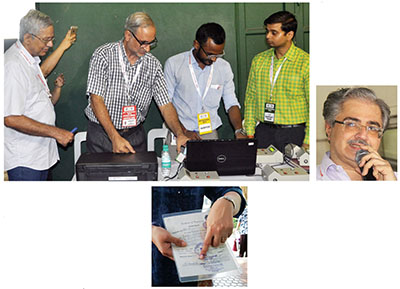
(Clockwise from top) Yazdi Tantra and On-Lyne team; Mahiyar Dastoor; vigilant voter
High turnout, long wait
"The Election Management Team Welcomes You” read the prominent banner at the entry point of all five election venues: Cusrow Baug (CB), Khareghat Colony (KC), Rustom Baug (RB), Dadar Parsi Colony Gymkhana (DPCG) and Bharucha Baug (BB). However in their endeavor to ensure that the electronic voting machines (EVMs) function efficiently, the management team seemed to have forgotten the human voter factor.
The first voter at KC had arrived at 7 a.m. Many old ladies were there by 8 a.m. thinking the elections started at that hour. When the Parsiana reporter reached the venue 20 minutes prior to the scheduled time of 10 a.m. there were around 70 people in queue, many of whom had been reminded at the last minute to cast their votes in favor of certain candidates whose representatives were campaigning at the venue regardless of the election code of conduct that forbade them. Bombay Parsi Punchayet (BPP) chairman Dinshaw Mehta reiterated, "Jéné joié téné vote karjo (vote for whoever you want). It is not compulsory to vote for all five seats.” At 10 a.m. Homi Ustad announced that due to "technical reasons” the voting process would be delayed by a few minutes. The chief polling officer in charge at Khareghat Colony was Rusi Bhumgara.
The few minutes stretched to over half-an-hour as the first voter was finally taken in at 10.33 a.m. when the first three machines at the ground level started functioning. It took another 15 minutes before the seven machines on the first floor became operational. By then the serpentine queue had around 200 patient Parsis waiting under the shamiana with no pedestal fans or any other conveniences offered. The queue for general category voters was apparently a big leveler, for be the individual the advocate general of Maharashtra, the chief executive officer or chief financial officer of his company, they all had the same treatment meted out to them, unless one was a BPP donor. The rows of chairs in the center and along the periphery of the route might have helped had they come to play musical chairs but served little purpose when the queue meandered four times up and down half the length of the shamiana.
Senior citizens with health difficulties and donor voters were directed to the EVMs at the ground level; the rest had to use the ones located above. Even the elders who were confident of walking had perforce to opt for a wheelchair to ensure that they did not need to stand for over half-an-hour in the queue earmarked for them. Two of them lost their balance on the unleveled road. Clearly underestimating the determination of senior septuagenarians, octogenarians and even nonagenarians to vote, initially only two wheelchairs were available for use; subsequently some more were organized from the BPP run Parukh Dharamshalla down the road. After the initial announcement was made, thereafter there were no indicators or volunteers guiding the voters on where to proceed. The more vociferous ones or those who threatened to leave the venue without voting managed to make faster progress in the queue. Dastur (Dr) Peshotan Mirza too was permitted to use the shorter queue.
Clearly 50% of the voters were senior citizens, some middle aged, and barely 10% youth. The long, arduous wait was clearly taxing and any attempts to breach the queue resulted in loud protests as when one lady with a Santa cap tried to walk ahead a few paces. When a gentleman showed his annoyance she further provoked him by insisting on standing next to him and taking his photograph on her mobile with a request to say "cheese!”
Sunday dhansak and siesta had ensured that the polling centers earned some relative respite in the afternoon, but by 4 p.m. the queue at KC had started extending once again. Some who realized the futility of the long wait in the morning had returned to vote in the evening because they were determined to exercise their franchise. Hand fans distributed by ZYNG (Zoroastrian Youth for the Next Generation) were happily accepted by those in line. Around sunset there were once again nearly 200 in queue at KC for an assurance was given that although the closing time was 7 p.m., all those who had reached the venue before that would be assured a chance to cast their vote. Finally the last voter exercised his right at 7.15 p.m. Whilst the voting room on the first floor was full of light, the shamiana below was shrouded in darkness.
Besides Mehta, BPP trustees Arnavaz Mistry and Khojeste Mistree’s presence was clearly visible at KC. Among the candidates Maneck Davar, Tehmton Dumasia, Cmde Medioma Bhada (Retd) and Kemas Wadia were seen in the morning while Viraf Mehta, Yazdi Desai, Xerxes Dastur were prominent in the evening.
It was subsequently learnt that KC had, as expected, the largest turnout, with 2,259 votes cast. Parinaz M. Gandhi
Smooth sailing despite rumors
By 9.45 a.m. there were already about 50 persons in the queue at Cusrow Baug (CB). Voting was to start at 10 a.m. and go up to 7 p.m. By the scheduled time, it had swelled to a 100 at the CB pavilion, with this trend continuing till lunchtime. Rumors were rife that machines were not working at Khareghat Colony (KC) and chaos prevailed at KC, one among the five venues. Interestingly, voters at KC heard that there was a glitch at CB! There was no such thing at either, really. Mudslinging extended from the candidates to the venues! At 12.30 p.m. CB had had 445 voters, whilst KC (which was termed crowded), had polled 505 votes. At the start, among those present were candidates Zarir Bhathena, Kersi Randeria, Noshir Dadrawala — called the Tremendous Three; Maj Gen Soli Pavri (Retd); Parvez Umrigar, among those Parsiana recognized. Though Viraf Mehta and Maneck Davar were absent in person to begin with, their teams were conspicuous in blue and white tees respectively. Some candidates were still issuing chits or pleas of "please vote for xyz number 123” in violation of the voluntary code of conduct.
The voting was by and large without any adverse incident — even lacking drama at CB. At peak time, one recognized several voters from the Malabar Hill and Worli areas, who would normally have gone to KC. Some said the queue there was a two-hour wait whilst at CB it was only one hour; some came here as they feared their elderly relatives would be unable to climb the steps leading to the polling station at KC. There were also comments on why there was no separate line for donors. The real difficulty seemed to be with the elderly unable to stand in line for an hour or more. Anyone who approached Homiyar Madon, the chief polling officer at CB, was fast tracked if he deemed they were physically incapacitated. Madon also acceded to a request by parents of a first time voter who had to go for his engineering exam. He did not permit the parents priority, which they requested, a consideration he allowed the young student as the average wait at peak time was one to one-and-a-half hours. Homai Modi sat for most of the nine hours at CB unflaggingly checking the Bombay Parsi Punchayet identification against the government one, remaining cool and efficient despite the oppressive heat.
In the course of the day most of the candidates made an appearance at CB. Maneck Engineer, a former trustee and CB resident sat for most of the day observing the happenings. High priests Dasturs (Dr) Firoze Kotwal and Khurshed Dastoor, also residents of CB, chose the tail-end timings to exercise their franchise. A total of 1,798 votes were cast at CB. Mehroo Kotval
Pre-poll preparations
At 8.30 am on October 18, 2015, the roads and the large central expanse of greenery inside Rustom Baug (RB) in Byculla were dotted with young people in red tee shirts. ‘On-Lyne’ on their garment revealed the name of the company hired by the Bombay Parsi Panchayet (BPP) to handle the IT (information technology) aspects of the trusteeship elections. About 25 such personnel were stationed at RB, one of five centers where voting was to be held. Wheelchairs were being readied. Signage was being nipped and tucked and hammered into shape. Polling agents of candidates were straggling in, and by 9.15 a.m. the first of two rows reserved for them were occupied. Parsiana spotted the IT auditors appointed to oversee the election process, the first that was being held with electronic voting machines, giving last minute instructions to the On-Lyne personnel. Assistant polling officer Rustom Jasoomoney was optimistic. "About 3,000 to 4,000 people will turn up to vote at Rustom Baug,” he told Parsiana. Candidate Zarir Bhathena was seen capturing three chairs, possibly for the polling agents of the triumvirate he was part of contesting the election.
Voters trickled in by 9.30 a.m. and by 10 a.m. when the polling was to start, there were approximately 40 eager people in the queue. Sixty-ish RB resident Mehroo Davar was among the first in the queue. When Parsiana asked her her name, she very kindly offered to show us her voting certificate too! A slight commotion erupted between the voters in queue and the polling agents as to which direction the large fan should point to — the voters or the polling staff.
At about 10.05 a.m., polling officer Behroze Guzdar announced a delay "of some time” in the start of the voting process, due to unnamed "technical problems.” This gave rise to murmurs from disgruntled voters, who were not very happy about the lack of fans above or alongside them, on this hot and sultry day.
The names started to be called at 10.25 a.m. and the first to kick off the voting was Behram Irani of the general category, followed by Davar, in the donor category. Candidates Zuleika Homavazir (Sattha) and Xerxes Dastur were seen casting their votes before noon. Candidate Percy Doctor was also present as an observer. The total voter count at RB was 1,678. Farrokh Jijina
According to information received from the BPP on October 19, 1,980 and 2,138 votes were cast at Bharucha Baug and Dadar Parsi Colony Gymkhana respectively.