
Bawa Musings
The other fire temple
Explaining our shameless bias for the Navsari Atash Behram
Apart from the hotly contested annual boat race and the position in the university league table, the alumni of Cambridge and Oxford never tire of condescendingly dismissing "the other place.” A similar rivalry exists between the residents of Udvada and Navsari about their respective fire temples. Navsari is obviously less visited, concede the Nausakras, but is more profoundly peace bestowing. As a diehard Navsari fanatic, this columnist is convinced beyond doubt of the Nausakras’ claim. There are multiple reasons for this bias: historical, personal, sentimental, spiritual and rational.
Every summer vacation, our grandmother, a no nonsense disciplinarian, would take us to Navsari. After the Gujarat Express had left Vasai, the second class compartment would impromptu turn into a dining car of sorts. The old lady would imperiously untie a straw container (called karandiyo) and serve a breakfast of brun pao (hard bread) — those days, an eagerly awaited import into Navsari — liberally plastered with Polson butter together with a plain vanilla omelette (not containing anything except the eggs – not the deep fried, onion laden reddish brown Parsi poro). At Navsari station, the coolies would barge into the compartment to grab your luggage, as if their life depended on it. You settled into a ghora gari (horse driven carriage) which meandered through the narrow dusty lanes until Tarota Bazar when you would get the first glimpse of the magnificent Atash Behram. As you reverentially bowed, the horse hoofs would resound on the cobbled streets of Desai Vad [then, not having a single juddin house – gosh! we sound like WAPIZ (World Alliance of Parsi Irani Zarthoshtis)!]. The next morning, scrubbed and shining, we would amble across to the Atash Behram, armed with a thin sandalwood stick and a 10 paise coin to be placed as aashodaad (offering). At times, we saved the coins for an illicit purchase of blushing pink hand-made Kolah’s ice-cream, an unauthorized diversification of funds [indicating our early potential to be a BPP (Bombay Parsi Punchayet) trustee].
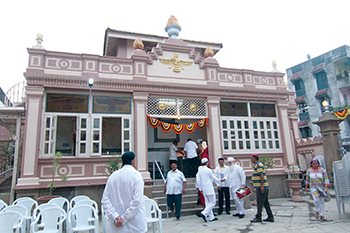
Pirojbai Cawasji Modi Dar-e-Meher in the Navsari Atash Behram compound
Post the worship, we dutifully carried the rakhiya (holy ash) to the aged relatives residing in the mohalla (locality) to be rewarded with multiple breakfasts, a secret from our grandmother. This daily gluttony for six weeks of the vacation ensured our mother’s look of utter disgust at her rotund child. We would never enter the Atash Behram from the main entrance but a small side entrance having a wrought iron door, close to the dar-e-meher, the Vazir (prime minister) of the Holy King. This practice has been followed by us for the last five decades, not only on the annual visit to the fire temple, but in our daily visualization exercise.
Close the wrought iron door carefully, kiss the parapet of the well, dunk the karasyo into the brass water pot to clean our hands and face (padyaab), prior to the kusti. [Talking of karasyo, we must rather unsublimely digress to narrate the story of a Navsari agiary worker called Burjorji (long deceased) nicknamed ‘Bai Bai karasyo,’ due to his lady employer who, during the muktad days, shouted at him from the toilet about the missing karasyo — those days, there were no cleaning faucets — whereupon the overtly enthusiastic man rushed into the toilet with the karasyo, saying "Bai, Bai, karasyo”]. Occasionally, a divo would be lit by us to assuage the guilt of having deprived God to pay Kolah.
A few decades ago, the Atash Behram, including the sanctum sanctorum, was majorly renovated with the holy fire temporarily housed in the dar-e-meher. Post this renovation, on the marble wall exactly opposite the sanctum, an impression of a priest praying with folded hands surfaced and became more prominent over the years. Many devout believe this to be a picture of the pious first Dastur Meherjirana who attended Emperor Akbar’s court and whose descendants have been, till today, the High Priests of Navsari.
Early morning or at dusk, when there are few worshippers, the silent attunement with Him, a visibly living presence, will make a devotee out of an atheist. Iranshah, being busier, rarely provides the same opportunity to meditate before the holy fire. Many boiwalas (mobeds tending to the fire) have narrated stories of seeing a tall figure, clad in white, whisking across in the wee hours of the morning. None have experienced fear but only protection from the guardian angel.
The Atash Behram was constructed by our direct lineal ascendant, Khurshedji Bapa, as he was popularly known and the interesting marble plaques narrate the history of successive contributions over nearly three centuries. The Desai Vad and the other mohallas near the Atash Behram were all Parsi as late as the 1960s, giving great character to the precinct. Sometimes xenophobia is tolerable. On the other hand, as the fiddler on the roof would say, non Parsis often stand outside the Atash Behram with bowed heads seeking the blessings and protection of the holy fire that they will never see. They request Parsis to place their sandalwood sticks and money. The circuit of devotion is palpable.
A quick day trip to both the Atash Behrams can conveniently be planned by boarding the Gujarat Express at 5.45 a.m. (have breakfast only if your metabolism is unusually robust), hopping into a hired car at the Navsari station, having a quick bath at Jamshed Baug which is a stone’s throw from the Atash Behram, offer prayers, dash across to the cute little dar-e-meher, drive to the Iranshah in less than an hour, worship, lunch, and be back in Bombay by early evening. Spiritual batteries recharged for the year.
After five decades, little has changed around the Navsari Atash Behram. The same little wrought iron gate opens with the same creaking sound, the same feeling of peace instantly descending upon you as soon as you enter the compound, the same experience of protection and peace when you gaze reverentially into the holy fire; time standing still forever. The Kolah shop still sells ice cream but with rather pretentious flavors. Both the Atash Behrams are pillars of our faith and, to protect these, our most precious heritage, many a Parsi would gladly perish; just as our forefathers did, centuries ago, to guard the Guardians from the marauding hordes.
Berjis M. Desai, managing partner of J. Sagar Associates, advocates and solicitors, is a writer and community activist.
◆ ◆ ◆
From the archive