
Books
Stay the course
"Whenever I found the key to the lock, somebody changed the lock.” Such pithy maxims formed the narrative of Nozer Buchia’s talk at the Bombay launch of his book Why Entrepreneurs Really Fail on January 9, 2015 at the Four Seasons Hotel. The 232-page book published by Bloomsbury India and priced at Rs 350 was "the result of countless mistakes and umpteen errors that I have committed in life and in the world of business,” candidly states the author in his preface.
"If you know what you want you get it… when you fall on your back, if you can look up you can get up… stay the course,” counselled Buchia. Just as there are signs on the road directing and advising drivers, so too in business there are signals. "If you ignore the signs you fall in the rut… There are no stumbling blocks; only stepping stones.” He advised the gathering "to be transparent, as open as you can be.”
To prosper in business we require the assistance of two types of people, attorneys and chartered accountants/bankers, he stated. "They keep you grounded… Debt is not bad; what is bad is if you don’t know how to manage debt… Select the partner only if you need the money or experience… Never run away from a legal issue.”
When people say "think outside of the box, do they know what’s in the box?” he asked. He termed a CEO (chief executive officer) as "a chief encouragement officer.” Entrepreneurship is "a 24x7 job... Entrepreneurs are not born they are made.”
Buchia said he wanted to meet Prime Minister Narendra Modi: "I don’t want to hear what he wants to say, I want to tell him what I want to say.”
"If you know what you want you get it… when you fall on your back, if you can look up you can get up… stay the course,” counselled Buchia. Just as there are signs on the road directing and advising drivers, so too in business there are signals. "If you ignore the signs you fall in the rut… There are no stumbling blocks; only stepping stones.” He advised the gathering "to be transparent, as open as you can be.”
To prosper in business we require the assistance of two types of people, attorneys and chartered accountants/bankers, he stated. "They keep you grounded… Debt is not bad; what is bad is if you don’t know how to manage debt… Select the partner only if you need the money or experience… Never run away from a legal issue.”
When people say "think outside of the box, do they know what’s in the box?” he asked. He termed a CEO (chief executive officer) as "a chief encouragement officer.” Entrepreneurship is "a 24x7 job... Entrepreneurs are not born they are made.”
Buchia said he wanted to meet Prime Minister Narendra Modi: "I don’t want to hear what he wants to say, I want to tell him what I want to say.”
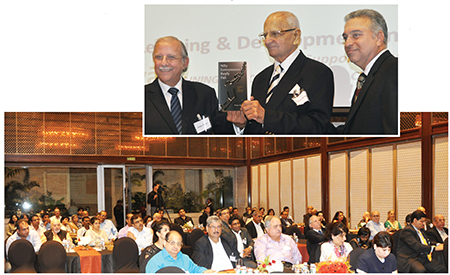
Minoo Shroff releasing book flanked by Homa Petit (left) and Nozer Buchia; Section of the gathering
Introducing the speaker noted solicitor and head of The B. D. Petit Parsee General Hospital, Homa Petit stated, "Nozer never takes no for an answer.” He termed the book "a must read for those who have the desire to do something great.” He noted that the subtitle of the book, which was not that visible, states "the road to success… always under construction.” Petit who has written the introduction, noted the implication was "the best is ahead.”
Petit informed the gathering that this is Buchia’s third book which is to be also translated in Hebrew; a fourth book is in the pipeline. He recalled novelist Norman Mailer’s observation that "writing books is the closest men come to undergoing childbirth.”
Defining an entrepreneur as "a dreamer, a doer, a thinker… one who sees possibility everywhere,” Petit believed the prescription fitted Buchia who is known as Mr Motivator.
In his keynote address Minoo Shroff, president of the World Zarathushti Chamber of Commerce, referring to the book observed that "failures are not analyzed as carefully as successes… Tatas failed in more businesses than they succeeded in.” But today they have the largest market capitalization in India.
He termed the launch of the Vistara Airline as "Ratan Tata’s dream come true.” The Tata group’s earlier attempts to launch an airline in collaboration with Singapore Airlines had been thwarted by Naresh Goyal, the founder of Jet Airways.
Shroff recalled that in the 1920s British companies dumped steel in the Indian markets, bringing down the prices and placing Tata Iron and Steel Company, now renamed Tata Steel, "in trouble… The Tatas mortgaged everything, including a diamond tie pin” to see the crisis through. They persevered and succeeded.
In business "anything that can go wrong, will go wrong... Never try to pull a fast one on your banker, collaborator or partner… Get a good team. Never underestimate your competition” and finally quoting the late British prime minister Winston Churchill, Shroff counselled, "Never, never, quit.”
Self-evident truths
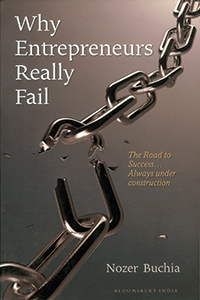 Why Entrepreneurs Really Fail by Nozer Buchia. Published in 2014 by Bloomsbury Publishing India Private Limited, Vishrut Building, DDA Complex, Building No. 3, Pocket C-6 and 7, Vasant Kunj, New Delhi 110070; website: www.bloomsbury.com Pp: xxiii + 232. Price: Rs 350.
The Austrian-American economist Joseph Schumpeter’s two greatest insights were that innovation is the driving force not only of capitalism but also of economic progress in general, and that entrepreneurs are the agents of innovation. But entrepreneurs are confronted with all sorts of obstacles, and innovation is hard to produce and harder to sustain: all successful businessmen stand on ground that is "crumbling beneath their feet.” And of course it produces losers as well as winners. Nozer Buchia’s Why Entrepreneurs Really Fail is about how to be a winning entrepreneur and the pitfalls to be avoided on the way to achieving success.
According to Buchia his book is "a handbook for those who want to lead and are not merely content to follow.” He says, "It is a path for those (who) want to rewrite the rules of the game and are not afraid to challenge the way it has always been done.” He also goes on to say that his book "is the missing link between your yearning for success and your attainment of success.” It requires a certain chutzpah to peddle such a sales spiel in the Foreword to a book which is a collection of self-help books. The book is full of sayings like, "Learn to strike while the iron is hot,” "When fate hands you a lemon let’s try and make lemonade” and "Luck favors those who help themselves.”
Buchia tells us that where others see obstacles, real entrepreneurs see opportunity. He enumerates and describes some of the hurdles that an entrepreneur must keep in mind before he embarks on his business venture. An entrepreneur must borrow prudently and not make the mistake of spending what he does not have. He emphasizes such self-evident truths as saving as much as one can; increase income; reduce expenses, and other such utterly tired-sounding stuff. He then proceeds to tell us that the key to success is to overcome all fear because it takes away "our ability to think and destroys our vision, our poise, our self-assurance.”
According to Buchia his book is "a handbook for those who want to lead and are not merely content to follow.” He says, "It is a path for those (who) want to rewrite the rules of the game and are not afraid to challenge the way it has always been done.” He also goes on to say that his book "is the missing link between your yearning for success and your attainment of success.” It requires a certain chutzpah to peddle such a sales spiel in the Foreword to a book which is a collection of self-help books. The book is full of sayings like, "Learn to strike while the iron is hot,” "When fate hands you a lemon let’s try and make lemonade” and "Luck favors those who help themselves.”
Buchia tells us that where others see obstacles, real entrepreneurs see opportunity. He enumerates and describes some of the hurdles that an entrepreneur must keep in mind before he embarks on his business venture. An entrepreneur must borrow prudently and not make the mistake of spending what he does not have. He emphasizes such self-evident truths as saving as much as one can; increase income; reduce expenses, and other such utterly tired-sounding stuff. He then proceeds to tell us that the key to success is to overcome all fear because it takes away "our ability to think and destroys our vision, our poise, our self-assurance.”

Nozer Buchia: motivating entrepreneurs
The book does have its moments. Buchia makes a distinction between chasing business and attracting it. "To attract business you only have to be slightly better but with a differentiating factor.” He adds, "And in order to differentiate... attempt to go where no man has gone before.” In business an entrepreneur must have the ability to pull the business in. He says that entrepreneurs must also work on the business and not in it. Any entrepreneur who attempts to micro-manage or do everything himself is doomed to failure. And while narrating the gut-feel of his beagle who goes berserk when he smells something, Buchia says that a dog has more friends than a man because he wags his tail more than his mouth!
The author also warns against doing the same thing over and over again but expecting a different result. "We cannot solve problems using the same kind of thinking we used to create them in the first place.” And he says that conservative behavior will not get you far because the turtle makes progress only when he sticks his neck out. Buchia gives as his examples Facebook, Wal-Mart, McDonalds and Dell among others. He also talks of the role of the spouse, the silent partner who he says can "either make a person or break a person.”
Nowhere does Buchia tell us in what field he was an "international entrepreneur.” A detailed narration of his own experiences would have made for more rewarding reading.
The book has a somewhat unique layout. On each page there is a stand-alone quotation with text on the facing page — nice, but unfortunately ruined by careless editing and proofing.
Also, the use of capital letters in the middle of sentences (entrepreneur starts with a capital ‘E’ all through the book as do other words), ostensibly for greater effect, are disconcerting. There are words missing in some of the stand-alone quotations (at least two cases, there may be more). In another bloomer (in at least one case) there is a disconnect between sentences and the subject matter. It seems that the manuscript went straight from Buchia’s laptop to the printing press with Bloomsbury India as an onlooker. When such glaring proofing and editing errors creep into a book the author and publisher must share the blame.
The book does make some important points but the overall presentation leaves the reader with the distinct feeling that this is an opportunity lost, both for the author and the publisher.
BAKHTIAR K. DADABHOY
◆ ◆ ◆
From the archive