
Medicine/Health
Masina’s new millennium
With the opening of a new Blood Bank, Parsi Ward and proposed dialysis unit, the century-old Masina Hospital is on a prescription to progress
For the 102-year-old Masina Hospital, the arrival of the new millennium has brought just what the doctor ordered. Recent transfusions and therapies have been several — a spanking new, state of the art Blood Bank which opened its doors in May 2004; a bright, airy and modern Parsi Ward formally inaugurated in April this year, upgraded pathology, X-ray and sonography departments; a modern physiotherapy unit which brings spring into the step of both indoor and outdoor patients...
Sustained through its century by generous financial first aid by Parsi philanthropists, Masina Hospital received its first major donation from a non-Parsi when T. S. Kandalgaonkar gave a sum of Rs 50 lakhs for the setting up of a nephrology center with dialysis machines slated to open its doors around Dassera this year.
"We are progressing by leaps and bounds,” says Burjor Antia, chairman of the board of trustees, who is also a trustee of the Bombay Parsi Punchayet (BPP). "We are aiming at self-sufficiency and a blood bank is the starting point for self-sufficiency in any hospital. Moreover, there is no other blood bank in the vicinity,” says the solicitor who became a trustee at Masina in 1978.
The Hospital itself bespeaks history and heritage. Founded in 1902 by Dr Hormusji Masina on the first floor of a building at Byculla’s Clare Road with just four patients and soon expanded, it was the city of Bombay’s first private hospital, states the centenary souvenir. The B. D. Petit Parsee General Hospital was opened in 1908, followed by Sir Harkisondas Hospital in 1925, the souvenir adds.
In 1907, Masina acquired the palatial building called "Sans Souci” (which means "without care,” though care is at the heart of its business) from the well-known Sassoon family. The souvenir narrates that Sassoon was reportedly so impressed by the meritorious service rendered by Masina that he gave the entire property admeasuring around six acres (24,000 sq m) for a paltry sum of Rs 25,000.
In a city starved of space, Masina Hospital still has room to expand. Contrasts abound. The founder’s wife Jerbai presides in marble over a tranquil garden; just outside is the clutter, clatter and congestion of Byculla, with its teeming wholesale market, plethora of shops and spewing traffic rumbling above and below the flyover.
The Hospital proclaimed its cosmopolitanism right from the start, admitting patients of all castes and creeds. Studded all around its campus, however, are the buildings and plaques which bear testimony to the popular dictum — "Parsi, thy name is charity.” The Kharas Memorial Centre; the Noshirwan Muluk Irani Operation Theatres, Intensive Cardiac Care Unit and Diabetic Clinic; the Alamai Shapoorji Mistry Ward; the Katgara Wing; the Lady Broacha College of Nursing Building; the Bai Serenebai M. Banajee Wing for the Nursing Home; the N. M. Wadia Out Patient Department; Dr F. N. Moos Memorial Building; donations from the Shirin and Jamshed Guzder Trust, the Godrej Foundation, the estate of Col P. M. R. Bharoacha and Dr Russi M. Bharoacha... the list is extensive.
For the progress made by the Hospital during the last few years, Antia accords "the highest credit” to managing trustee Dr Aspi Golwalla. "Practically every Sunday he is at the Hospital, solving problems, guiding the staff, looking into details,” says Antia. "We are concentrating on essentials — upgrading the wards, bringing in new and up-to-date equipment, modernizing the operation theaters... People have seen the changes. When they like what they see, they give donations,” asserts Golwalla who has been associated with the Hospital for more than 35 years, as honorary physician, trustee and managing trustee. With Byculla densely peopled by Muslims, Christians, Parsis and Hindus, occupancy is good. "We are not competing with anyone,” adds Golwalla, a former BPP chairman. "Patients will come on the Hospital’s merits.”
"I love this Hospital,” declares senior honorary Dr Dinyar Gamadia. "Way back in 1966, this was my very first attachment (as honorary physician). It was here that I met my wife Dilnavaz when she was house physician in 1969-1970.” The specialty departments are the institution’s strengths, believes Gamadia. The Hospital’s Burns Unit was the first to use the path-breaking potato peel dressing for burns, their premature babies ward with incubators was the first in Bombay in a private charitable hospital, their X-ray unit was reportedly the first in a hospital in India... notes the souvenir.
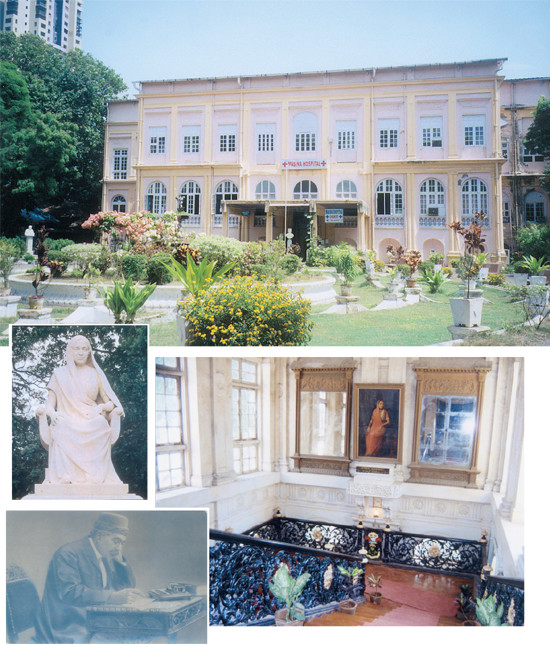
Masina Hospital’s heritage wing overlooking tranquil garden (top) Photo: Hilla Guzder; elegance of antiquity on the stairway; the founder Hormusji Masina Photo: Hilla Guzder; Jerbai Masina in marble amidst the foliage
The Hospital recently opened a rehabilitation ward for patients addicted to drugs and alcohol; the psychiatric ward with 40 beds is in great demand; the gynecology and children’s departments are also doing very well, avers Golwalla. The extensively renovated Parsi Ward bears a bright and airy look, thanks to the munificent recent donation of one crore ten lakh rupees from the estate of Pesi and Russi Bharoacha. Energetic in his efforts to channelize Parsi philanthropy towards the Hospital is trustee Fali Sarkari, a chartered accountant by profession who guides and advises the Hospital in accounts, taxation and charity commissioner-related matters.
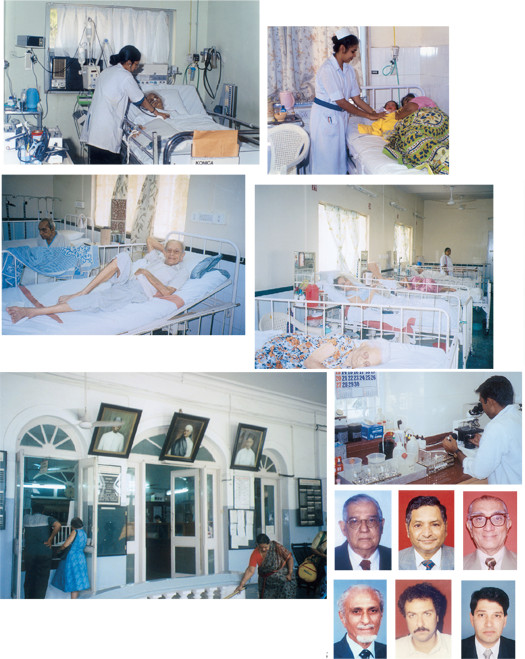
Top from left: (first row) Care in the different departments;male and female wings of the Parsi Ward Photos: Hilla Guzder ; Interior of heritage structure (bottom left); the new Blood Bank (right) Photos: Hilla Guzder. The trustees (1st row) Golwalla, Antia, Sarkari; (2nd row) Bhappu, Mistry, Katgara
"All the trustees are contributing in their own way,” commends Antia. "Sarkari is a very resourceful man; Shapoor Mistry (son of Pallon S. Mistry of construction giant Shapoorji Pallonji and Company) helps in the construction/renovation fields; Homi Katgara (of well-known freight forwarders Jeena and Company) has got our computer systems working very well.” Also on the board is Capt Darius Bhappu, ex-Customs official, who was away in Singapore at the time of the Parsiana interview. "We are providing medical services at a cheaper rate. People should appreciate that. Other hospitals charge five-star hotel rates!” observes Antia. While the Nursing Home and other sections of the Hospital are open to all, the Parsi Ward caters to deserving Parsi patients. Also available in the same building for Parsis are two special deluxe rooms with air conditioning, TV, fridge and telephone at costs below those in other hospitals, says social worker Zareen Cyrusi who looks after the administration of the Parsi Ward.
While there is virtually no Parsi nursing staff and only one Parsi house doctor at present, the new Blood Bank is in charge of Dr Nina Dhondy; Dr Jini Jagose is slated to oversee the nephrology and dialysis unit when it opens. Squadron Leader Firdaus Commissariat (Retd) is the newly appointed chief administrative officer. The long list of consultants and honoraries visiting the 250-bed Hospital encompasses many a Parsi medical luminary practicing in Bombay.
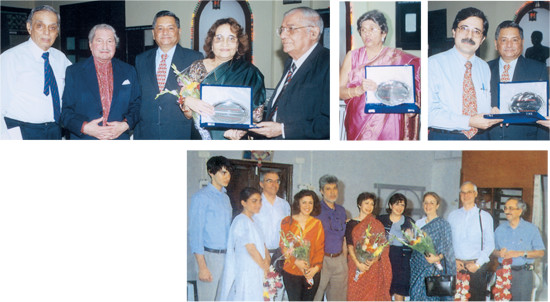
At a function felicitating the honora-ries: from left (above) Gamadia, Jamshed Guzder, Antia, Hansotia and Golwalla; Nargish Motashaw; Sunil Keswani with Antia. The Godrej family (alongside) at inauguration of physiotherapy department
Prescriptions for progress have come through the years from stalwarts like Drs Kekobad Mody, Tehemton Udwadia, Rusi Soonawalla, Nargish Motashaw, Mehroo Hansotia, Jer Master, Mahrukh Joshi, Shirin Mullan... Sons have followed in fathers’ footsteps — the second generation of Udwadias, Soonawallas, Keswanis... have retained their ties with Masina Hospital, providing the millennium’s new remedies with scores of other established and upcoming consultants from other communities as well.
"I have learnt that buildings do not make hospitals. It is the staff that do so,” writes Motashaw in the centenary souvenir. "Some great men have walked the corridors both by day and night. Dr Rustomji Billimoria who was a renowned physician in those early days... Dr Bomi Billimoria, a brilliant thoracic surgeon and a pioneer in his chosen specialty, Dr Ardeshir Kohiyar, Col Daly Bharucha... When other hospitals were built, Masina Hospital went through a rough period. Fortunately, the late Hormuzd Meherji-Rana, a philanthropist and friend of the Hospital, as well as Col Bharucha, Dr Rustom Colah and my late brother Dr Murzban Motashaw struggled hard to keep it afloat.”
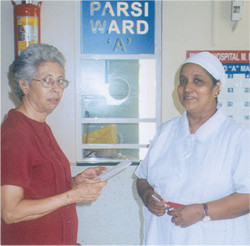
Cyrusi ( above and left) with nursing staff at Parsi Ward
Encapsulating the Hospital’s 100-year history on film is An Oasis of Healing — The Masina Hospital, directed by Cyrus Dastoor of Frohar Films who also produces the tele-serial Humata, Hukhta, Hvarashta. The film was sponsored by The Katgara Foundation and the Pallonji Shapoorji Charity Trust, as per a press note from Frohar Films. Project coordinator Dr Arnavaz Havewala scripted the film which tells us that the founder Hormusji Masina was the third Indian to obtain the FRCS (Fellowship of the Royal College of Surgeons) way back in 1898. Hormusji died in 1946, after a saga of service to his Hospital, aided by his wife Jerbai who predeceased him. Their son Ardeshir took over the stewardship of the Hospital, but his untimely death a year later created a void, filled temporarily by his elder brother Dr Maneck Masina.
In 1949, the founder’s daughter Dr Mehroo Masina took charge of the Hospital and remained the principal medical officer till she emigrated to England in 1966, relates the centenary souvenir. A gynecologist by profession, Mehroo passed away in the UK in June 2002, the Hospital’s centenary year. "What I admired most about her was the kind of treatment meted out to the poor... If one happened to visit the Hospital even at 4 a.m., one would see a white-coated figure go silently round the hospital from patient to patient while bearing a torch in her hand. She once said to me, ‘I do not ask the ward sister, I like to find out for myself,’” writes Nargesh Motashaw of Mehroo’s dedication to Masina Hospital.
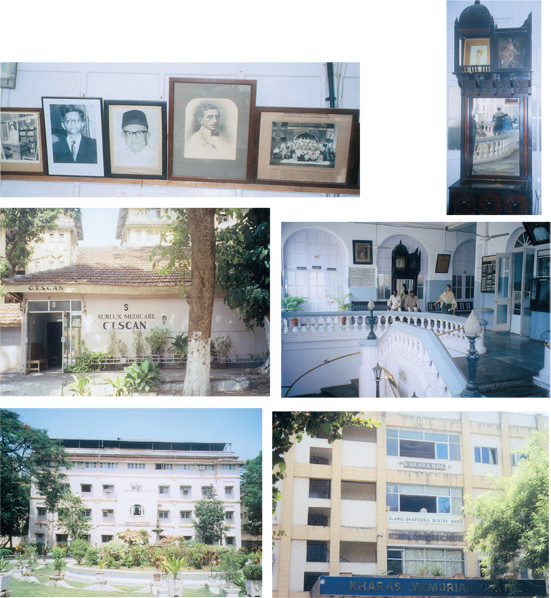
Top left : Portrait gallery; The curve of the bannister reflected in antique furni-ture (alongside); CT Scan department (below, left) and lobby outside Poly-clinic in old wing; (last row) Serenebai Banajee Wing for the Nursing Home; Kharas Memorial Centre with upgraded wards
Photos: Hilla Guzder
Despite the prophylactic steps of recent years, some maladies await a salubrious solution. "The cost of repairs to our heritage structure is huge,” elaborates Sarkari. "Moreover, no changes are allowed without approval from the Urban Heritage Conservation Committee.”
At Sans Souci, Jerbai’s gilded portrait looks over the regal gold and black of the bannisters. Pigeons roost, an occasional windowpane stands cracked by the thump of wings. "This is really heavy on maintenance and so difficult to keep clean,” sighs Cyrusi, guiding Parsiana on a tour of the building which now houses, among other things, a Polyclinic on the first floor and a renovated Centenary Hall on the second, equipped with computers and audio visual conveniences required for medical seminars and conferences.
"There is still a lot of work to be done. Much improvement is possible. Come and see the quality of work,” states Sarkari. Into the future stands the elixir of a vision — to establish a super specialty hospital for the treatment of ailments of the brain, heart or kidney. "The plans have not yet fructified,” says the chairman. "But God willing, things will materialize.”
◆ ◆ ◆
From the archive