
Books
The prescriptions of Parsis
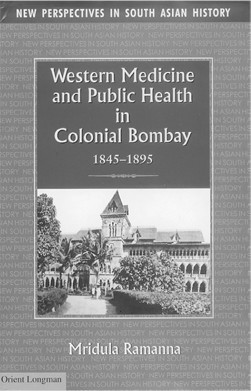
Western Medicine and Public Health in Colonial Bombay, 1845-1895 by Mridula Ramanna. Published in 2002 by Orient Longman Private Limited, 1/24 Asaf Ali Road, New Delhi 110002. Pp: xii+270. Price: Rs 550.
For Parsis prone to giving themselves the proverbial pat on the back for the community having produced many a leading light in the medical field, this book should be of more than passing interest! Dr Mridula Ramanna’s Western Medicine and Public Health in Colonial Bombay, 1845-1895 is replete with Parsi names — of medical institutions founded by Parsis as well as individual medical men and women.
Perhaps the genesis of this Parsi interest in medicine is to be found in Bombay’s early colonial history. Upto the first decade of the 18th century, the town had a reputation among Europeans for being extremely non-conducive to health! This was ascribed mainly to the humid climate, the ‘native’ practise of "manuring” coconut palms with dead fish, the pestilential deposit left by the sea during high tide and the dissolute lifestyle of the majority of Europeans!
By the mid 1800s, notes Ramanna, Bombay had already acquired a status "as the second city of the (British) empire, after London.” The first all-India census of 1872 placed Bombay’s population at 6,44,405 — according it also the dubious distinction of being the largest city in India, with the highest density! And with the people came the problems. Epidemics visited regularly — fevers, typhus and typhoid, cholera, small pox, and of course the deadly plague which broke out in 1896.
By 1881 the British government had executed a series of measures to improve the living conditions. Clean water supply schemes were implemented, the beginnings of underground sewerage and drainage laid, hospitals and dispensaries set up. Small pox vaccination was introduced.
Ramanna’s book focuses on the period 1845-1895. It was in 1845 that the first medical institutions in the city — the J. J. (Jamsetjee Jejeebhoy) Hospital and its adjacent Grant Medical College (GMC) — were founded by that great Parsi businessman and philanthropist Sir Jamsetjee Jejeebhoy. These institutions continue to function, even 150 years later, as major healthcare providers for the people. Initially, it was the British doctors from the Indian Medical Service (IMS) who promoted Western medicine among the locals. By 1851, the first batch of students graduated from the GMC, and Indian doctors qualified to practice Western medicine became available.
Several Parsi doctors, however, passed the IMS exam in England — Rustamji Byramjee in 1856, D. N Parekh, H. D. Masani, K. S. Nariman, K. H. Mis-tri, B. N. Koyaji, R. H. Cama, etc in the late 1870s. Most of them qualified for the LRCS (Licentiate of the Royal College of Surgeons) and LRCP (Licentiate of the Royal College of Physicians), in addition to their basic medical training in India. On their return to government service in India, writes Ramanna, their patients were mostly fellow Indians, with European women declining to be treated by them and even British officers reluctant to seek their advice! Nearly all the doctors practicing Western medicine in Bombay presidency were the alumni of the GMC. The University of Bombay awarded the Licentiate of Medicine (LM) degree from 1862-1877, thereafter it was redesignated as Licentiate of Medicine and Surgery (LM & S). Ramanna informs us that of the 48 doctors listed in 1871, almost half (20) were Parsis, 11 were Europeans, 10 Indian Christians and seven Hindus. By 1895, out of a total of 63, more than half (35) were Parsis, 13 were Hindus, 12 Christians, two Europeans and one Muslim!
Besides Jejeebhoy, many a Parsi philanthropist voluntarily came forward with large donations. Bomanji Hormusji Wadia of the legendary shipbuilding family donated Rs 12,000 and provided a house for the Meethabai Hormusji Dispensary which was founded in Kurla in 1856. When the inhabitants of Bandora (Bandra) petitioned for a dispensary, the majority of donors were Parsis, resulting in the establishment of the Lowji Wadia Dispensary in 1865. While the initial endowments were made by the donors, the government often refused to pay the salaries of the doctors working in them, compelling the donors to raise further funds to hire their own doctors! An offer by Dinsha and Nusserwanji Manekji Petit to endow a dispensary at Colaba was turned down by the government. M. F. Panday’s sanatorium accommodated the ill and convalescent Parsis free of charge. A large number of leprosy cases led Rustomji Jamsetjee Jejeebhoy to offer in 1865 to construct a leper ward at the J. J. Hospital provided the government maintained and repaired it. The ward was later set up, but closed in 1889 with the 24 male and three female patients sent to the Edalji Framjee Albless Home at Trombay and Dinsha Manekji Petit Hospital at Ratnagiri respectively. The J. J. Dharamshala accepted lepers from its inception in 1844 as well as all kinds of indigents, till the Acworth Leprosy Hospital was opened in 1891.
Sir Cowasji Jehangir Readymoney’s munificent donation of one lakh rupees set up the C. J. (Cowasji Jehangir) Ophthalmic Hospital in 1866, Pestonji Hormusji Cama’s one lakh rupee donation, later increased to Rs 1,64,000 set up the Cama Hospital — the first hospital exclusively for women and children, to be managed exclusively by women — a concept reluctantly accepted by the government! A donation of Rs 72,000 from the trustees of the estate of Bomanji Edulji Allbless led to the neighboring Allbless Hospital being built. The Parsi Lying-in Hospital founded in 1887 by Tehmulji Bhicaji Nariman, the Bai Motlibai Obstetric Hospital attached to the J. J. Hospital, the Petit Hospital for Women and Children, the Avabai Bhownagari Home for Pupil Nurses, the Wadia Home for Nurses — the pockets of Parsi philanthropists were deep and fulfilling!
Ramanna: insight into medical history
Delving into detail, Ramanna provides many a nugget of interesting information — Kaikhosru Nasserwanji Bahadurji was born to poor parents in Umra near Surat, yet won a scholarship to study in England, acquiring research experience at the Pasteur Institute in Paris and later with revered names like Robert Koch in Berlin; R. M. Kalapesi with a diploma in tropical medicine from London University assisted Waldemar Haffkine in developing the plague prophylactic at what was then the Bombay Bacteriological Laboratory; Heerajee Eduljee’s History of the Medical Art, Past and Present published in 1880 commended the use of anesthesia and new methods of arresting hemorrhage during surgery as well as the use of the aspirator to remove effluents from the inner cavities of the body!
Academic angles did not lag behind. Parsi doctors presented papers at national and international conferences on subjects as diverse as arsenic poisoning, disbelief in the local custom of curing snakebite with charms or an analysis of the soil, vegetation, hospitals, bazaars and jail in the British outpost of Aden! Publications like Parsi Punch, owned and edited by Barjorji Nowrosjee, carried cartoons, sketches and colorful advertisements for medical products and people. A single copy cost eight annas, the yearly subscription rupees six!
Not shy of locking horns with the authorities, Parsis spearheaded drives for social reform and participated in the civic life of the city, with Cowasji Hor-musji and Nariman serving as sheriffs of Bombay. Bahadurji, N. N. Katrak, Rus-tamjee Khory and F. N. Bisni were doctor members of the Corporation; D. P. Cooper and N. F. Surveyor were among the fellows of Bombay University.
Ramanna’s two-pronged research analyses "in micro-focus” the policies of the colonial rulers in the domain of public health and civic amenities on the one hand and the reactions of the populace to Western medicine on the other. The fact remains, she believes, that even in the last decades of the 19th century, the majority of Bombay’s population still went to vaids (practitioners of Ayurveda) and hakims or even to quacks. The celebrated Parsi bone-setters were patronized by the poor and the well-to-do. Hakims sometimes succeeded where Western medicine had failed. Edulji Pestonji Hakim was known for his ointments and plasters, successfully treating even a British member of the Viceroy’s Council, Pranacharya Rustomji Edulji Hakim was reputed for his non-operative treatment of piles and remedy for diabetes.
A reader in history at the SIES (South Indian Education Society) College, Bombay, Ramanna has been teaching and researching the history of Western medicine in India since 1994. The book carries no pictures (save the one of the Goculdas Tejpal Hospital on the cover), but is studded with tabulations of the city’s patient population, community wise and gender wise, disease and mortality figures, etc — a book of value for the serious student and for the layman seeking an insight into the health history of the Bombay of yore. Hilla P. Guzder
◆ ◆ ◆
From the archive